



The short answer: what the September hike means for Bitcoin
If “fed rate hike bitcoin” is the question you typed into Google this week, here is the answer in one sentence: on September 16, 2026, the Federal Reserve raised its key interest rate for the first time since 2023, and Bitcoin barely reacted because the hike was already priced in and the market’s real focus was on what comes next.

The facts are simple. The FOMC voted 12-0 to lift the federal funds target range by 25 basis points to 3.75%-4.00%.
- The short answer: what the September hike means for Bitcoin
- Why Bitcoin barely moved: the priced-in paradox
- The 90% rule: when everyone expects the news, the news does nothing
- The selloff happened before the meeting, not after
- The real surprise was the dot plot
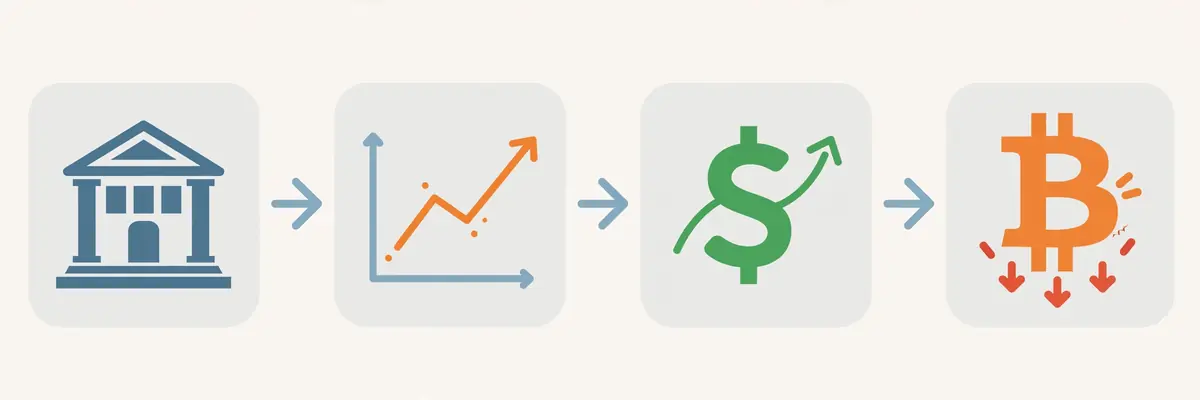
- How a Fed rate hike reaches Bitcoin: the transmission chain in plain words
- Step 1: the Fed raises its policy rate
- Step 2: Treasury yields rise (the 10-year jumped toward 5.26%)
- Step 3: the dollar strengthens and liquidity tightens
- Step 4: leverage gets expensive and Bitcoin feels the squeeze
- The hard numbers: the fed rate hike bitcoin timeline and ETF flows
- 2022 vs 2026: why this tightening cycle is not last time
- The September dot plot, decoded honestly for beginners
- What the dot plot is (30-second version)
- What the September dots actually said
- Why dots are not promises
- What to watch next: your October checklist
- The October FOMC meeting (odds now a coin flip near 50%)
- The next CPI and inflation data (headline 3.4%, core 2.4%, PCE 3.7%)
- The 10-year Treasury yield (currently ~5.26%)
- The dollar
- Spot ETF daily flows (watch for the next $500M+ swing)
- Derivatives leverage and open interest (watch the leverage)
- Common mistakes investors make after a Fed hike
- Is Bitcoin a good investment when interest rates are high?
- Frequently asked questions
- How much did the Fed raise interest rates in September 2026?
- Why did Bitcoin not crash after the Fed rate hike?
- Will the Fed raise interest rates again in October 2026?
- How do interest rate hikes affect Bitcoin prices?
- What did the Fed dot plot show in September 2026?
- Is Bitcoin a good investment when interest rates are high?
- What time was the September 2026 Fed decision released?
- How did the stock market react to the September 2026 Fed hike?
- Should I buy Bitcoin now after the Fed rate hike?
- What is the difference between the 2022 Fed tightening and 2026?
- The bottom line
- Your next step
It was the first increase since July 2023 and the first under new Chair Kevin Warsh. Bitcoin touched $75,355 in the hour of the decision, then settled near $75,813, ending the day roughly where it started.
Why did nothing happen? Markets trade expectations, not announcements.
By the time Warsh spoke, traders had already assigned more than a 90% probability to the hike. The selling happened before the event, not after it. The genuine surprise was not the hike itself but the Fed’s updated dot plot, which signaled that one more increase is likely before year end.
How did Bitcoin then rally to about $87,300 by September 21? Fresh demand arrived through US spot Bitcoin ETFs, which pulled in roughly $2.65 billion across five sessions, while forced short covering added fuel. A concrete example: corporate buyer Strategy disclosed a purchase of 950 BTC for $75.7 million made during September 14 to 20.

Key Takeaways
- Sept 16, 2026: Fed hiked 25 bps to 3.75%-4.00% in a unanimous 12-0 vote, the first increase since July 2023.
- Bitcoin was flat on the day because the hike carried 90%+ odds; the real news was the hawkish dot plot pointing to one more hike.
- BTC dipped to $75,355 in the decision hour, then rallied to ~$87,300 by Sept 21 on ~$2.65B of ETF inflows over five sessions.
- Two FOMC meetings remain in 2026 (Oct 27-28, Dec 8-9); after NY Fed President Williams’ Sept 29 “no need for urgency” remarks, October hike odds sit near 50%, a coin flip. Watch the 10-year yield and ETF flows.
Why Bitcoin barely moved: the priced-in paradox
Every fed rate hike bitcoin explainer says markets “priced it in.” Few explain what that actually means for your coins.
The idea is simple: prices move when expectations change, not when the calendar catches up to them. If almost everyone already expects a hike, almost nobody is left to sell when it is confirmed.
The sequence of events tells the story cleanly. Chair Warsh’s hawkish Jackson Hole speech on August 28 pushed September hike odds from roughly 35% to above 55%.
August CPI then lifted Polymarket odds to 81% on September 11. By decision day, CME FedWatch showed a 92.9% probability of the quarter-point move. Each step in that climb pulled the actual market reaction forward in time.
That is why the biggest Fed move in three years felt like a non-event on Bitcoin charts. One detailed reconstruction of the decision found that Bitcoin finished the next 24 hours roughly where it started, and that the same pattern has repeated across eight years of Fed decisions. Bitcoin reacts to surprises, not to confirmations.
The 90% rule: when everyone expects the news, the news does nothing
Think of it like a weather forecast. If every weather app says it will rain tomorrow and you already packed an umbrella, the rain itself changes nothing about your plans.
Markets work the same way. At 90%+ odds, traders had already positioned for higher rates: they sold early, hedged early, and set their stops early.
This is also why Bitcoin can rally on seemingly bad news. When the expected hike arrived and nothing new was revealed, some traders who had sold in advance bought back in. That relief buying is a normal part of the “priced-in paradox,” and it showed up in the days after the decision.
The selloff happened before the meeting, not after
The data confirms that the pain was front-loaded. Roughly $455 million in leveraged crypto bets was wiped out in the 24 hours before the decision, and about $450 million left US spot Bitcoin ETFs. Bitcoin slid toward $75,000 while the meeting was still hours away.
Then look at what happened right after: choppy trading in the decision hour, a touch of $75,355, and a settle near $75,813. That is not a market shocked by news.
That is a market that had already done its reacting. Earlier warnings that a Fed hike could rattle Bitcoin were proved right in timing but wrong in direction of causality: the warning itself was the event, and the event itself was the release.
The real surprise was the dot plot
BitGo’s head of research Matt Cipolaro put it precisely: the 25-basis-point increase was expected, but “the dot plot wasn’t” fully priced. While traders argued about September, the Fed’s updated projections quietly told them that 16 of 18 officials expect at least one more hike in 2026, and that the median rate for end-2027 jumped from 3.6% to 4.1%.
That is the part of the announcement that actually repriced expectations, which is why yields stayed high and the 10-year Treasury pushed to 5.264% by September 29. For the fed rate hike bitcoin story, the lesson is clean: stop watching whether the Fed hikes. Start watching how many more hikes the Fed expects.
How a Fed rate hike reaches Bitcoin: the transmission chain in plain words
The fed rate hike bitcoin transmission chain has four links, and most explainers skip straight from link one to link four. That is why the relationship feels mysterious. Once you see the full chain, you can judge for yourself which links are strong and which are weak right now.
The honest caveat comes first. Higher rates do pressure risk assets on average, but Bitcoin’s connection to rates is looser than the headlines suggest.
Bitcoin rallied hard in 2023 and 2024 while the Fed held rates at their highest level in two decades, then lost more than half its value in late 2025 while the Fed was cutting. The chain below explains the average case, and the exceptions come from the other forces in the market.
Note: This chain describes how rate pressure normally travels. In September 2026, links 3 and 4 were partly offset by ETF demand, which is exactly why Bitcoin absorbed the hike instead of crashing.
Step 1: the Fed raises its policy rate
The federal funds rate is the interest rate banks charge each other for overnight loans. When the Fed raises it to 3.75%-4.00%, borrowing gets more expensive across the entire economy: mortgages, credit cards, business loans. Think of it as the Fed turning down the economy’s thermostat.
Step 2: Treasury yields rise (the 10-year jumped toward 5.26%)
Government bonds must offer higher yields to compete with the new rate. The 10-year Treasury yield, the most watched number in global finance, moved above 5% ahead of the September meeting and reached 5.264% by September 29. This yield is the “risk-free” return: the guaranteed payout an investor can get without touching anything risky.
Step 3: the dollar strengthens and liquidity tightens
Higher US yields attract global money into dollars, which tends to strengthen the currency. A stronger dollar plus higher borrowing costs drains liquidity, meaning there is less easy money sloshing around looking for speculative bets. This is the link that hurts all risk assets equally, from tech stocks to crypto.
Step 4: leverage gets expensive and Bitcoin feels the squeeze
Bitcoin trades with heavy leverage. When borrowing costs rise, leveraged traders pay more to hold positions, and forced liquidations cascade faster.
That is what happened before the decision: about $455 million in leveraged bets was liquidated in a single day. The squeeze is real, but notice that it happened before the announcement, because traders positioned for the hike weeks in advance.
The hard numbers: the fed rate hike bitcoin timeline and ETF flows
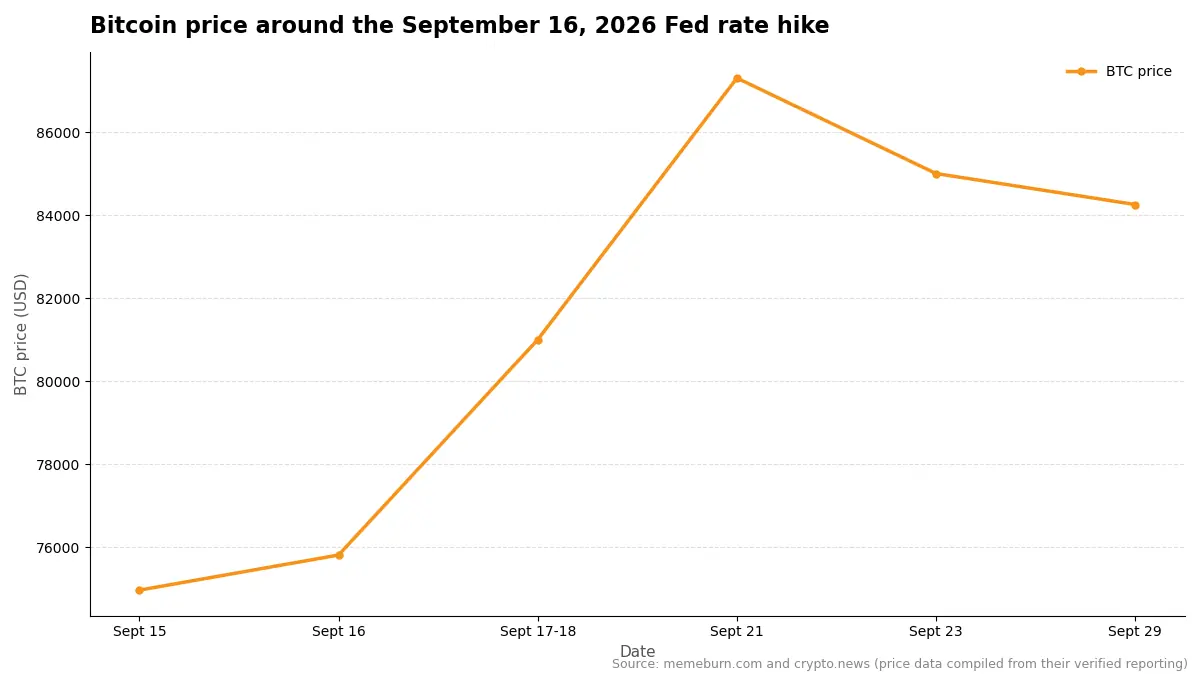
The fed rate hike bitcoin story looks completely different when you line up the actual numbers instead of the headlines. Two tables tell it: the two-week price timeline and the ETF flow reversal that explains the rally.
The first table covers September 15 to September 29. Note how the biggest single-day drama (the Senate’s CLARITY Act cloture vote failing 49-50 on September 15) actually hit Bitcoin harder than the Fed decision did, a detail most fed rate hike bitcoin recaps skip.
| Date | Event | Bitcoin price |
|---|---|---|
| Sept 15, 2026 | Senate CLARITY Act cloture fails 49-50 | Dips below $76,000 (low ~$74,968) |
| Sept 16, 2026 | Fed hikes 25 bps to 3.75%-4.00% (12-0 vote) | Touched $75,355 in the decision hour, settled ~$75,813 |
| Sept 17-18, 2026 | Markets digest the hawkish dot plot | Recovers toward $78,000, then above $81,000 |
| Sept 21, 2026 | 2026 record ~$999M single-day ETF inflow | Surges to ~$87,300 (eight-month high), pulls back toward $84,000 |
| Sept 23, 2026 | Five straight positive ETF sessions | ~$84,000-$86,000; ~$2.65B inflows over five sessions |
| Sept 29, 2026 | 10-yr Treasury yield at 5.264% | ~$84,254 |
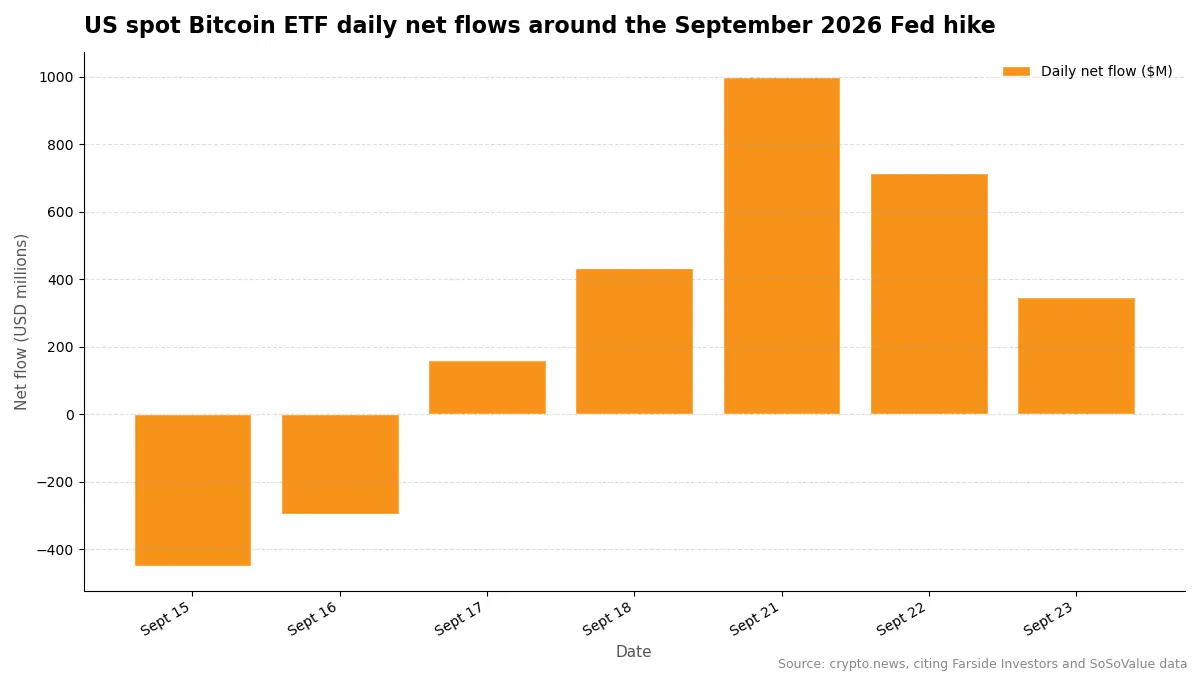
The second table is the real answer to “who bought it.” US spot Bitcoin ETFs bled a combined $746.3 million on September 15 and 16, then reversed into a five-session inflow streak worth about $2.65 billion through September 23. For scale, total net ETF assets stood near $95.19 billion, roughly 6.2% of Bitcoin’s market cap, with the funds holding about 1.24 million BTC.
| Date | ETF daily net flow |
|---|---|
| Sept 15, 2026 | -$450.4M (largest single-day outflow since June 24) |
| Sept 16, 2026 | -$295.9M (IBIT -$144.1M, ARKB -$84.4M, FBTC -$52.7M) |
| Sept 17, 2026 | +$159.5M (turnaround begins) |
| Sept 18, 2026 | +$433.0M |
| Sept 21, 2026 | ~+$999.0M (2026 record inflow day, IBIT-led) |
| Sept 22, 2026 | +$714.7M |
| Sept 23, 2026 | +$347.0M (fifth straight positive session) |
$87.3K
Bitcoin high on Sept 21 (8-month high)
$2.65B
ETF inflows over 5 sessions through Sept 23
16 of 18
Fed officials expecting another 2026 hike
The flow flip is the “who bought the rally” evidence, and a careful accounting of the buyers keeps it honest. The $2.65 billion figure is real, but it is the net of two sharply different periods, and ETF subscriptions cannot be mapped one-to-one onto the price at any given hour.
Short covering also played a role: analysts at Nansen and CoinMarketCap both described the move as a mix of genuine ETF demand and traders closing losing short positions. Strategy’s 950 BTC purchase ($75.7 million, September 14-20) added a named corporate buyer to the picture.
2022 vs 2026: why this tightening cycle is not last time
Every commentator claims this cycle is different from 2022, but almost nobody shows the numbers side by side. Here they are. This fed rate hike bitcoin comparison is the strongest evidence that Bitcoin’s market structure has fundamentally changed.
In 2022 the Fed hiked seven times, from near zero to 4.25%-4.50%, and Bitcoin fell about 77% to a low near $15,500. There were no US spot Bitcoin ETFs. When retail capitulated, there was no standing bid to catch the fall, and the Terra and FTX collapses removed what little liquidity remained.
In 2026 the Fed delivered its first hike of a new cycle and Bitcoin absorbed it, then rallied to an eight-month high within five days. The difference is not sentiment.
It is plumbing. Spot ETFs now hold about 1.24 million BTC, roughly 6.2% of supply, and they pulled in $2.65 billion in five sessions right after the hike.
| 2022 tightening cycle | 2026 tightening cycle | |
|---|---|---|
| Fed action | Seven hikes, to 4.25%-4.50% | First hike, to 3.75%-4.00% (Sept 16) |
| Spot Bitcoin ETFs | Did not exist | ~$95.19B in net assets, ~6.2% of BTC supply |
| Bitcoin low after shock | ~$15,500 (-77% from peak) | ~$74,968 pre-hike dip, then recovered past $87K |
| Who was selling | Retail capitulation, no bid | $746M ETF outflows over two days, then absorbed |
| Who was buying | Nobody (Terra, FTX removed liquidity) | ETF subscriptions, Strategy’s 950 BTC, short covering |
| 10-year yield | ~3.5%-4.2% range | ~5.17%-5.26% |
What “structural floor” actually means
A structural floor is not a price level where Bitcoin cannot fall. It is a standing buyer that did not exist before: daily subscriptions into spot ETFs from pensions, registered advisers, and brokerage customers. How the ETF approval changed Bitcoin’s investor base explains the mechanics in full, but the short version is that these buyers do not trade on margin the way crypto-native traders do, so their flows are steadier.
That steadiness is why the post-hike outflows reversed so fast. The $746.3 million that left on September 15 and 16 was panic selling. The $2.65 billion that arrived over the next five sessions was the structural bid reasserting itself once the expected news was out of the way.
Where the 2026 setup could still break
The floor softens drawdowns. It does not make Bitcoin immune.
A genuine liquidity shock could still overwhelm it: imagine another hike in October combined with a hot CPI print and a 10-year yield spiking well above current levels. In that scenario, even ETF buyers can turn into sellers, exactly as they did on September 15 and 16.
There is also a leverage warning buried in the rally. Derivatives data showed leveraged exposure building rapidly as Bitcoin broke above $82,000, before roughly $1.7 billion of it unwound between September 22 and 25, according to CryptoQuant.
Short sellers took heavy damage too: roughly $650-$800 million in short positions was liquidated during the squeeze, per multiple reports. Leverage-driven rallies can unwind just as fast as they start, which is why the rally stalled near $87,300 and slipped back toward $84,000.
The September dot plot, decoded honestly for beginners
If you take one concept from this article, make it the dot plot. It moved markets more than the actual rate decision did, and most fed rate hike bitcoin coverage of it is either jargon or hype. Here is the honest version.
What the dot plot is (30-second version)
The dot plot is a chart the Fed publishes four times a year. Each dot is one Fed official’s private guess about where interest rates should be at the end of this year, next year, and beyond.
That is all it is: a poll, not a promise. Officials change their dots every meeting, and the dots have been wrong plenty of times before.
The number that matters most is the median dot, the middle guess. Think of it as the committee’s collective best estimate, with the spread of the other dots showing how much they disagree.
What the September dots actually said
The September dots were unambiguously hawkish, and the numbers are worth reading directly:
- Median year-end rate: 4.1% for 2026 and 4.1% for 2027, up from 3.8% and 3.6% in June.
- 16 of 18 officials project the year-end 2026 rate above the current range. Twelve pencil in one more hike (to 4.125%), four expect two more (to 4.375%), and only two see the September move as the last one.
- The median 2027 projection jumped from 3.6% to 4.1%, which means the middle view now contains zero rate cuts next year.
- The Fed does not expect inflation to return to its 2% target until 2029.
- Behind the dots: 2026 PCE inflation forecast raised to 3.7%, GDP growth lifted to 2.3%, unemployment cut to 4.1%.
Chair Warsh’s message matched the dots. “Inflation is too high and has been for too long,” he said, calling current financial conditions nowhere near restrictive.
He also withstood direct pressure from the White House: President Trump, who nominated Warsh, has demanded rates of 1% or less, while Treasury Secretary Scott Bessent publicly backed the chair. For more on the political backdrop, see Trump’s pressure campaign on the Federal Reserve.
Why dots are not promises
Here is the honesty part. “16 of 18 expect another hike” does not mean October is a lock.
Dots are individual guesses made on one day, and they change. The last time a September dot plot promised one more hike, back in 2023, that hike never arrived.
Markets know this, which is why they price their own odds alongside the dots. Right now the picture is mixed: the dot plot still signals one more increase this year.
But after New York Fed President John Williams’ September 29 “no need for urgency” remarks, October hike odds fell to near 50% on CME FedWatch, a coin flip. If inflation data surprises to the downside, those dots will move again at the December meeting, and the market will move first.
What to watch next: your October checklist
The intent behind this article is practical: you want to know what actually matters next so you can decide what, if anything, to do. If you only track six things in the fed rate hike bitcoin aftermath, track these. For each one, here is what it is, why it matters for Bitcoin, and the current reading.
The October FOMC meeting (odds now a coin flip near 50%)
What: the next Fed meeting is October 27-28, with another on December 8-9. Why it matters: a second hike would confirm a genuine tightening cycle rather than a one-off adjustment, and that would tighten every link in the transmission chain.
Current reading: CME FedWatch puts October hike odds near 50% after New York Fed President John Williams said on September 29 that there was “no need for urgency.” Williams still called one more hike “appropriate late this year,” so the base case has shifted from October to December. For the price levels that matter around that decision, see our Bitcoin price prediction for October 2026.
The next CPI and inflation data (headline 3.4%, core 2.4%, PCE 3.7%)
What: the monthly inflation prints that move the dots. Why it matters: the entire hiking case rests on inflation running hot; a cool print would deflate October odds fast.
Current reading: August headline CPI at 3.4% (down from a 4.2% May peak), core at 2.4%, and the Fed’s preferred PCE gauge at 3.7% in July. For the full pre-decision setup, see what to watch when a Fed decision looms.
The 10-year Treasury yield (currently ~5.26%)
What: the market’s own verdict on rates, updated every second. Why it matters: this is the opportunity cost of holding Bitcoin, which pays no yield.
When it spikes, risk assets feel it immediately. Current reading: 5.264% on September 29, up from just above 5% before the meeting. If it keeps climbing into October, expect chop.
The dollar
What: the trade-weighted dollar index. Why it matters: higher US yields pull money into dollars, and a strong dollar has historically been a headwind for Bitcoin priced in dollars. Current reading: watch whether the dollar index breaks higher on any October-hike repricing; a flat dollar despite the hike would be a quietly bullish signal for BTC.
Spot ETF daily flows (watch for the next $500M+ swing)
What: the daily net creations and redemptions of US spot Bitcoin ETFs. Why it matters: flows were the whole story in September.
Outflows of $450 million preceded the dip; inflows of $999 million in a single day powered the rally. Current reading: five straight positive sessions through September 23 totaling $2.65 billion. The next $500 million swing in either direction will likely lead Bitcoin’s next move.
Derivatives leverage and open interest (watch the leverage)
What: how much borrowed money is riding on Bitcoin’s price. Why it matters: leverage amplifies both directions.
Derivatives data showed leveraged exposure building rapidly after Bitcoin broke $82,000, which is exactly the kind of positioning that turns a small pullback into a cascade. Current reading: CryptoQuant reported roughly $1.7 billion in open interest contracting between September 22 and 25 as positions closed. Healthy so far, but watch for it rebuilding too fast into October.

Common mistakes investors make after a Fed hike
The fed rate hike bitcoin news cycle reliably produces the same five investor mistakes. Each one below is tied to a number from the sections above, with a one-paragraph fix.
1. Selling the panic dip, then buying the rally top. About $450 million left Bitcoin ETFs on September 15, the day before the decision. Investors who sold that dip sold into the exact moment of maximum fear, then watched Bitcoin rally 15% to $87,300.
The fix: decide your plan before the event, not during it.
2. Treating the dot plot as a promise. Sixteen of 18 officials expect another hike, but those are guesses, not commitments. The 2023 dot plot made the same promise and the hike never came.
The fix: track prediction-market odds and inflation data alongside the dots, and update your view when they move.
3. Watching only Bitcoin while ignoring the 10-year yield and the dollar. Bitcoin is the last link in the chain, not the first. The yield and the dollar move first and explain most of the “why” behind BTC’s moves.
The fix: check the 10-year yield and the dollar index before checking the BTC chart.
4. Using heavy leverage into the October meeting. Roughly $455 million in leveraged bets was liquidated in the 24 hours before the September decision. Leverage turns a normal 3% wobble into a total loss.
The fix: if you must trade the October meeting, size positions so a surprise cannot wipe you out.
5. Assuming the 2022 playbook still applies. “Hike equals crash” was true when there were no spot ETFs and no standing institutional bid. In 2026, a hike arrived and Bitcoin rallied to an eight-month high within five days.
The fix: update your mental model. The market structure changed; your assumptions should too.
Is Bitcoin a good investment when interest rates are high?
This is the commercial-investigation undertone behind the whole topic, so here is the honest, both-sides answer to the fed rate hike bitcoin debate. There is no one-size answer, and anyone who gives you one is selling something. This is not financial advice.
The case for holding
- Fixed supply of 21 million coins while inflation runs at 3.4%+: scarcity is the core thesis.
- ETF-era structural demand: ~$95B in fund assets creates a buyer that did not exist in 2022.
- Proven resilience: BTC absorbed the first hike since 2023 and recovered past pre-hike levels within a week.
The case against holding
- 10-year Treasury above 5% competes with every risk asset, Bitcoin included.
- Another hike could bring choppier trading and deeper short-term pullbacks.
- High-yield cash alternatives reduce the urgency to take on crypto risk.
The balanced read is this. Bitcoin’s long-term scarcity case actually strengthens when inflation is the reason rates are high: Warsh himself said inflation “is too high and has been for too long,” and fixed-supply money is designed for exactly that environment.
But the short-term path is genuinely harder when money is expensive, and the 2025 experience proves cuts do not automatically save Bitcoin either (three cuts that year, and BTC still fell from $126,080 to near $58,000).
Not everyone agrees the Fed is even on the right path. For the contrarian view, read one prominent economist’s call for emergency rate cuts and weigh it against Warsh’s hawkishness yourself. If you are a beginner deciding how to act, start with a beginner’s guide to investing in Bitcoin safely and build a plan, such as steady dollar-cost averaging, that does not depend on predicting the next FOMC vote.
Frequently asked questions
Here are direct answers to the ten questions readers ask most about the September hike and what it means for Bitcoin. Each answer is kept short so you can scan straight to the one you need.
How much did the Fed raise interest rates in September 2026?
The FOMC raised the federal funds target range by 25 basis points, from 3.50%-3.75% to 3.75%-4.00%, in a unanimous 12-0 vote on September 16, 2026. It was the first increase since July 2023 and the first under Chair Kevin Warsh. The move ended a three-year, two-month pause in rate changes.
Why did Bitcoin not crash after the Fed rate hike?
The short answer to the fed rate hike bitcoin question is that the hike was priced in: traders had assigned it more than a 90% probability before the meeting, so the selling happened in advance (about $455 million in leveraged bets liquidated in the 24 hours before the decision). When the expected news arrived with no surprises attached, there was nobody left to panic-sell. Bitcoin then rallied because fresh ETF demand ($2.65 billion over five sessions) and short covering outweighed the rate pressure.
Will the Fed raise interest rates again in October 2026?
It is now a coin flip. The September dot plot showed 16 of 18 officials expecting at least one more hike in 2026, but after New York Fed President John Williams said on September 29 that there was “no need for urgency,” CME FedWatch odds fell from about 70% to near 50%. Williams added that one more hike “may be appropriate late this year,” so December is the likely backup date. The next FOMC meeting is October 27-28. The decision will depend on inflation data released before then, so watch the next CPI print more than the calendar.
How do interest rate hikes affect Bitcoin prices?
Rate hikes reach Bitcoin through a four-link chain: the Fed raises its policy rate, Treasury yields rise, the dollar strengthens and liquidity tightens, and leveraged Bitcoin positions get more expensive to hold. The effect is real but indirect, and Bitcoin often reacts more to surprises than to the hikes themselves. In the ETF era, strong fund inflows can offset the pressure entirely, as they did in September 2026.
What did the Fed dot plot show in September 2026?
The median projection for the year-end federal funds rate rose to 4.1% for both 2026 and 2027, up from 3.8% and 3.6% in June. Sixteen of 18 officials projected the year-end 2026 rate above the current range: twelve expect one more hike and four expect two.
The median 2027 projection of 4.1% implies no rate cuts next year, and the Fed does not expect inflation back at 2% until 2029.
Is Bitcoin a good investment when interest rates are high?
There is no universal answer, but both sides are clear. The case for: fixed supply during persistent inflation, plus structural ETF demand that did not exist in 2022.
The case against: a 10-year yield above 5% competes with every risk asset, and another hike could bring more choppy trading. This is not financial advice; beginners should build a plan (such as steady dollar-cost averaging) rather than betting on any single Fed decision.
What time was the September 2026 Fed decision released?
The FOMC statement, the Summary of Economic Projections, and the dot plot were released at 2:00 p.m. Eastern Time on September 16, 2026. Chair Kevin Warsh held his post-meeting press conference at 2:30 p.m. ET. Bitcoin’s choppiest trading of the day came in the hour around the release, which is typical: the decision hour is when positioned traders react to any surprise in the statement or projections.
How did the stock market react to the September 2026 Fed hike?
Stocks slipped on decision day: the S&P 500 fell 0.45% to 7,551.81, the Dow dropped 1.21% to 51,462, and the Nasdaq was nearly flat at 25,978. The selling was about the hawkish guidance (the dot plot signaling more hikes), not the 25 basis points themselves. A day later the move reversed: the Nasdaq jumped 1.69% and the S&P 500 gained 1.14% as Treasury yields and oil prices eased.
Should I buy Bitcoin now after the Fed rate hike?
Only you can answer that, and it should depend on your plan, not the headlines. What the data shows: Bitcoin absorbed the hike and rallied to ~$87,300 on strong ETF demand, but another hike is still possible before year end and leverage in the market is elevated, so volatility is probable.
A common beginner approach is steady dollar-cost averaging over time rather than trying to time Fed meetings. Consider your risk tolerance, never invest money you cannot afford to lose, and do your own research.
What is the difference between the 2022 Fed tightening and 2026?
In 2022 the Fed hiked seven times to 4.25%-4.50% with no spot Bitcoin ETFs in existence, and Bitcoin fell about 77% to near $15,500 as retail capitulated with no standing bid. In 2026 the Fed has hiked once to 3.75%-4.00%, spot ETFs hold about 1.24 million BTC (roughly 6.2% of supply, ~$95 billion in assets), and Bitcoin absorbed the hike then rallied to an eight-month high. The rate tool is the same; the market structure receiving it is completely different.
The bottom line
The September 16 hike was historic as a policy signal but a non-event for Bitcoin’s price, because it was fully priced in and absorbed by a structurally different market. The dot plot, not the hike, is what moved expectations: 16 of 18 officials want more tightening, the 2027 median jumped to 4.1%, and the 10-year yield sits at 5.26%.
The fed rate hike bitcoin puzzle resolves into something simple once you see it. Bitcoin in 2026 is no longer just a retail sentiment trade reacting to every headline.
It is an asset with a standing institutional bid, a four-link transmission chain to rates, and a price that moves on surprises rather than confirmations. That is why the old “rate hike equals crash” reflex failed, and it is the lens to use for October.
Your next step
If you are investing, do it with a written plan rather than a reaction: steady, scheduled buying beats trying to outguess the Fed. Start with how beginners can build a safe Bitcoin investing plan and recheck the October hike odds the week before the meeting, because that single number now matters more than any headline.