


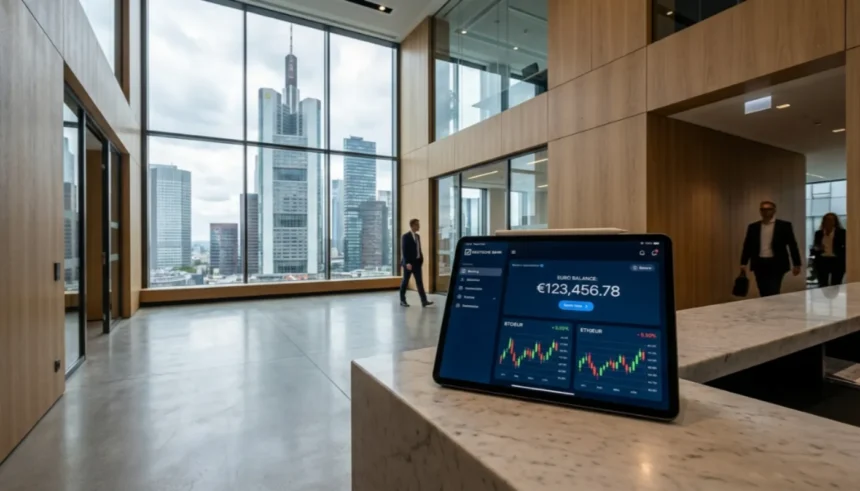
Millions of German bank customers are about to get crypto trading built directly into apps they already use, Bloomberg reports.
Both the country’s savings bank network and its cooperative banking sector are moving from planning to execution, without customers needing a separate exchange account.

Two Networks, One Regulatory Push
Sparkassen, Germany’s public savings bank group with roughly 50 million retail customers, has been building toward this since it first confirmed plans a year ago.
The service runs through DekaBank, Sparkassen’s securities arm, and is targeted for a summer 2026 rollout inside the existing Sparkasse app. DekaBank already rolled out institutional crypto trading and custody earlier this year before turning to retail.
DZ Bank, Germany’s second-largest lender and the central institution for roughly 700 cooperative banks, cleared its own regulatory hurdle in December 2025.
DZ Bank’s own announcement confirms it received MiCAR authorization from BaFin, Germany’s financial regulator, to operate its “meinKrypto” platform.
The service launches with four assets: Bitcoin, Ethereum, Litecoin, and Cardano, built as a wallet inside the existing VR Banking App used by Volksbanken and Raiffeisenbanken customers.

Neither rollout is instant or universal. Individual banks inside each network still have to file their own MiCAR notification with BaFin before switching the feature on for their customers.
DZ Bank’s own release notes that meinKrypto is explicitly an execution-only offering, not something branch staff will recommend or advise on.
Why Both Moved Now
MiCA is the reason the timing lines up. The EU’s Markets in Crypto-Assets Regulation gave banks a single legal framework for offering crypto custody and trading across the bloc, replacing what had been a patchwork of national rules.
That clarity is what let two of Germany’s most conservative banking networks, both of which spent years treating crypto as too risky to touch, move to execution within months of each other.
Demand did the rest. A September 2025 survey by cooperative association Genoverband found 71% of Germany’s roughly 670 Volksbanken and Raiffeisenbanken were actively considering retail crypto services, up from 54% the year before. That kind of internal pressure, combined with rival fintechs already offering easy crypto access, made standing still the riskier option for both networks.
Infrastructure Behind The Rollout
Both networks are using the same regional exchange group for backend support. Boerse Stuttgart Digital handles custody for DZ Bank’s meinKrypto, with trade execution running through EUWAX, the exchange’s execution arm.
Sparkassen’s Volksbanken counterparts have leaned on the same infrastructure provider for liquidity, giving both rollouts a shared technical foundation even though they operate as separate platforms for separate customer bases.
What This Means Beyond Germany
MiCA applies across all 27 EU member states, not just Germany. Once two of Germany’s largest banking networks are fully live, retail customers in France, Italy, Spain, and elsewhere will be asking their own banks the same question German customers are already asking: why can’t I do this here?
It’s a dynamic that echoes how Robinhood’s European stock tokens forced competitors to respond once one major platform moved first under a shared regulatory umbrella.
The contrast with the US regulatory picture is hard to miss.
Germany’s two largest banking networks went from public commitment to live regulatory approval in about eighteen months under a single EU-wide framework, while US crypto regulation continues to lag behind comparable clarity, even as lawmakers work through proposals like the Senate’s crypto market structure bill.
Bank-based crypto access also raises the same liquidity and consumer-protection questions regulators have been focused on elsewhere, an area where the ECB’s own guidance on emergency cash availability shows how seriously European regulators are treating resilience across the wider financial system, not just crypto-specific rules.
For now, the practical shift is simple. Two networks covering tens of millions of German bank customers are moving from crypto skeptics to crypto access points, inside apps people already use for their everyday banking.