



Celestia Price Prediction 2026-2030: The Short Answer
Celestia (TIA) trades near $0.31 on November 21, 2026. That price sits about 98.5% below the all-time high of about $20.85, and it leaves the token down about 45% in a month.
Our Celestia price prediction 2026-2030 puts the base case at $0.35 by the end of 2026, $0.55 in 2027, $0.85 in 2028, $1.20 in 2029, and $1.60 in 2030. The $1 target is a 2027 bull-case outcome, not the base case, because $1 would demand a market cap near $1 billion at the current supply.

Read on for the math, the catalysts, and the risks that could break this forecast.
- Celestia Price Prediction 2026-2030: The Short Answer
- Celestia (TIA) Price Today
- Why TIA Is Near Its Lows
- What Is Celestia?
- The 2026 Upgrades That Could Change the Story
- Fibre Goes Live in October 2026
- Matcha Cut Inflation and Raised Capacity
- Hibiscus Added Cross-Chain Transfers
- Celestia Price Prediction 2026
- Celestia Price Prediction 2027
- Celestia Price Prediction 2028
- Celestia Price Prediction 2029
- Celestia Price Prediction 2030
- What Would It Take for TIA to Reach $1?
- The Number No Other Forecast Shows: TIA Trades at 9,200 Times Its Fee Revenue
- Key Levels to Watch
- Risks: What Could Go Wrong
- Fee Income Is Almost Zero
- Ethereum Is the Biggest Competitor
- Supply Keeps Growing
- The Market Has Not Rewarded the Tech
- Is Celestia a Good Investment?
- Celestia Price Prediction 2026-2030: FAQs
- What is the Celestia price prediction for 2026?
- What will TIA be worth in 2030?
- Can Celestia reach $1?
- Can TIA return to its all-time high of $20.85?
- Why is TIA so low right now?
- Is Celestia a good long-term investment?
- Conclusion
Key takeaways
- TIA trades at about $0.31, down about 45% in 30 days and about 49% over the past year.
- Celestia activated Fibre in October 2026, a major upgrade that lifts data capacity about 15 times.
- The network holds more than 50% of the data availability market, yet it earned only about $2,712 in fees in the 30 days to October 17, 2026.
- Our 2030 base case is $1.60. Our bull case is $3.00. Our bear case is $0.70.
- $1 needs a market cap near $1 billion, about 3.2 times the current value.
- TIA trades at roughly 9,200 times Celestia’s annualized fee revenue, so the price depends on future demand, not current income.
Celestia (TIA) Price Today
Here is the snapshot as of November 21, 2026, at about 08:10 UTC. Prices move fast, so treat these numbers as a morning reading, not a live quote.
| Metric | Value |
|---|---|
| Price | About $0.31 |
| 24-hour change | Down about 10% |
| 7-day change | Down about 11% |
| 30-day change | Down about 45% |
| 1-year change | Down about 49% |
| Year-to-date change | Down about 33% |
| Market cap | About $305 million |
| Market cap rank | Around 119th |
| Circulating supply | About 993 million TIA |
| Total supply | About 1.18 billion TIA |
| Fully diluted valuation | About $365 million |
| All-time high | About $20.85 (February 2024) |
| 24-hour trading volume | About $32 million |
The 30-day drop tells the story. TIA traded near $1.06 at the start of November 2025, then slid through the year as Bitcoin fell and the whole market turned risk-off.
TIA now sits 98.5% below its all-time high. Few major coins have fallen that far and stayed down this long.
Why TIA Is Near Its Lows
Three forces pushed TIA down. The broad market sold off, Celestia’s own fee income stayed tiny, and sellers found few buyers at these levels.

Bitcoin drives most altcoins, and Bitcoin has had a rough November. Bitcoin now trades about $27,000 below what it costs to mine one, and that pressure spills into every smaller coin.
The token fell about 45% in a month while Bitcoin lost far less in percentage terms.
The Year-Long Slide, Month by Month
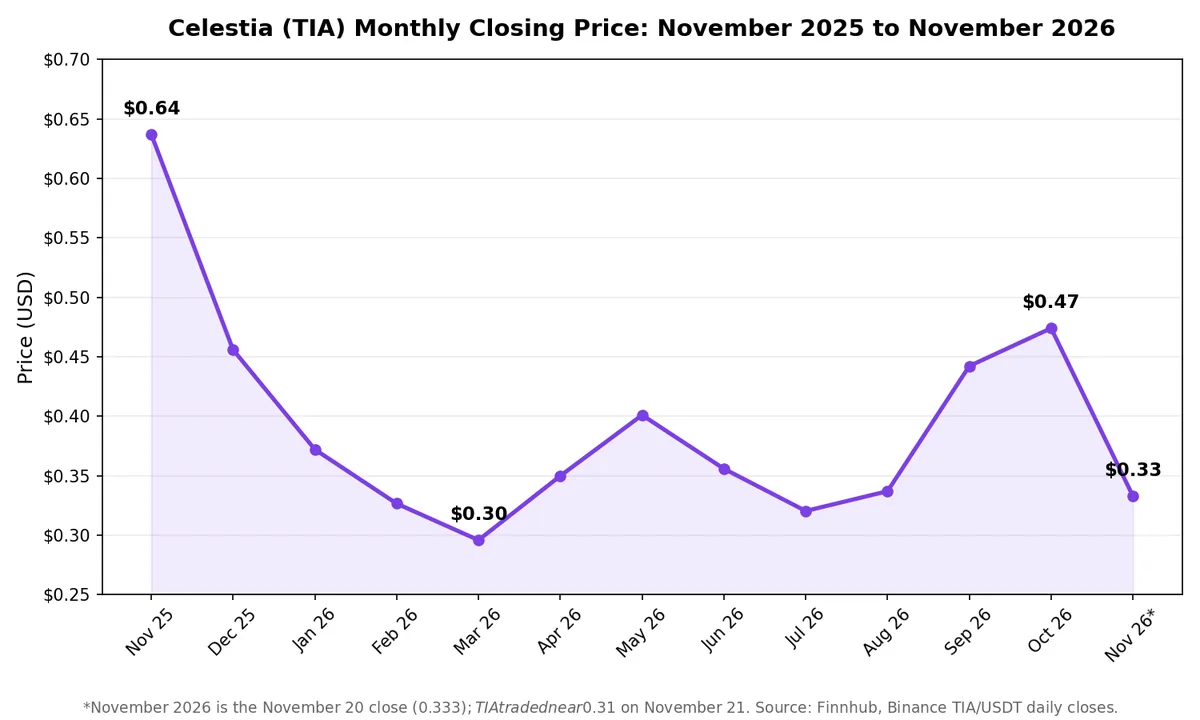
The slide shows up clearly in the monthly closes. TIA closed November 2025 at $0.637, then lost ground through the winter and touched $0.2959 at the end of March 2026.
It recovered to $0.474 by the end of October 2026, then gave back a third of its value in three weeks. It closed November 20 at $0.333 and traded near $0.31 this morning.
The chart below tracks that year.
The Fee Problem Is the Real Story
Celestia’s technology keeps winning, but its business has not followed. The network earned only about $2,712 in fees in the 30 days to October 17, 2026, according to DefiLlama.
On some days in September 2026, the whole network earned only around $70 in fees. That is a rounding error for a network with a $305 million market cap.
Capacity is not the problem. Demand for that capacity is.
What Is Celestia?
Celestia is the first modular blockchain built for one job: data availability. It launched in October 2023, founded by Mustafa Al-Bassam and others, with a large airdrop of its TIA token.
A normal blockchain does three jobs. It runs transactions, it puts them in order, and it keeps the raw data public so anyone can check the result.
Celestia keeps the last two jobs and drops the first. It does not run smart contracts for apps.
How Data Availability Works
Its customers are mostly rollups. A rollup bundles transactions, runs them away from the base layer, and posts the data somewhere public, so anyone can rebuild its state and challenge a wrong result.
On Ethereum, that public place is Ethereum itself. Celestia sells a separate one, and the industry calls this split modular design.
Its key innovation is data availability sampling. Instead of downloading every block in full, light nodes download a few random pieces and still gain strong confidence that the data is really there.
Rollups pay for that space in TIA, and validators stake TIA to secure the network. That gives the token three jobs: payment, staking, and governance.
Why Rollups Matter to TIA
Rollups are the main buyers of Celestia’s product. When a rollup posts data to Celestia instead of Ethereum, it pays less, and its users get cheaper transactions.
Optimism is the best-known rollup family, and its own token faces the same market math. Our Optimism price prediction 2026-2030 tracks OP from $0.09 toward $1 on the same rollup growth bet.
Celestia held more than 50% of the data availability market in the first quarter of 2026, with more than 56 rollups integrated and 37 of them live on mainnet. The technology leads its market.
The question is whether that lead turns into fees. So far, it has not.
The 2026 Upgrades That Could Change the Story
Celestia shipped more real upgrades in 2026 than in any year since launch. Each one is verifiable, and each one targets the same goal: far more capacity at a far lower cost.
Fibre Goes Live in October 2026
Celestia activated Fibre on about October 20, 2026, and the project calls it the biggest upgrade since launch. Fibre is a new lane that lets rollups upload large amounts of data directly to validators.
It starts at about 150 megabytes per second, roughly 15 times the previous capacity. Each Fibre blob can hold up to 128 megabytes, and the team targets 2.2 gigabytes per second in November.
The headline figure comes from testing, not live use. In an October 1 benchmark, Fibre averaged 3.07 terabits per second across 120 validators over 143 seconds.
The speedup comes from ZODA, a new data encoding method. Celestia says Fibre processes data up to 881 times faster than KZG-based protocols, the method other data layers use.
Fibre is aimed at high-volume uses such as AI agents and round-the-clock markets. TIA takes on three jobs in the new system: staking, escrow deposits, and fee payments.
Matcha Cut Inflation and Raised Capacity
The Matcha upgrade of November 2025 lifted the maximum block size 16 times, from 8 megabytes to 128 megabytes. It also cut TIA inflation from 8% a year to about 2.5%, and it keeps falling each year until it reaches 1.5%.
Matcha also cut the staking unbonding period from 21 days to about 14 days. Blocks have arrived about every three seconds since July 2026.
Lower inflation matters for holders. Every new token needs a new buyer, and slower supply growth means less selling pressure on the price.
Hibiscus Added Cross-Chain Transfers
The Hibiscus upgrade reached mainnet in mid-March 2026. It added zero-knowledge proof checks for cross-chain messages and single-signature token transfers through Hyperlane.
Before Hibiscus, moving tokens through Celestia to another chain needed several signatures. The new system creates a destination address, and permissionless relayers handle the rest.
The upgrade also raised the minimum validator commission from 10% to 20% and the maximum from 25% to 60%. It lets consensus nodes prune old blocks far faster, down to about five hours of history instead of 14 days.
Celestia Price Prediction 2026
TIA ends 2026 in a weak position. It trades near $0.31, the market is risk-off, and only six weeks remain in the year.
Our 2026 base case is $0.35. That needs a modest bounce from $0.31, not a rally.
The bull case is $0.45, which needs Bitcoin to stabilize and buyers to defend the $0.30 level. The bear case is $0.28, which follows if Bitcoin breaks lower and TIA prints a new yearly low.
CoinStats expects TIA to trade between $0.30 and $0.47 for the rest of 2026, with an average near $0.36. Changelly sees a December range of $0.325 to $0.355.
Both ranges sit close to our own, and both agree that 2026 ends quietly.
Celestia Price Prediction 2027
By 2027 the Fibre story gets its first real test. Either rollups start buying serious capacity, or the market will treat Fibre as another upgrade with no customers.
Our 2027 base case is $0.55. That assumes modular demand grows slowly and the price holds above the $0.47 level for part of the year.
The bull case is $1.00, which needs a broad altcoin recovery plus real fee growth from Fibre. The bear case is $0.25, which follows if demand stays flat and unlock-related selling continues.
CoinStats puts the 2027 average at $0.50 with a high of $0.90, which lands close to our base case. CoinLore is more cautious, with a 2027 base case near $0.37.
The spread between these forecasts is wide, and that spread is the honest story: nobody can pin 2027 down yet.
Celestia Price Prediction 2028
By 2028 the picture should be clearer. Either Celestia’s data availability share turns into revenue, or the market will have priced it as a great technology with a small business.
Our 2028 base case is $0.85. The bull case is $1.60, which needs Celestia to keep a major share of data availability demand as rollups scale.
The bear case is $0.40, which means the token barely moves for two more years.
CoinStats folds 2028 and 2029 into one range with a $0.80 average and a $1.60 high. CoinLore puts the 2028 base case near $0.50.
Both land close to our base case, which adds some comfort to the number.
Celestia Price Prediction 2029
Our 2029 base case is $1.20. That assumes steady growth in rollup data demand and that the remaining supply unlocks get absorbed without crushing the price.
The bull case is $2.20, which needs a full bull market plus a step change in fee income. The bear case is $0.55, which follows if adoption stalls and Ethereum’s own blob space keeps winning rollup business.
Few forecasters publish detailed 2029 numbers. CoinStats folds 2028 and 2029 into one range, and CoinLore puts its 2029 base case near $0.53.
Our 2029 base case sits above both, so treat it as the optimistic side of the range.
Celestia Price Prediction 2030
Our 2030 base case is $1.60. That is about 5.2 times the current price, and it assumes sustained growth in modular demand over four years.
The bull case is $3.00, which needs a strong bull market and Celestia keeping a major share of data availability demand. The bear case is $0.70, which means five years of slow, disappointing progress.
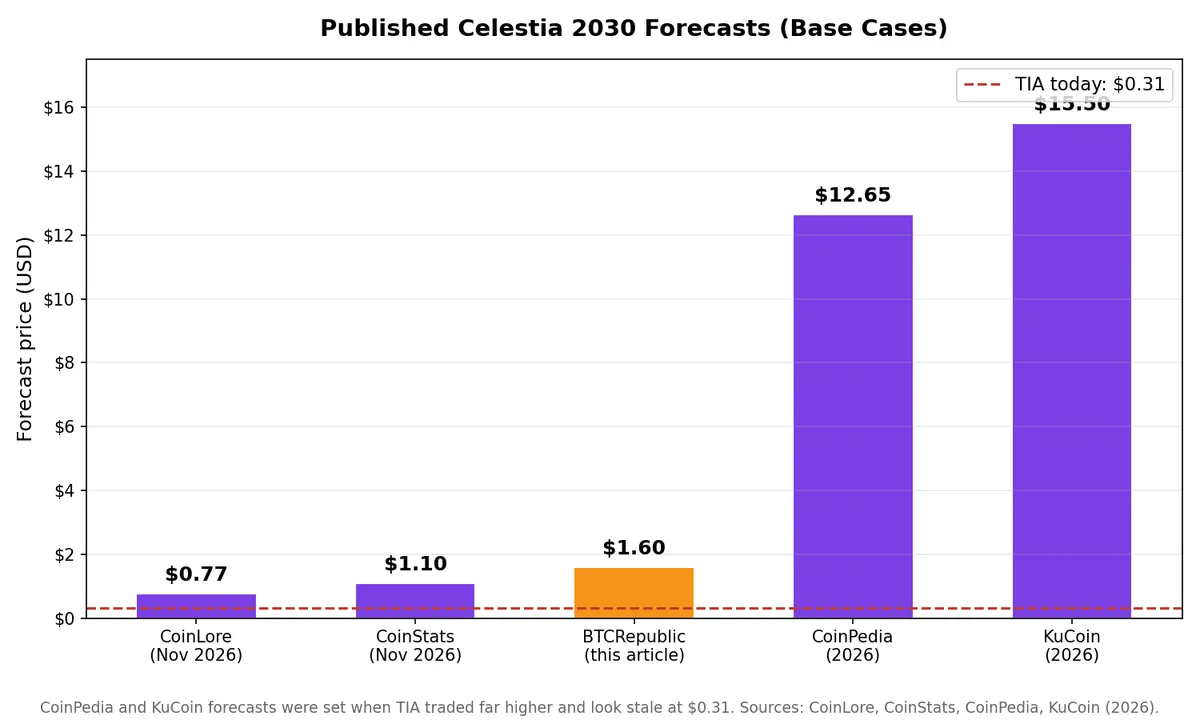
Published forecasts for 2030 disagree sharply, and the chart below shows the gap. CoinStats expects an average of $1.10 with a high of $2.50, which lands near our base case.
CoinLore expects a 2030 base case near $0.77, with a bull case of $4.08.
CoinPedia and KuCoin are the outliers, with 2030 averages of $12.65 and $15.50. Both were set when TIA traded far higher, and both look stale at $0.31.
| Year | Bear | Base | Bull |
|---|---|---|---|
| 2026 | $0.28 | $0.35 | $0.45 |
| 2027 | $0.25 | $0.55 | $1.00 |
| 2028 | $0.40 | $0.85 | $1.60 |
| 2029 | $0.55 | $1.20 | $2.20 |
| 2030 | $0.70 | $1.60 | $3.00 |
What Would It Take for TIA to Reach $1?
The $1 question dominates every Celestia discussion, so here is the exact math. TIA has about 993 million tokens in circulation, so every price target maps to a fixed market cap.
At $0.31, the market cap is about $305 million. At $1.60, it would be about $1.59 billion.
At $1, it would be about $0.99 billion, roughly 3.2 times the current value. At the old all-time high of $20.85, it would be about $20.7 billion.
| TIA price | Implied market cap | Multiple from today |
|---|---|---|
| $0.31 (today) | About $0.31 billion | 1x |
| $0.35 | About $0.35 billion | 1.1x |
| $0.55 | About $0.55 billion | 1.8x |
| $0.85 | About $0.84 billion | 2.7x |
| $1.00 | About $0.99 billion | 3.2x |
| $1.60 | About $1.59 billion | 5.2x |
| $3.00 | About $2.98 billion | 9.7x |
| $20.85 (all-time high) | About $20.7 billion | 68x |
This table is our own calculation from the circulating supply, and it frames the debate honestly. A $1 billion market cap is not fantasy: it would put Celestia near the top 100 coins at today’s values.
But it needs either a broad market recovery or a step change in usage, and neither is visible yet.
For comparison, our Algorand price prediction 2026-2030 faces the same market-cap math on its own road to $1. Both coins need a market that rewards technology with real demand.
The Number No Other Forecast Shows: TIA Trades at 9,200 Times Its Fee Revenue
Here is the calculation that frames every price target in this article. Celestia earned about $2,712 in fees in the 30 days to October 17, 2026, according to DefiLlama.
Annualize that figure and the network earns about $33,000 a year in fees. Divide the $305 million market cap by that number, and TIA trades at roughly 9,200 times Celestia’s annualized fee revenue.
That multiple is the real story of this token. Buyers pay for the future, not for the present, because the present earns almost nothing.
Now run the same math on our own forecasts. At the 2030 base case of $1.60, the market cap would be about $1.59 billion at today’s supply, and more near $1.7 billion once slow inflation adds tokens.
That is about 52,000 times today’s fee run rate. For that price to make sense on fundamentals, fee income would need to grow thousands of times over, or the market would need to keep valuing promise over revenue.
This does not mean the base case is wrong. Crypto markets routinely pay for growth years before it arrives, and Celestia owns more than half of its market.
It does mean the forecast depends on demand that does not exist yet.
Watch the fee line each quarter. If it stays near $3,000 a month, the bear case wins.
Key Levels to Watch
Traders watch a few clear levels on TIA. Support sits at $0.30, the round number TIA tested on November 21.
If that level breaks, the next support is the March 2026 monthly close near $0.2959, then the yearly low area near $0.28.
Resistance sits at $0.34, the top of the November 21 daily range, then at $0.47, the October monthly close, and at $0.50, the round number that capped the spring recovery.
A close above $0.50 would be the first real sign that the downtrend is breaking.
Risks: What Could Go Wrong
Celestia’s risks are concrete, and any honest forecast must name them. The upgrades are real, but so are the headwinds.
Fee Income Is Almost Zero
The network earned about $2,712 in a month, and some days brought in only about $70. A data layer with no paying demand is a science project, not a business.
Fibre adds capacity for demand that may never arrive. If rollups keep posting data elsewhere, the price has little to stand on.
Ethereum Is the Biggest Competitor
Ethereum’s 2024 and 2025 upgrades added cheap blob space of its own. Many rollups no longer need an outside data layer at all.
Every rollup that stays on Ethereum is a customer Celestia never wins. That competition caps how fast fee income can grow.
Supply Keeps Growing
Circulating supply reached about 993 million TIA, roughly 84% of the 1.18 billion total. Inflation runs about 2.5% a year and falls slowly toward 1.5%.
Every new token needs a new buyer, or the price drifts lower. The Matcha cut helped, but it did not stop dilution.
The Market Has Not Rewarded the Tech
TIA fell about 45% in 30 days while Celestia shipped its biggest upgrade ever. Good engineering and good prices are different things, and the market has punished this coin for a year.
Polygon faces the same gap between shipping and price, and our Polygon price prediction 2026-2030 tracks a similar climb from a 2026 low. Technology alone has not lifted either token.
Is Celestia a Good Investment?
Celestia offers a real asymmetry at these prices. The downside from $0.31 to the bear case of $0.25 is small in dollar terms, while the base case implies a 5.2x gain by 2030.
That math attracts buyers who believe modular blockchains will win the long game.
The other side of the trade is just as real. TIA has fallen 49% in a year, it sits 98.5% below its all-time high, and its network earns almost no fees.
A buyer here bets that rollups will pay for data availability at scale, and that Celestia keeps its market lead. That bet has not paid off yet.
This article is not financial advice. Do your own research, size any position for a total loss, and never invest money you need soon.
If you hold TIA for the long term, staking can add yield while you wait: TIA secures the network through staking, and our roundup of the best crypto staking platform covers where to put tokens to work.
Celestia Price Prediction 2026-2030: FAQs
These are the questions readers ask most about TIA. Each answer uses the numbers and facts from this article.
What is the Celestia price prediction for 2026?
Our Celestia price prediction for 2026 has a base case of $0.35, a bull case of $0.45, and a bear case of $0.28. CoinStats expects a range of $0.30 to $0.47 for the rest of the year.
What will TIA be worth in 2030?
Our 2030 base case for TIA is $1.60, with a bull case of $3.00 and a bear case of $0.70. CoinStats expects an average of $1.10, while CoinLore expects a base case near $0.77 and CoinPedia expects an average of $12.65.
Can Celestia reach $1?
Yes, but only in a bull case for 2027 or as part of the longer climb. At the current supply of about 993 million tokens, $1 needs a market cap near $0.99 billion, roughly 3.2 times the current value.
That needs a broad market recovery or a big jump in real demand for Celestia’s data availability.
Can TIA return to its all-time high of $20.85?
Not in any realistic forecast for 2030. At the current supply, $20.85 would need a market cap above $20 billion, which would put Celestia among the top 20 cryptocurrencies.
No published forecaster expects that this decade.
Why is TIA so low right now?
TIA trades near $0.31 because the whole crypto market sold off in November, Celestia’s fee income is almost zero, and Ethereum’s own blob space now competes for the same rollup customers. The token is down about 45% in 30 days and about 49% over the past year.
Is Celestia a good long-term investment?
Celestia has genuine strengths: the first modular data availability network, more than 50% market share, the Fibre upgrade, and falling inflation. It also has real weaknesses: almost no fee income, strong competition from Ethereum, and a price 98.5% below its all-time high.
Whether it is a good investment depends on your risk tolerance and your time horizon, and this article is not financial advice.
Conclusion
Celestia in November 2026 is a coin with better technology than price action. Fibre, Matcha, and Hibiscus all point the right way, yet TIA trades near $0.31 because fee income and market mood have not caught up.
Our base case sees a slow climb: $0.35 by the end of 2026, $0.55 in 2027, $0.85 in 2028, $1.20 in 2029, and $1.60 in 2030. The $1 target stays a bull case for 2027, and the math shows why: it needs a market cap near $1 billion.
Watch the $0.30 level first. If it holds, the bottom may be in.
If it breaks, the bear case takes over.
Want the same treatment for another beaten-down Layer-1? Read our Ethereum Classic price prediction 2026-2030, which tracks a similar climb from a 2026 low.
And if you hold TIA for the long term, staking can add yield while you wait.






