



Mantle price prediction 2026-2030 starts with a hard number. MNT trades near $0.37 on November 17, 2026, down about 87 percent from its all-time high near $2.86, and down about 31 percent in the past month alone.
Our short answer is this. Our base case puts MNT near $1.00 by 2030, with a bear case near $0.30 and a bull case near $2.00.

Nobody knows the real outcome. Published 2030 averages run from $0.53 to $2.10, a gap of about four times, and that spread tells you more about this token than any single number does.
- Key Takeaways
- MNT Price Today: November 17, 2026
- What Is Mantle, in Plain English
- The Treasury Question Nobody Can Skip
- What Changed in November 2026
- Mantle Price Prediction 2026
- Mantle Price Prediction 2027
- Mantle Price Prediction 2028-2029
- Mantle Price Prediction 2030
- What Could Push MNT Higher
- What Could Push MNT Lower
- How to Think About MNT Before You Buy
- Frequently Asked Questions
- What is the Mantle price prediction for 2026?
- What is the Mantle price prediction for 2027?
- What is the Mantle price prediction for 2030?
- Can MNT reach $1?
- Can MNT reach $10?
- Will MNT ever return to its $2.86 all-time high?
- Is Mantle a good investment?
- Conclusion
Key Takeaways
- MNT trades near $0.37 on November 17, 2026, with a market value near $1.25 billion, rank 63, and about 3.31 billion coins in circulation.
- MNT is down about 87 percent from its $2.86 peak, down about 19 percent in the past week, and down about 31 percent in the past month.
- Mantle holds a treasury worth about $1.66 billion as of November 15, 2026, but about 69 percent of it is MNT itself, so the headline number falls when the token falls.
- Governance proposal MIP-35, published October 28, 2026, would cut the annual spending cap by 25 percent, to 150 million MNT and 40 million USDx.
- Mantle moved to ZK proofs in September 2025 and now runs on Reth, with a state-root bug fix shipped on November 6, 2026.
- Our base case puts MNT near $1.00 by 2030, with a bear case near $0.30 and a bull case near $2.00.
- A $1.00 MNT needs a market value near $3.31 billion at today’s supply, about 2.7 times what the token is worth now, while a return to the $2.86 peak would need about $9.47 billion.
MNT Price Today: November 17, 2026
Here is the snapshot we verified this morning, before writing a single forecast. Prices move fast, so treat these as the starting point for the ranges below, not as a quote you can trade on.
| Metric | Value (Nov 17, 2026) |
|---|---|
| Price | About $0.37 |
| 24-hour range | $0.36 to $0.38 |
| 24-hour change | Near flat |
| 7-day change | Down about 19% |
| 30-day change | Down about 31% |
| Market value | About $1.25 billion |
| Market rank | 63 |
| 24-hour trading volume | About $27 million |
| Circulating supply | About 3.31 billion MNT |
| Maximum supply | About 6.22 billion MNT |
| Fully diluted value | About $2.27 billion |
| All-time high | About $2.86 |
| Distance from all-time high | Down about 87% |
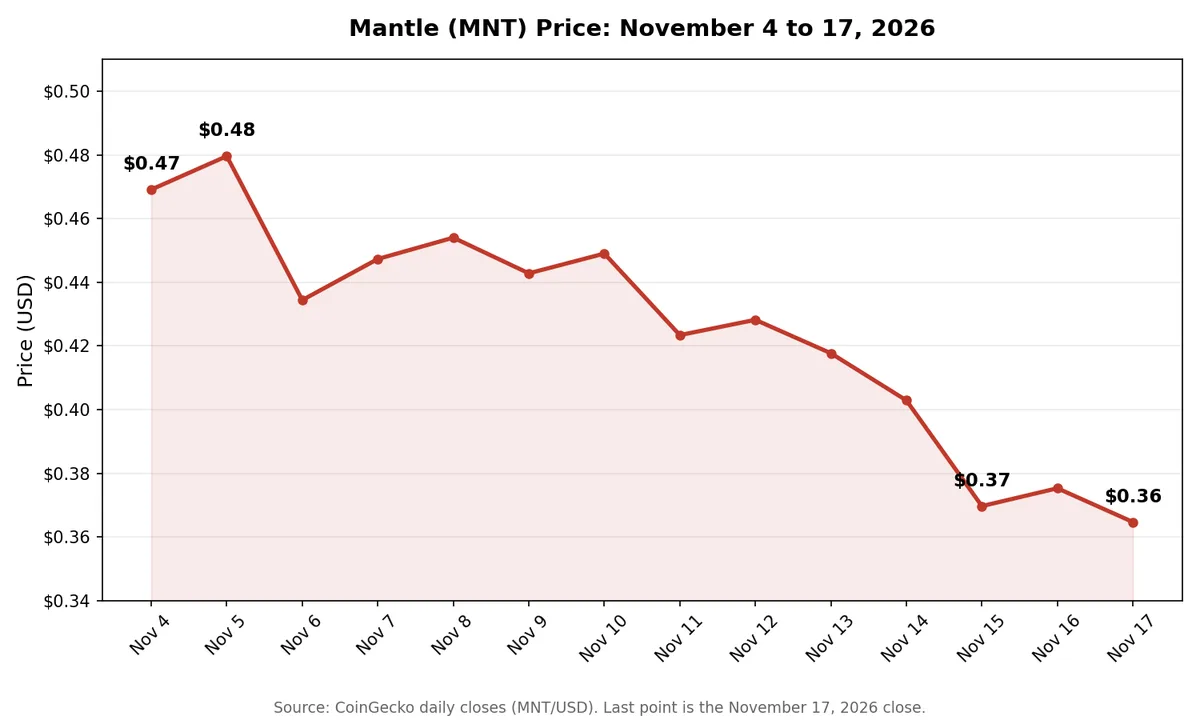
The short-term trend is weak. MNT traded near $0.48 on November 5, near $0.45 on November 10, then fell to $0.37 on November 15, and it has now lost about 22 percent of its value in 13 days.
Bitcoin sets the mood, and it is ugly today. Bitcoin trades near $64,700 after falling to about $62,000 over the weekend, its sixth straight weekly loss, and our Bitcoin price prediction for 2026 explains why the whole market is on edge.

The Crypto Fear and Greed Index stood at 12 on November 17, deep in extreme fear. When fear runs this hot, traders sell first and ask questions later, and small tokens like MNT fall harder than Bitcoin.
One supply detail should worry any MNT holder. About 2.9 billion MNT have never entered circulation, nearly half the maximum supply, and most of that sits in the treasury, so future releases can add selling pressure for years.
What Is Mantle, in Plain English
Mantle is an Ethereum layer-2 network. It moves transactions off Ethereum’s crowded main chain, processes them cheaply, and then settles them back on Ethereum for security.
MNT is the network’s gas and governance token. Users pay fees in MNT, and holders vote on how the DAO spends its treasury, which makes MNT part currency and part voting chip.
The network launched in July 2023 out of the BitDAO merger, and it inherited one of the largest treasuries in crypto. That treasury is Mantle’s biggest selling point and its biggest question mark, as the next section shows.
Mantle runs on the OP Stack, the same toolkit behind Optimism, and it uses ZK proofs for faster finality. Our Arbitrum price prediction 2026-2030 covers the biggest layer-2 rival, and the same forces shape both tokens.
The Treasury Question Nobody Can Skip
Mantle’s homepage lists a total treasury of $1,662,272,265 as of November 15, 2026. That number sounds like a fortress, until you read what sits inside it.
MNT itself accounts for $1,144,448,128 of the total, or about 69 percent. Only about $518 million sits in other assets like Bitcoin, stablecoins, and ETH, which is the part that holds its value when MNT falls.
| Treasury piece (Nov 15, 2026) | Value |
|---|---|
| Total treasury | $1.66 billion |
| MNT held by the treasury | $1.14 billion (about 69%) |
| Non-MNT assets (BTC, stables, ETH) | About $518 million |
| Non-MNT backing per circulating MNT | About $0.16 |
| MNT portion per circulating MNT | About $0.35 |
Here is the math we ran ourselves, and no other prediction page publishes it this way. Divide the $518 million of outside assets by the 3.31 billion MNT in circulation, and you get about $0.16 of real backing per token.
That does not make MNT worth $0.16. The treasury is a budget the DAO spends to fund the ecosystem, not a claim that holders own, and the token trades on demand, not on book value.
But it frames the risk honestly. When MNT falls, the headline treasury falls with it, because nearly 70 percent of it is the token itself.
A buyer who thinks the $1.66 billion backs the price is reading the number backwards.
The real question is whether the DAO spends that war chest well. Our Ondo price prediction 2026-2030 covers a tokenized-asset rival, and Mantle’s own real-world-asset push is where much of the spending now goes.
What Changed in November 2026
Three developments landed in the past three weeks, and each one changes the forecast a little. None of them is a price catalyst on its own, but together they show a team still shipping while the token falls.
First, the core team published MIP-35 on October 28, 2026. The proposal would cap the July 2026 to June 2027 budget at 150 million MNT and 40 million USDx, down from 200 million MNT and 52 million USDx in the previous cycle.
That is a 25 percent cut in token spending. Fewer new tokens hitting the market is good for holders, but it also means slower ecosystem funding, so the trade-off is real.
Second, Mantle Mainnet now runs on Reth, a faster execution client built in Rust. The network announced the move on November 2, 2026, and it sits on the same foundation as the ZK proving system Mantle adopted with Succinct.
Third, the team shipped op-reth version 1.6.3 on November 6, 2026, fixing a state-root bug in the upstream Reth client. The bug could leave nodes out of sync or return wrong proofs on some Ethereum networks, but Mantle said user assets stayed safe and no user action was needed.
Mantle Price Prediction 2026
The rest of 2026 looks flat at best. MNT has six weeks left in the year, the market is in extreme fear, and Bitcoin is testing the $60,000 line that analysts call the key level for the coming weeks.
Our base case puts MNT near $0.40 by the end of 2026, a small recovery from $0.37 if Bitcoin holds above $60,000. The bear case near $0.30 assumes Bitcoin breaks below that line and drags altcoins down with it.
The bull case near $0.50 needs a fast turn in sentiment, and nothing in the last two weeks points that way. Published forecasts agree on a weak finish: CoinCodex expects about $0.29 by year-end, while Coincub’s base case sees $0.48 to $0.56.
Short-term traders should note the gap. Our Optimism price prediction 2026-2030 shows the same pattern across layer-2 tokens, and none of them escapes a Bitcoin sell-off.
Mantle Price Prediction 2027
2027 is the year MIP-35 shapes. If the proposal passes, the fourth budget cycle runs on a tighter cap, and about 2.9 billion unreleased tokens stay mostly locked away for another year.
Our base case puts MNT near $0.60 in 2027, with a bear case near $0.35 and a bull case near $0.85. That range assumes layer-2 demand stabilizes and Mantle keeps its place among the leading networks.
The bull case needs real-world assets to do the heavy lifting. Mantle’s tokenized-asset value topped $210 million in August 2026, with 96 percent of it in yield-bearing products, and the Mantle Vault product crossed $200 million after opening to any wallet on August 25, 2026.
The bear case needs almost nothing to go wrong for it to happen. If on-chain capital stays near current levels and Bitcoin stays weak, MNT can drift sideways for another year, and the token has already shown it can do exactly that.
Mantle Price Prediction 2028-2029
The middle years depend on one question: does anyone actually use Mantle? The network’s DeFi value locked sits near $84 million, which is small for a chain with a $1.66 billion treasury.
Our base case puts MNT near $0.75 in 2028 and near $0.90 in 2029. The bear case holds near $0.30 to $0.35 in both years, and the bull case reaches $1.20 in 2028 and $1.60 in 2029.
The bull case assumes the ZK upgrade pays off. Mantle’s OP Succinct ZK proof system went live on mainnet in September 2025, targeting one-hour finality instead of seven-day exits, and that speed matters for exchanges and payment apps.
The network also moved from EigenDA to Ethereum blobs in early 2026, with the Arsia upgrade in April 2026 removing the old data path. These are real technical gains, but they only move the price if developers build on them.
Mantle Price Prediction 2030
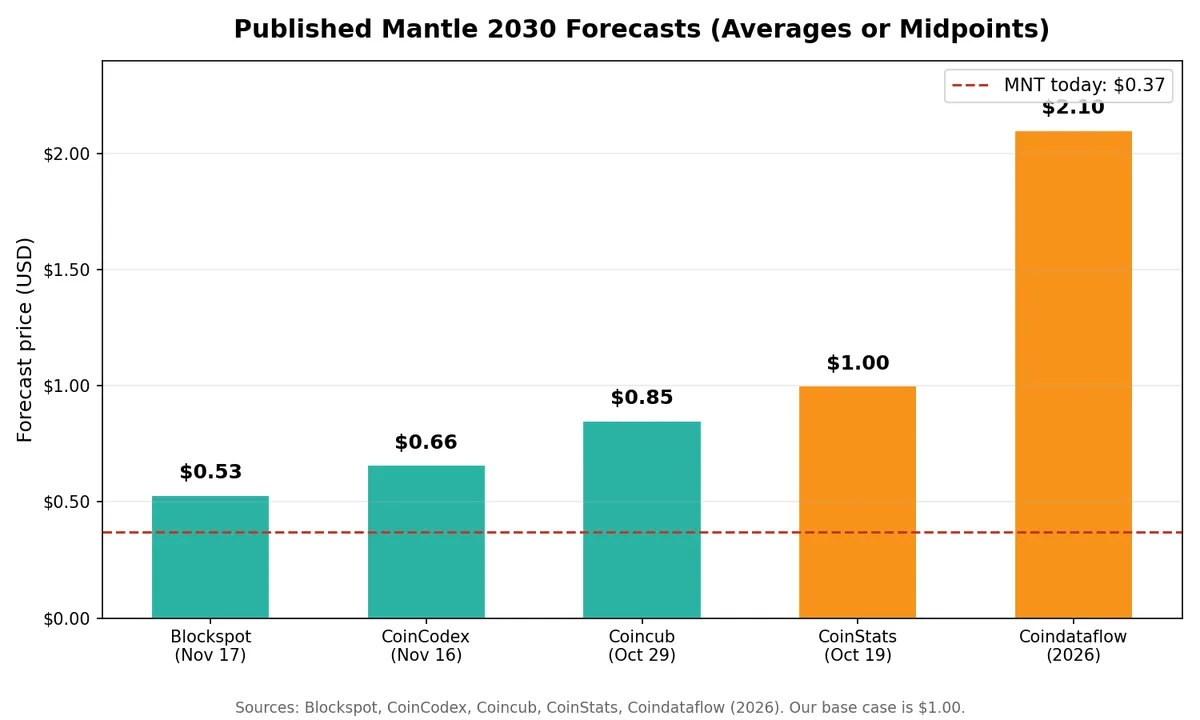
2030 is where the forecasts split widest. Five published sources give 2030 averages from $0.53 to $2.10, and our base case sits near the middle of that pack.
| Source | Dated | 2030 average |
|---|---|---|
| Blockspot | Nov 17, 2026 | $0.53 (range $0.19-$0.87) |
| CoinCodex | Nov 16, 2026 | $0.66 |
| Coincub | Oct 29, 2026 | $0.85 (base range $0.69-$1.00) |
| CoinStats | Oct 19, 2026 | $1.00 (range $0.55-$1.60) |
| Coindataflow | 2026 | $2.10 (range $0.90-$3.32) |
Our base case puts MNT near $1.00 by 2030, matching the CoinStats average and the top of Coincub’s base range. The bear case near $0.30 assumes the token never recovers its 2026 losses, and the bull case near $2.00 assumes tokenized assets and layer-2 demand grow hard for four straight years.
Here is the market-cap test, and it is the table most prediction pages skip. Every price below is multiplied by today’s 3.31 billion circulating coins, so you can see what each target actually costs the market.
| MNT price | Market value needed (3.31B coins) | Multiple of today |
|---|---|---|
| $0.37 (today) | About $1.25 billion | 1.0x |
| $0.50 | About $1.66 billion | About 1.3x |
| $0.66 (CoinCodex 2030) | About $2.19 billion | About 1.8x |
| $1.00 (our base case) | About $3.31 billion | About 2.7x |
| $2.00 (our bull case) | About $6.62 billion | About 5.3x |
| $2.86 (all-time high) | About $9.47 billion | About 7.6x |
One warning belongs in this table. Coincub expects circulating supply to rise toward 3.9 billion MNT by 2030, and at that supply a $1.00 price needs a $3.90 billion market value, not $3.31 billion.
Supply growth is the quiet tax on every MNT forecast. Our Polygon price prediction 2026-2030 faces the same math, and it is why we keep our base case modest even in the bull case.
What Could Push MNT Higher
Four drivers could lift MNT above our base case. None of them is guaranteed, but each one is visible in the numbers today.
First, tokenized assets. Mantle’s real-world-asset value topped $210 million in August 2026, and the network added tokenized stocks through xStocks, which lets users trade equities on-chain around the clock.
Second, the ZK upgrade. One-hour finality instead of seven-day exits makes Mantle faster to enter and leave, and that matters to exchanges, funds, and payment apps that move real money.
Third, budget discipline. MIP-35 would cut token spending by 25 percent, which slows new supply and signals that the DAO takes dilution seriously.
Fourth, a Bitcoin recovery. MNT fell with the whole market, and it can rise with it, and our Internet Computer price prediction 2026-2030 shows the same Bitcoin link across every altcoin we cover.
What Could Push MNT Lower
Four risks could drag MNT below our bear case. Each one is already visible, so none of them should surprise a holder.
First, the treasury concentration. About 69 percent of the $1.66 billion treasury is MNT itself, so a falling token shrinks the war chest that is supposed to fund the recovery.
Second, the unlock overhang. About 2.9 billion MNT have never circulated, and every future release adds supply that buyers must absorb before the price can rise.
Third, weak usage. DeFi value locked near $84 million is thin for a chain of this size, and the April 2026 exploit on Mantle’s Aave market, which drained roughly $190 million using stolen rsETH as collateral, showed how fast confidence can break.
Fourth, Bitcoin. If Bitcoin breaks below $60,000, analysts warn of pressure toward the $50,000 range, and MNT has already fallen about 19 percent in a week while Bitcoin fell about 13 percent.
How to Think About MNT Before You Buy
Start with the market-cap test, not the price target. A token at $0.37 can still be expensive if its supply keeps growing, and a $1.00 target means nothing until you know what market value it needs.
Do not buy the treasury headline. The $1.66 billion sounds like backing, but only about $518 million of it sits outside MNT, which works out to about $0.16 per token.
Watch the MIP-35 vote and the next treasury update. A passed budget cap and a rising share of outside assets would both be real signs of discipline, while a failed vote or more token-heavy holdings would be the opposite.
Never bet money you need back soon. MNT has fallen about 31 percent in a month and about 87 percent from its peak, and this article is not financial advice.
Frequently Asked Questions
Readers ask the same seven questions about MNT more than any others. Here are the short answers, with the numbers from the sections above.
What is the Mantle price prediction for 2026?
Our base case puts MNT near $0.40 by the end of 2026, with a bear case near $0.30 and a bull case near $0.50. The token trades near $0.37 today, so the base case means a small recovery, not a rally.
What is the Mantle price prediction for 2027?
Our base case puts MNT near $0.60 in 2027, with a bear case near $0.35 and a bull case near $0.85. The year depends on whether the MIP-35 budget cap passes and whether tokenized assets keep growing.
What is the Mantle price prediction for 2030?
Our base case puts MNT near $1.00 by 2030, with a bear case near $0.30 and a bull case near $2.00. Published forecasts disagree widely, with 2030 averages from $0.53 at Blockspot to $2.10 at Coindataflow.
Can MNT reach $1?
Yes, and it is our base case for 2030: a $1.00 MNT needs a market value near $3.31 billion at today’s supply, about 2.7 times what the token is worth now. At the 3.9 billion supply Coincub expects by 2030, it would need about $3.90 billion.
Can MNT reach $10?
Not by 2030 in any published forecast, because a $10 MNT needs a market value near $33.1 billion at today’s supply, about 27 times the current value. No forecaster we checked expects $10 by 2030.
Will MNT ever return to its $2.86 all-time high?
A return to the $2.86 peak would need a market value near $9.47 billion at today’s supply, about 7.6 times the current value. No published forecast comes close by 2030, so treat the all-time high as history, not a target.
Is Mantle a good investment?
MNT suits a long-term investor who believes Ethereum layer-2 networks and tokenized assets grow, and who accepts very high risk, but the network holds only about $84 million in DeFi value locked and the token sits about 87 percent below its peak. It is not a safe or income-producing investment, and this article is not financial advice.
Conclusion
MNT is a token with a rich treasury and a poor chart. The network behind it keeps shipping real upgrades, from ZK proofs to a Reth migration, yet the token has lost about 31 percent in a month and about 87 percent from its peak.
That gap is either the opportunity of the cycle or a warning. If tokenized assets grow and the DAO spends its war chest with discipline, our base case near $1.00 by 2030 starts to look cautious.
If usage stays thin and supply keeps growing, MNT stays a well-funded chain with a token nobody needs to hold. Our bear case near $0.30 prices in that slower path, and it is the honest middle ground until the usage numbers arrive.
Watch the MIP-35 vote first. The budget cap will tell you more about MNT’s future than any forecast can.
The next treasury update will tell you the rest. For the long view, our Bitcoin price prediction for 2030 shows the market backdrop every altcoin still depends on.
For another OP Stack token in the same format, see our Worldcoin price prediction for 2026-2030, which puts WLD at $1.00 in its 2030 base case.






