



Nigeria changed the rules on Bitcoin tax in 2026, and most of the guides online still have it wrong.
If you search for bitcoin tax in nigeria explained today, you will still find pages that quote a flat 10% capital gains tax. That rate is dead.

The Nigeria Revenue Service replaced it with progressive income tax bands that run from 0% to 25%, and it added a 1% withholding tax, a 1.5% stamp duty and a rule that calculates your gain in dollars first.
- Key Takeaways
- The Short Answer: The 10% Flat Rate Is Gone
- What Changed in 2026
- The New Rates: 0% to 25%
- The USD Rule That Protects You From Naira Depreciation
- The 1% Your Exchange Takes Before You File
- Staking, Mining and Airdrops: Taxed at 10% at Source
- Stamp Duty and VAT: The Two Charges Nobody Budgets For
- What Counts as a Taxable Event
- How to File Your Bitcoin Tax in Nigeria
- Step 1: Get a Tax Identification Number
- Step 2: Keep Records of Every Trade
- Step 3: Reconcile the Withholding
- Step 4: File Your Return
- Common Mistakes Nigerian Bitcoin Holders Make
- How the New Rules Compare With Other Countries
- Frequently Asked Questions
- Sources
This guide explains the new system in plain English. It uses the NRS Guidelines on the Taxation of Virtual Assets, issued on 31 July 2026, and the Nigeria Tax Act 2025 that sits underneath them.
This guide is general information only. It is not tax advice.
Tax rules depend on your own situation, so talk to a qualified Nigerian tax adviser before you file.
Key Takeaways
- The flat 10% capital gains tax on crypto ended with the 2025 tax year. From 1 January 2026, Bitcoin gains are added to your total income and taxed at progressive rates of 0% to 25%.
- The first NGN 800,000 of chargeable income is taxed at 0%. The top rate of 25% applies only to income above NGN 50 million.
- Your gain is calculated in US dollars first, then converted to naira at the CBN/NAFEM rate on the disposal date. Naira depreciation alone does not create a taxable gain.
- Exchanges and P2P marketplaces must withhold 1% of your gross disposal proceeds. Stablecoin sales are exempt from this withholding.
- Staking, mining, airdrop and DeFi income is taxable on receipt, with 10% withheld where a platform pays it.
- Every conversion between fiat and tokens attracts 1.5% stamp duty, and VASP service fees carry 7.5% VAT.
- Holding Bitcoin is not taxable. Only selling, swapping, spending or earning it creates a tax event.
- Anyone who trades virtual assets must register for tax and hold a Tax Identification Number.
The Short Answer: The 10% Flat Rate Is Gone
For years, Nigerian crypto traders lived under a simple rule. You sold Bitcoin at a profit, you paid 10% capital gains tax on the gain, and that was the end of it.

That rule died on 1 January 2026. The Nigeria Tax Act 2025 folded crypto gains into the personal income tax system, and the NRS guidelines of 31 July 2026 spelled out how the new system works in practice.
Now your Bitcoin gain joins your salary, your business income and everything else you earned in the year. The total is taxed at the progressive bands, so your crypto tax now depends on your other income.
A trader with no other income pays far less than 10% on a modest gain. A high earner pays far more.
The old flat rate treated everyone the same. The new system does not.
Our full Bitcoin tax guide shows how other countries handle the same question, and Nigeria now sits at the stricter end of the range.
What Changed in 2026
The change came in two steps. First, the Nigeria Tax Act 2025 and the Nigeria Tax Administration Act 2025 took effect on 1 January 2026, and the old Capital Gains Tax Act was repealed.
Second, the NRS published its Guidelines on the Taxation of Virtual Assets as Information Circular No. 2026/21 on 31 July 2026.
The guidelines are the first document that explains in detail how Nigeria intends to tax crypto. They cover individuals, companies, exchanges, P2P marketplaces and anyone paid in crypto.
| Rule | Up to 31 December 2025 | From 1 January 2026 |
|---|---|---|
| Tax on Bitcoin gains | Flat 10% capital gains tax | Progressive income tax, 0% to 25% |
| How the gain is worked out | In naira, at the time of each trade | In US dollars first, then converted at the CBN/NAFEM rate |
| Withholding on disposals | None | 1% of gross proceeds, taken by the platform |
| Staking, mining, airdrops | Taxed as other income | Taxable on receipt, 10% withheld through platforms |
| Stamp duty on conversions | None | 1.5% on token-to-fiat and fiat-to-token transfers |
| VAT | Unclear | 7.5% on VASP service fees, not on the transfer itself |
| Tax authority | Federal Inland Revenue Service (FIRS) | Nigeria Revenue Service (NRS) |
The tax authority itself changed its name. The Federal Inland Revenue Service became the Nigeria Revenue Service, and the new guidelines carry its name.
The Investments and Securities Act 2025 adds another layer. It recognises digital assets as securities, which puts them under the Securities and Exchange Commission.
A presidential executive order of 17 July 2026 then set up a Virtual Asset Council, chaired by the Central Bank of Nigeria, to coordinate the NRS, the SEC and the financial intelligence unit.
Nigeria is not a small market that the taxman can ignore. Chainalysis recorded $38.1 billion of crypto activity in Nigeria between July 2025 and June 2026, the second largest in Sub-Saharan Africa after South Africa.
That scale explains why the government moved from vague threats to a written framework.
The New Rates: 0% to 25%
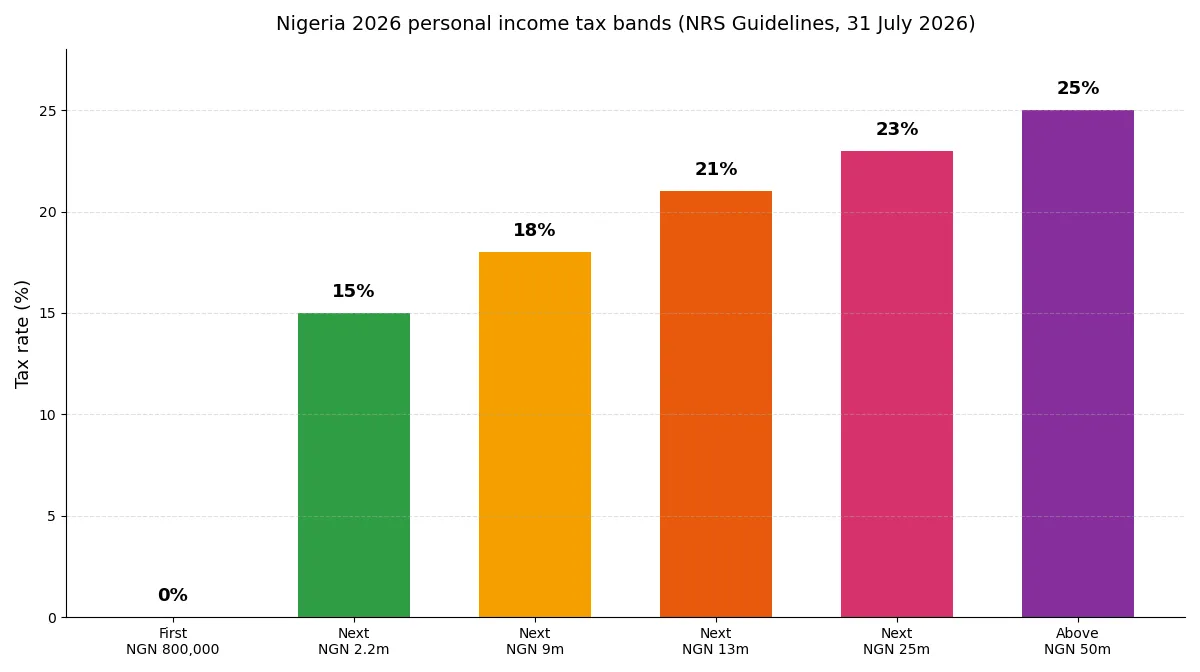
The 2026 personal income tax bands work like a staircase. Each slice of your income is taxed at its own rate, and only the slice above NGN 50 million pays 25%.
| Chargeable income band (NGN) | Rate |
|---|---|
| First 800,000 | 0% |
| Next 2,200,000 | 15% |
| Next 9,000,000 | 18% |
| Next 13,000,000 | 21% |
| Next 25,000,000 | 23% |
| Above 50,000,000 | 25% |
Companies pay differently. A company other than a small company pays 30% company income tax on its crypto profits.
The bands apply to your total chargeable income, not to your crypto gain alone. That detail decides whether the new system helps you or hurts you.
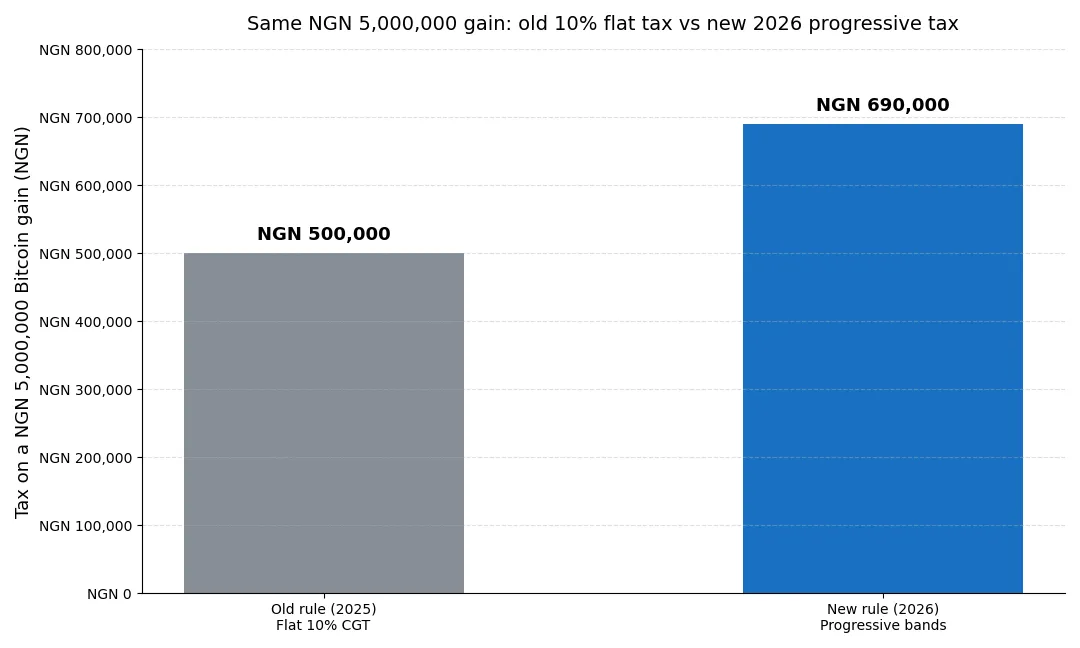
A Worked Example: The Same NGN 5,000,000 Gain, Old Rules vs New Rules
Take a trader whose total chargeable income for the year is NGN 5,000,000, all of it from one Bitcoin sale. Under the old flat rate, the bill was simple: 10% of NGN 5,000,000, or NGN 500,000.
Under the 2026 bands, the maths runs like this. The first NGN 800,000 is taxed at 0%, so it costs nothing.
The next NGN 2,200,000 is taxed at 15%, which is NGN 330,000. The remaining NGN 2,000,000 falls in the 18% band, which is NGN 360,000.
The total is NGN 690,000. That is an effective rate of 13.8% on the gain, and NGN 190,000 more than the old flat rate charged.
Now flip the numbers. A trader whose only income is a NGN 700,000 Bitcoin gain pays nothing at all, because the whole gain sits inside the 0% band.
Under the old rules, that same trader paid NGN 70,000.
Small traders win under the new system. Big traders lose.
That is the honest summary, and it is the first thing to understand before you complain about the 25% headline rate.
The USD Rule That Protects You From Naira Depreciation
The most important rule in the guidelines is also the least discussed. Your gain is calculated in US dollars first, and only the dollar gain is converted to naira.
The steps are simple. Take the dollar price when you bought the Bitcoin.
Take the dollar price when you sold it. Subtract the first from the second.
That dollar gain is then converted to naira at the CBN/NAFEM rate on the disposal date.
This matters because the naira has lost value against the dollar for years. Under the old naira-based method, a trader could owe tax on a gain that existed only because the naira fell, even if the Bitcoin price in dollars had not moved at all.
Here is an example. You buy 0.1 BTC for $6,000 and sell it later for $9,000.
Your gain is $3,000. If the NAFEM rate on the day you sell is NGN 1,500 to the dollar, your taxable gain is NGN 4,500,000.
If Bitcoin had stayed flat at $6,000 while the naira weakened, your dollar gain would be zero and you would owe nothing on that trade, even though the naira value of your coins rose. The guidelines protect you from being taxed on currency depreciation.
Keep your dollar prices for every trade. Your exchange history shows them, and a simple spreadsheet works too.
Without the dollar figures, you cannot do the calculation the NRS expects.
The 1% Your Exchange Takes Before You File
The guidelines put exchanges and P2P marketplaces at the centre of collection. When you sell Bitcoin through a platform, it must withhold 1% of your gross disposal proceeds.
Note the word gross. The 1% comes off the full sale price, not off your profit.
Sell Bitcoin for NGN 10,000,000 and the platform withholds NGN 100,000, even if your profit on that sale was only NGN 500,000.
The withholding is an advance payment, not an extra tax. You subtract the total withheld during the year from your final income tax bill when you file.
If the platform withheld more than you owe, you get a refund. If it withheld less, you pay the balance.
The 1% applies to three of the six virtual asset categories in the guidelines: cryptocurrencies and exchange tokens, security and investment tokens, and NFTs. It does not apply to every token type.
Stablecoin sales are exempt. Selling USDT or USDC does not attract the 1% withholding, although the sale can still create a taxable gain if you sell above your cost.
If you trade peer to peer, the marketplace operator carries the same duty. Our guide to selling Bitcoin on P2P platforms safely explains how to pick a platform that handles this properly, and our guide to buying Bitcoin in Nigeria covers the local exchanges that now operate under these rules.
Staking, Mining and Airdrops: Taxed at 10% at Source
Income from staking rewards, mining, airdrops and DeFi yield is taxable when you receive it. The guidelines treat it as income, not as a capital gain, and they value it at its dollar fair market value on the day you receive it.
Where a platform pays that income, it must withhold 10%. That 10% is also an advance payment, credited against your final tax bill in the same way as the 1% disposal withholding.
Your cost base steps up to the value you were taxed on. If you later sell those staked coins, you only pay tax on the gain above the value at which you already paid income tax.
You do not pay tax twice on the same coins.
Miners face the same treatment. Mining rewards are income on receipt, and the rules for how Bitcoin miners are taxed still apply on top of the Nigerian withholding.
Airdrops with no realisable value are taxed only when you dispose of them, on the full proceeds.
Stamp Duty and VAT: The Two Charges Nobody Budgets For
The 1.5% stamp duty is the charge that will surprise most traders. Every conversion between fiat and tokens attracts it, in both directions.
Buy Bitcoin with naira and you pay 1.5%. Sell Bitcoin back to naira and you pay 1.5% again.
The duty is borne by the transferee and withheld from the tokens credited to that person. On a NGN 1,000,000 buy, that is NGN 15,000 gone before the trade even starts.
Two round trips in a year cost you 6% in stamp duty alone, before any income tax.
Frequent traders should count this cost honestly. A strategy that looked profitable on paper can turn into a loss once the duty is applied at both ends of every trade.
VAT works differently. The transfer of a virtual asset itself is not a taxable supply, so no VAT applies to the coins changing hands.
But the services around the trade carry 7.5% VAT: exchange fees, brokerage commissions, custody, wallet management, listing fees and advisory work.
In practice, you will see the VAT inside the fees your exchange charges. You do not file it yourself, but you pay it all the same.
What Counts as a Taxable Event
Not every Bitcoin movement creates tax. The guidelines draw a clear line between holding and disposing, and the line is worth learning.
| Action | Taxable? |
|---|---|
| Buying Bitcoin and holding it | No |
| Selling Bitcoin for naira | Yes, income tax on the gain |
| Swapping Bitcoin for another coin | Yes, a disposal of both sides |
| Paying for goods or services with Bitcoin | Yes, taxed on the gain in the coins spent |
| Receiving staking, mining or airdrop rewards | Yes, income on receipt |
| Receiving salary or fees in Bitcoin | Yes, employment or business income |
| Moving Bitcoin between your own wallets | No |
| Receiving a gift of Bitcoin | Yes, income tax can apply to gifts received in virtual assets |
| Selling a stablecoin | Yes, if you made a gain, but no 1% withholding |
| Using the eNaira | No, sovereign digital currencies sit outside the framework |
Holding is never taxable. An unrealised gain in your wallet is not income, however large it grows.
Swapping deserves a warning. Many traders swap Bitcoin for another coin and assume nothing happened because no naira reached their bank account.
The guidelines treat a swap as a disposal, and tax applies on the gain in the coins you gave up.
How to File Your Bitcoin Tax in Nigeria
Filing starts before the tax year ends. The guidelines expect you to register, keep records and let the platforms do their part, then file a self-assessment return.
Step 1: Get a Tax Identification Number
Anyone who carries on virtual asset activity must register with the NRS and obtain a Tax Identification Number. Your exchange will ask for it, and the guidelines expect platforms to collect it from customers.
If you trade without a TIN, you are already outside the rules. Register first, then trade.
Step 2: Keep Records of Every Trade
Record the date, the coin, the amount, the dollar price at the time, the naira value, the fees and the platform for every transaction. Keep your exchange statements, your wallet addresses and your bank records together.
Good records also protect you. If the NRS queries your return, a clean transaction log settles the question fast.
A missing log leaves you guessing, and the taxman does not guess in your favour.
Crypto tax software can track your trades and build the gain calculations for you, which is worth the cost once your trade count passes a few dozen a year.
Step 3: Reconcile the Withholding
Add up every 1% disposal withholding and every 10% income withholding your platforms took during the year. These amounts reduce your final bill, so keep the figures from your exchange statements.
If a platform withheld tax on a stablecoin sale, raise it with them. Stablecoin sales are exempt from the 1% withholding, and an error there is money you should not have lost.
Step 4: File Your Return
Nigeria runs on a calendar tax year, 1 January to 31 December. Your crypto gains for 2026 go on your self-assessment return for that year, with the withheld amounts subtracted from the tax due.
PwC notes that the return is due 90 days after the year ends, which puts the 2026 deadline at 31 March 2027. The tax acts themselves do not state a date, so confirm the deadline with your adviser or the NRS before you rely on it.
Losses matter too. A realised loss from selling below your cost reduces your total taxable income for the year.
Tax loss harvesting can cut a real bill, but only if you record the loss and claim it properly.
Common Mistakes Nigerian Bitcoin Holders Make
The first mistake is the oldest one. People still quote the 10% flat rate because an old blog told them to.
That rate ended with the 2025 tax year, and filing under it in 2026 means filing wrong.
The second mistake is ignoring the 1% withholding. Traders see the deduction on their exchange statement and assume it settles their tax.
It does not. It is an advance payment, and the final bill depends on your total income for the year.
The third mistake is forgetting the stamp duty. A trader who buys and sells often can pay more in stamp duty than in income tax, and the duty applies whether the trade made money or not.
The fourth mistake is treating swaps as free. Swapping Bitcoin for another coin is a taxable disposal, and the NRS expects you to report the gain even though no naira touched your account.
The fifth mistake is poor records. Without dollar prices and dates, you cannot calculate the USD-first gain the guidelines require, and you cannot defend your return if the NRS asks questions.
The sixth mistake is assuming the rules will not be enforced. Exchanges now report transaction data to the NRS, and platforms must withhold tax at source.
The tax authority no longer depends on you volunteering the information.
How the New Rules Compare With Other Countries
Nigeria is not alone in tightening crypto tax, but its mix is unusual. Ireland taxes Bitcoin gains at a flat 31% capital gains rate after its 2026 Budget cut, with no withholding at source.
New Zealand has no capital gains tax at all, yet taxes most gains as income and now gets your exchange data automatically.
Nigeria combines the worst of both worlds for traders: progressive rates up to 25%, withholding at source, stamp duty on every conversion and VAT on exchange fees. The USD-first gain rule is the one genuine protection in the package, and it is a good one.
My view is simple. The framework is harsh, but it is clear, and clarity beats the old grey zone.
A trader who knows the rules can plan around them. A trader who pretends they do not exist will pay more later, with interest.
Frequently Asked Questions
Is Bitcoin taxed in Nigeria in 2026?
Yes. Bitcoin gains are taxed as income at progressive rates of 0% to 25% from 1 January 2026, under the Nigeria Tax Act 2025 and the NRS Guidelines on the Taxation of Virtual Assets.
What happened to the 10% capital gains tax on crypto?
The flat 10% rate applied up to and including the 2025 tax year. The Capital Gains Tax Act was repealed, and from 2026 your gain is added to your total income and taxed at the progressive bands.
How much tax do I pay on a Bitcoin gain in Nigeria?
It depends on your total income for the year. The first NGN 800,000 of chargeable income is taxed at 0%, then 15% to NGN 3,000,000, 18% to NGN 12,000,000, 21% to NGN 25,000,000, 23% to NGN 50,000,000, and 25% above NGN 50,000,000.
Does my exchange withhold tax when I sell Bitcoin?
Yes. Exchanges and P2P marketplaces must withhold 1% of your gross disposal proceeds.
It is an advance payment credited against your final tax bill, not an extra tax. Stablecoin sales are exempt from the 1% withholding.
Do I pay tax if I only hold Bitcoin and never sell?
No. Buying and holding Bitcoin is not a taxable event, and moving coins between your own wallets is not a disposal either.
Tax applies when you sell, swap, spend or earn the coins.
What is the 1.5% stamp duty on crypto in Nigeria?
Every conversion between fiat and tokens attracts 1.5% stamp duty, in both directions. It is borne by the transferee and withheld from the tokens credited to that person, and it applies whether or not the trade made a profit.