


Binance is stabilising, not yet recovered. Outflows have slowed sharply since reopening, and a second withdrawal phase began on November 3, but order book evidence still points to thin trading liquidity.
That split matters. A slower outflow rate shows fewer people rushing for the exit at the same time, while a thin order book shows market makers still hesitate to quote size close to the price.

Key takeaways
- Phase 2 withdrawals began progressively from 04:00 UTC on November 3, across nine named networks.
- Reported 24-hour net outflows fell from a peak near $7 billion to about $3.29 billion, then to $2.57 billion on Monday.
- Binance completed a new zero-knowledge proof-of-reserves snapshot on Monday, covering ten major assets.
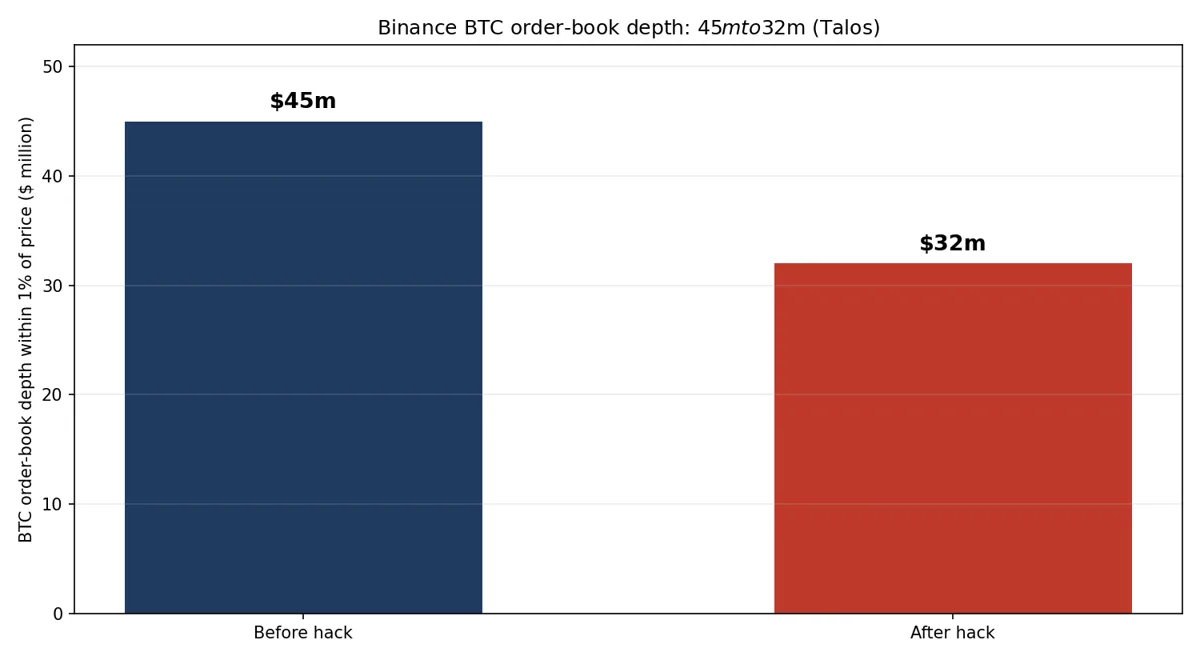
- Talos put Bitcoin order-book depth at about $32 million after the hack, down from about $45 million before it.
- My verdict: call this a stabilisation, not a recovery, until depth data and the next snapshot confirm the turn.
What changed on day five
Binance began phase 2 withdrawals progressively from 04:00 UTC on Tuesday, November 3. The rollout followed phase 1, which reopened withdrawals for selected assets and regions first.
Deposits remain available during the phased reopening. Binance said it prioritised tokens based on user demand and system readiness, rather than opening every market at once.
Networks named for phase 2
Binance named Binance Smart Chain, Ethereum, Solana, XRP Ledger, Sui, Arbitrum, Optimism, Tron and Base as the networks for phase 2. Users should still check the official notice for their asset and network, because a named network does not mean every token on that chain is live yet.
Binance also reopened withdrawals for several fiat currencies on Monday, including the US dollar, UAE dirham, Vietnamese dong, Philippine peso and Indonesian rupiah, according to Cointelegraph. That list adds local currency rails, but it does not replace the crypto withdrawal checks for each asset.

The outflow numbers, reconciled
Several outflow figures look contradictory at first glance, but they measure different windows. The table below separates the peak, the later daily reading, the Monday figure, the phase 1 window and the cumulative total.
This reconciliation is the original work in this article. Most fast coverage quotes one outflow number, then a reader compares it with a different window and wrongly concludes the figures disagree.
| Measurement | Figure | What it actually means |
|---|---|---|
| Peak 24-hour net outflow | About $7 billion | The worst 24-hour reading reported by DeFiLlama after withdrawals reopened. |
| Later 24-hour net outflow (The Block) | About $3.29 billion | More than 50 percent below the peak, in a later 24-hour window. |
| Monday net outflow (Cointelegraph, DeFiLlama) | $2.57 billion | Monday alone, down from $6.1 billion the day before. |
| Phase 1 first 9.5 hours | Net about $3.64 billion | Withdrawals of $4.649 billion minus deposits of $1.01 billion in that short window only. |
| Cumulative net outflow by November 2 | About $4.7 billion | A running total to November 2, not a daily rate, so do not compare it directly with a daily figure. |
KuCoin’s November 3 daily report also put the deposit-to-withdrawal ratio at 78 percent, after the 24-hour outflow figure fell. A rising ratio helps, but it still means withdrawals were ahead of deposits in its reading.
DeFiLlama tracked Binance assets fell from about $144.9 billion on October 29 to about $128.3 billion on November 2. That $16.6 billion drop mixes market price moves with net withdrawals, so it should not be read as a pure outflow total.
Order books: the thin part
Talos, a digital asset trading infrastructure provider, measured Bitcoin order-book depth within 1 percent of the mid-price at about $45 million before the hack, falling to about $32 million after it. That depth fell by about 29 percent, even though Binance stayed open and trading continued.
No updated Talos depth figure had appeared in the November 3 reporting I checked for this article. That absence matters, because it means the thin book is still the last measured depth, not a forecast or a claim.
Why depth matters more than a headline outflow
A thin order book means a normal sized order can move the price further than usual. Traders feel that cost on every fill, even if the exchange itself processes withdrawals on time.
Depth also signals confidence from market makers. Those firms quote prices with their own capital, and they widen spreads or shrink size when they fear sharp moves, forced selling, or unclear counterparty risk.
Binance’s rebate move
Binance proposed higher spot and futures fee rebates for some small and mid-sized market makers, according to Bloomberg reporting on November 2. Under the one-week plan, Tier 2 and Tier 3 market makers would receive the same rebate rate as Tier 4, the top tier.
The goal is clear: pay smaller liquidity providers to quote more size and deepen the book. The test is equally clear: watch for a fresh Talos depth reading above $32 million, not for a press line about incentives.
Proof of reserves: landed, with limits
Binance completed its latest zero-knowledge proof-of-reserves snapshot in its Monday morning recovery update, according to The Block. Users holding BTC, ETH, USDT, BNB, SOL, USDC, XRP, USD1, RLUSD and ZEC can independently verify 1:1 backing for those assets through the snapshot.
That answers the timing question from our proof-of-reserves test guide in a useful way. The report due by November 3 did not stay missing until the end of the day, because the latest snapshot already landed on Monday, with another snapshot planned for Wednesday.
Binance co-CEO Richard Teng wrote on X: “We’ve completed the latest Proof of Reserves verification, giving users another way to independently check that their assets are backed.” He added: “There’s still work to do, and we’ll continue to communicate our progress openly.”
Binance also said it replenished about 95 percent of affected assets with its own funds. The remaining gap matters, but it is smaller than a claim that users must wait for frozen funds to return before withdrawals can continue.
A snapshot also proves backing at one moment, not solvency over time. It does not audit company debts, off-balance-sheet exposures, or assets held outside the snapshot set.
Market frame, without promises
Bitcoin traded at $76,808.90 at November 3, 00:00 UTC, down 1.97 percent in 24 hours, while Ether traded at $2,253.08, down 0.98 percent. Those levels show a market still under pressure, not a market that has priced in a clean recovery.
KuCoin’s daily report framed support at $76,000 to $76,600 and resistance at $79,500 to $80,500. Those bands are useful for risk planning, but they are not a prediction that price must hold or break.
Traders also priced a short volatility bump around the US midterm elections on November 3. CoinDesk reported implied volatility near 43.5 percent for November 4 expiries, against about 36 percent for later expiries, which points to a brief rise in expected volatility rather than a directional call.
Readers who want the sentiment gauge explained in plain terms can use our Fear and Greed Index guide. A score of 26 shows fear, but fear alone never tells a trader whether to buy, sell, or wait.
Background readers should not blur
The FBI attributed the October 29 hack to TraderTraitor, a North Korea-linked group, and Binance put the impact at about $6.3 billion. That attribution and that loss figure describe the attack itself, not the later withdrawal flows.
About $2.85 billion to $3 billion in associated assets has been frozen or seized by partners, according to KuCoin and earlier reporting. Frozen funds sit in a separate pool from Binance’s own replenished funds, so adding the two together would double count the recovery story.
Our earlier coverage tracked the reopening step by step, starting with the first withdrawal reopening and the frozen funds check. The same caution from those articles still applies today: confirm the asset, the network, and the official notice before moving coins.
Binance also warned users about impersonators exploiting the phased reopening. Scammers may offer accelerated withdrawals, priority processing, compensation claims, or a fake Binance vault, and Binance said anyone promising to expedite a withdrawal for a fee is scamming you.
What I am watching next
First, I want the Wednesday reserves snapshot and any change in the ten-asset backing list. Second, I want a fresh Talos depth number, because that single figure will confirm or challenge the rebate story faster than any announcement.
Third, I want phase 2 completion data: which assets actually cleared checks, and whether withdrawal queues stayed orderly. Fourth, I want the deposit trend to keep rising relative to withdrawals, because a ratio near 78 percent still leaves net outflows in place.
My opinion, stated plainly: Binance bought time with its own funds, slowed the exit, and published a checkable snapshot. That earns a stabilisation label, not a recovery label, and the next depth reading decides which label survives the week.
Common mistakes to avoid
Do not add daily, cumulative, and phase-window outflow figures together. Do not treat a proof-of-reserves snapshot as a full company audit, and do not treat a market-maker rebate as proof that depth already returned.
Do not move coins back in one large transfer just because withdrawals reopened. A small test transfer, a verified address, and a check of the official asset list cost minutes and prevent the exact loss that scammers now target.
For larger holdings, our Sparrow Wallet self-custody guide walks through free Bitcoin self-custody in seven steps. Self-custody carries its own risks, including lost keys, so readers should learn the backup steps before they move funds.
FAQs
These answers use only the figures and updates verified for November 3. They do not promise a recovery date or a price move.
Is Binance liquidity recovered?
No, not yet on the evidence available on November 3. Outflows eased and withdrawals expanded, but order-book depth had no confirmed rebuild figure in the reporting checked for this article.
Have Binance outflows stopped?
No, they slowed rather than stopped. Monday net outflows of $2.57 billion still exceeded deposits, even though that figure fell sharply from $6.1 billion the day before.
Has the proof of reserves report landed?
Yes, in snapshot form. Binance completed its latest zero-knowledge snapshot on Monday for ten major assets, with another snapshot planned for Wednesday.
Does a thin order book mean Binance is insolvent?
No, depth and solvency measure different risks. Depth measures how much trading size sits near the price, while solvency depends on assets against liabilities, which a snapshot only partly addresses.
What should users do before moving coins back?
Verify the asset and network on Binance’s official notice, ignore anyone offering faster withdrawals for a fee, and test with a small amount first. Readers who hold size should also review the options expiry context in our earlier Binance security and options article before they trade around election volatility.
Watch the Wednesday snapshot and the next Talos depth update before calling this recovery complete. Until then, treat slower outflows as progress, and treat thin books as a reason to stay cautious.