

Yes, you can buy Bitcoin in Switzerland legally, and the country gives you some of the best buying routes in Europe. This guide shows you the exact steps, the real fees on each route, and the tax rules that make Switzerland special for private investors.
Key takeaways
- Bitcoin is legal in Switzerland, and private investors generally pay no capital gains tax on profits.
- Bank transfer is the cheapest way to fund a buy, and Mt Pelerin charges 0 percent on your first CHF 500.
- For orders of CHF 5,000 or more, Kraken Pro usually beats Swiss apps on fees by a wide margin.
- Non custodial services let you buy under CHF 1,000 per 30 days without full ID verification.
- Declare your holdings every year, since cantons charge wealth tax on their December 31 value.
Is Bitcoin Legal in Switzerland?
Yes. You can buy, hold, and sell Bitcoin in Switzerland without breaking any law.

Swiss law treats Bitcoin as a movable asset, not as legal tender, so you cannot force a shop to accept it, but no rule stops you from owning it.
- Key takeaways
- Is Bitcoin Legal in Switzerland?
- The 5 Ways to Buy Bitcoin in Switzerland
- 1. Swiss Bitcoin Apps: Relai, Bity, and Mt Pelerin
- 2. Global Exchanges: Kraken and Coinbase
- 3. Swiss Banks and Crypto Banks
- 4. Bitcoin ATMs
- 5. Peer to Peer Platforms
- Step by Step: Your First Purchase
- What It Costs: Fees Compared
- Paying in Swiss Francs: TWINT, Bank Transfer, and Cards
- ID Checks and the CHF 1,000 Rule
- Switzerland’s Tax Edge, and the Catch
- Storing Your Bitcoin Safely
- Lugano and Crypto Valley: Why Switzerland Feels Different
- Scams to Avoid in Switzerland
- Common Mistakes Beginners Make
- Why a Switzerland Specific Guide Matters
- FAQs
- Is Bitcoin legal in Switzerland?
- What is the cheapest way to buy Bitcoin in Switzerland?
- Can I buy Bitcoin in Switzerland without ID?
- Do I pay tax when I sell Bitcoin in Switzerland?
- Can I pay my taxes with Bitcoin in Switzerland?
- Final Checklist Before You Buy
Switzerland regulates the companies that handle your money, not the coin itself. The Financial Market Supervisory Authority, known as FINMA, supervises banks and financial intermediaries, and the DLT Act of 2021 gave digital assets a clear legal footing.
That clarity is a big reason Switzerland earned its crypto friendly reputation.
The 5 Ways to Buy Bitcoin in Switzerland
Swiss buyers have more good routes than most Europeans. You can use a Swiss Bitcoin app, a global exchange, a Swiss bank, a Bitcoin ATM, or a peer to peer platform.
Each route trades cost against convenience, so the best choice depends on how much you plan to buy and how often.

Start with the route that matches your habits. A monthly saver needs a different tool than someone making one large purchase, and the fee table later in this guide shows exactly how that choice changes your cost.
1. Swiss Bitcoin Apps: Relai, Bity, and Mt Pelerin
Relai is the best known Swiss Bitcoin app, and it keeps things simple by selling Bitcoin only. You buy from your bank account or card, and the Bitcoin goes straight to a wallet you control, not to an account Relai holds.
Its standard fee is 1 percent, and the first CHF 100 of each month costs nothing in fees.
Bity, based in Neuchatel, works as a Swiss broker and wallet service with a similar local focus. Mt Pelerin, also based in Neuchatel, is a non custodial service, which means it never holds your Bitcoin at any point.
Its bank transfer route charges 0 percent on your first CHF 500 and caps at 1.3 percent after that, which makes it one of the cheapest Swiss options for bank funded buys.
2. Global Exchanges: Kraken and Coinbase
Kraken accepts Swiss residents and offers direct BTC to CHF trading pairs, so you can skip a currency conversion step. Its Pro trading fees start around 0.16 percent for makers and 0.26 percent for takers, which beats most Swiss apps on larger orders.
Coinbase also serves Switzerland, but its standard fees run higher, up to about 1.49 percent, unless you use its Advanced Trade platform.
Global exchanges demand full identity verification before you trade. You also need to check that the platform lets you withdraw Bitcoin to your own wallet, since some services restrict withdrawals by region or product.
3. Swiss Banks and Crypto Banks
Swissquote, a licensed Swiss bank, lets existing customers buy Bitcoin inside a familiar banking app. Its trading fees run about 0.5 percent to 1 percent, but its crypto pairs trade in USD or EUR, so a CHF buyer also pays a 0.95 percent currency conversion charge, plus a quarterly custody fee.
Bitcoin Suisse, Sygnum, and AMINA are FINMA licensed crypto banks that serve wealthier clients with custody, trading, and advisory services.
Banks suit buyers who value regulatory comfort over the lowest fee. If you already bank with Swissquote, the convenience can justify the extra cost, but a fee sensitive buyer will do better elsewhere.
4. Bitcoin ATMs
Switzerland hosts Bitcoin ATMs in cities such as Zurich, Geneva, and Lugano, including machines run by Swiss operator Bity. You insert cash or use a card, scan your wallet address, and receive Bitcoin within minutes.
ATM fees run higher than online routes, often several percent, so they suit small urgent buys rather than regular investing.
Always check the machine fee on screen before you confirm. Some machines also ask for a phone number or ID scan above certain amounts, under Swiss anti money laundering rules.
5. Peer to Peer Platforms
Peer to peer platforms such as Peach Bitcoin connect you directly with sellers and settle trades through escrow. You can pay by bank transfer or TWINT, and prices vary by seller, so compare offers before you accept one.
Peer to peer trades can beat exchange prices, but they need more care, since you must judge each counterparty yourself.
Never trade outside the platform escrow, even if a seller offers a discount for doing so. That discount is the oldest trick in peer to peer fraud, and it leaves you with no way to recover your francs.
Step by Step: Your First Purchase
Follow these steps in order, and your first buy should take under an hour from start to finish.
- Pick your route. First time buyers who want simplicity should start with Relai or Mt Pelerin. Larger buyers should compare Kraken Pro first.
- Set up a wallet. Download a reputable Bitcoin wallet app and write down its 12 word recovery phrase on paper. Store that paper somewhere safe, and never photograph it or type it into a website.
- Complete verification. Have your Swiss ID card or passport ready, plus proof of address if the platform asks for it. Most verifications finish within minutes, though banks can take a day.
- Fund your purchase. A Swiss bank transfer costs least. A card costs more but settles instantly, which matters if you want a specific price.
- Buy and withdraw. Confirm the exact amount of Bitcoin you will receive after fees, then complete the order. If you bought on an exchange, withdraw to your own wallet right away.
- Record the trade. Save the receipt, the date, the CHF amount, and the Bitcoin amount. You will need these records for your tax return.
What It Costs: Fees Compared
Fees look small as percentages, but they change real outcomes over time. The table below shows what each route costs on two typical orders, using the fee schedules the providers publish.
Figures are indicative, since spreads and network fees can shift the final amount slightly.
| Route | Fee on CHF 500 | Fee on CHF 5,000 | Best for |
|---|---|---|---|
| Mt Pelerin, bank transfer | CHF 0 (first CHF 500 free) | About CHF 58 to CHF 65 | Cheapest Swiss bank funded buy |
| Relai, bank transfer | About CHF 4 (first CHF 100 free, then 1 percent) | About CHF 49 | Monthly savers and beginners |
| Kraken Pro | About CHF 1 to CHF 2 | About CHF 8 to CHF 13 | Larger orders and active traders |
| Swissquote | About CHF 10 | About CHF 98 (trading plus CHF conversion) | Existing Swissquote customers |
| Bity | About CHF 5 | About CHF 50 | Swiss broker with ATM network |
The lesson is simple. For a one off CHF 500 buy, Mt Pelerin or Relai wins on cost.
For CHF 5,000 or more, Kraken Pro wins by a wide margin. Swissquote only wins if you already bank there and value keeping everything in one app.
Paying in Swiss Francs: TWINT, Bank Transfer, and Cards
Paying in francs matters more than most beginners expect. Every conversion to EUR or USD adds a hidden fee, so a route that accepts CHF directly saves you money before trading fees even start.
Relai, Bity, Mt Pelerin, and Kraken all accept CHF funding, which is a key advantage of buying in Switzerland.
Swiss bank transfer is the cheapest funding method on nearly every platform, though it can take a few hours to arrive. TWINT, the Swiss mobile payment system, works on some local brokers and peer to peer platforms and settles fast.
Cards settle instantly but cost most, since Relai adds 3 percent for card buys and 1.5 percent for Apple Pay or Google Pay.
ID Checks and the CHF 1,000 Rule
Swiss anti money laundering rules shape how much ID you must show. Non custodial services such as Mt Pelerin and Peach Bitcoin let you buy without full identity verification for amounts under CHF 1,000 per 30 days, because they never hold your funds.
Above that threshold, or on any custodial exchange, you must verify your identity.
Standard verification asks for a government ID and a selfie or video check. Some platforms also ask for proof of address, such as a utility bill or bank statement.
Keep your documents ready before you start, and use the same name and address on every platform to avoid delays.
Switzerland’s Tax Edge, and the Catch
Switzerland gives private Bitcoin investors one of the best tax deals in Europe. Capital gains on Bitcoin held as private wealth are generally tax free at federal, cantonal, and municipal level.
Sell at a profit, and you owe no tax on the gain, as long as the tax office still classes you as a private investor.
The catch has three parts, and beginners often miss all three. First, you must declare your holdings every year at their market value on December 31, and your canton charges wealth tax on that total, usually between 0.3 percent and 1 percent.
Second, income from staking, mining, or lending counts as taxable income in the year you receive it, even if you never convert it to francs. Third, heavy frequent trading with borrowed money can push the tax office to class you as a professional trader, which turns your gains into taxable self employment income.
Keep clean records and talk to a Swiss tax adviser before you trade at scale. This guide explains the rules, but it is not tax advice, and cantonal practice can differ.
Switzerland also plans to adopt the OECD Crypto Asset Reporting Framework from 2027, so automatic reporting of crypto accounts will expand in the coming years.
Storing Your Bitcoin Safely
Buying Bitcoin is only half the job. Where you store it decides whether a hack or a company failure can take it from you.
Bitcoin left on an exchange belongs to an account the exchange controls, while Bitcoin in your own wallet belongs to whoever holds the recovery phrase.
For amounts you plan to hold for months or years, move your Bitcoin to a hardware wallet. These small devices keep your private keys offline, so an online attacker cannot reach them.
For small spending amounts, a mobile wallet works fine, but treat it like a physical wallet and never keep your life savings in it.
Guard your 12 word recovery phrase like cash. Anyone who reads it can take your Bitcoin, and no bank or support team can reverse that transfer.
Write it on paper, store copies in two separate safe places, and never share it with anyone who contacts you first.
Lugano and Crypto Valley: Why Switzerland Feels Different
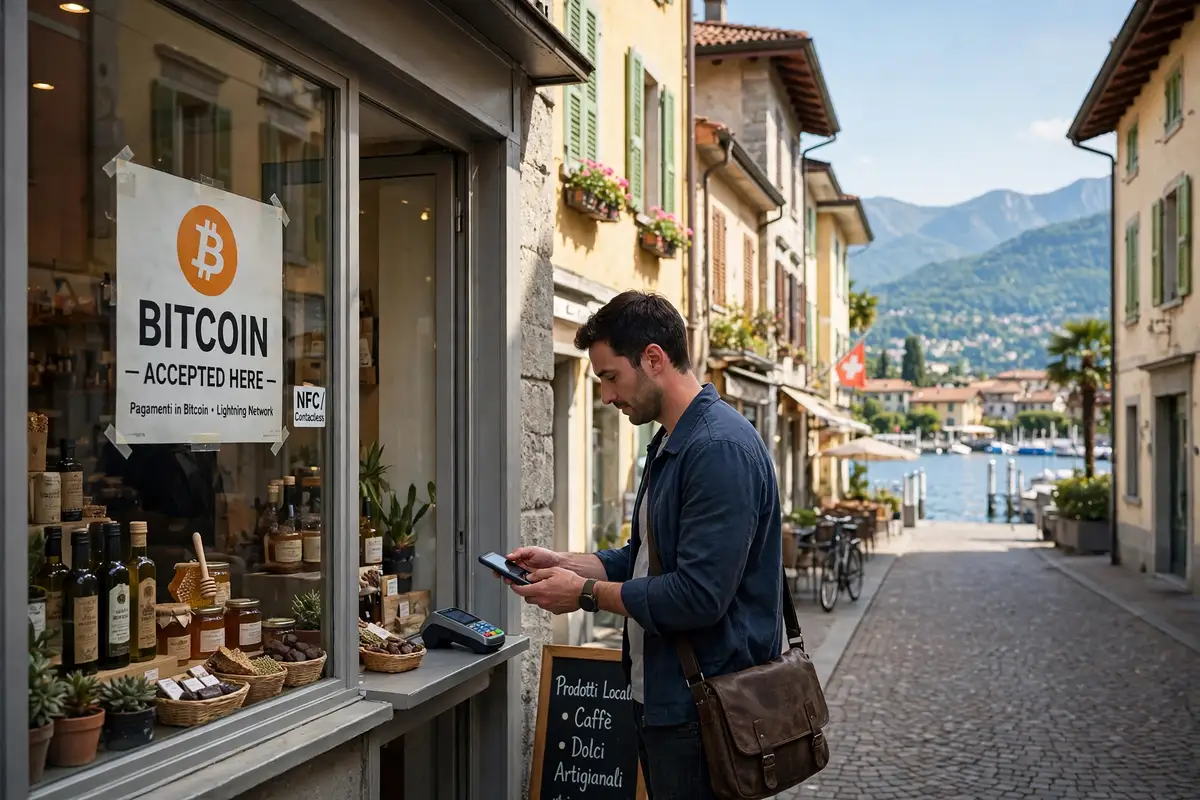
Switzerland is not just friendly on paper. In Lugano, the Plan B project launched in 2022 with Tether lets residents pay municipal bills, taxes, parking fines, and tuition in Bitcoin or USDT through QR code invoices.
More than 400 local merchants accept Bitcoin, and Lightning Network payments keep merchant fees under 1 percent, compared with about 3 percent for card networks.
North of the Alps, the Zug region known as Crypto Valley hosts hundreds of blockchain companies, including Bitcoin Suisse and Sygnum. That cluster gives Swiss buyers local support, local jobs, and local expertise that few other countries can match.
In October 2026, FINMA also approved Switzerland’s first retail spot Bitcoin ETF, the BBIT fund from BIT Asset Management, for listing on the SIX Swiss Exchange, which you can read about in our Switzerland spot Bitcoin ETF guide.
Scams to Avoid in Switzerland
Scammers target Swiss buyers precisely because the country looks wealthy and crypto friendly. FINMA maintains a public warning list of unauthorised providers, and checking it takes two minutes before you send money to any new platform.
If a company claims FINMA approval but does not appear on official lists, walk away.
Watch for three red flags above all else. Guaranteed returns do not exist in Bitcoin, and anyone promising them is lying.
Support agents who contact you first on WhatsApp or Telegram are almost always impostors, since real platforms never ask for your recovery phrase. Fake investment groups that show rising balances on a website you cannot withdraw from are a classic setup, since the balance is fictional and your deposit is already gone.
Common Mistakes Beginners Make
Most first time losses come from avoidable errors, not from market moves. Buying with a credit card for speed and paying 3 percent extra is the most common one.
Leaving a large balance on an exchange for months is another, since exchange failures have cost users billions across the industry.
Other mistakes include sending Bitcoin to the wrong network address, which can lose funds permanently, and panic selling during a normal 20 percent dip. Decide your plan before you buy, write it down, and judge it over months, not hours.
Bitcoin has dropped by half and recovered several times in its history, and nobody can time those moves reliably.
Why a Switzerland Specific Guide Matters
Bitcoin rules change at every border, so a guide written for another market can mislead you badly. Tax treatment, payment rails, ID thresholds, and licensed providers all differ by country, which is why we publish a dedicated guide for each market in our country guides hub.
Readers moving between markets can compare this guide with our Sri Lanka guide or our Netherlands guide to see how much the details shift. Switzerland also ranks among the most welcoming jurisdictions in our crypto friendly countries ranking, and buyers looking for an alternative funding route can read our gift card buying guide.
FAQs
These are the questions Swiss beginners ask most often, with short direct answers.
Is Bitcoin legal in Switzerland?
Yes. Bitcoin is legal to buy, hold, and sell in Switzerland, and FINMA supervises the banks and intermediaries that offer crypto services.
Bitcoin is not legal tender, so shops can choose whether to accept it.
What is the cheapest way to buy Bitcoin in Switzerland?
For bank funded buys, Mt Pelerin charges 0 percent on your first CHF 500, and Kraken Pro offers the lowest fees on larger orders at around 0.16 percent to 0.26 percent. Always compare the final Bitcoin amount after fees and spread, not just the headline percentage.
Can I buy Bitcoin in Switzerland without ID?
Yes, for small amounts. Non custodial services let you buy under CHF 1,000 per 30 days without full identity verification, because they never hold your funds.
Larger amounts and all custodial exchanges require government ID.
Do I pay tax when I sell Bitcoin in Switzerland?
Private investors generally pay no capital gains tax on Bitcoin profits, but you must declare your holdings each year and pay cantonal wealth tax on their December 31 value. Staking, mining, and lending rewards count as taxable income.
Can I pay my taxes with Bitcoin in Switzerland?
In Lugano, yes. The city accepts Bitcoin and USDT for municipal bills, taxes, and fines through QR code invoices under its Plan B project.
Zug and Zermatt also accept Bitcoin for some municipal payments.
Final Checklist Before You Buy
Run through this checklist before your first order. Pick a route that accepts CHF directly, confirm the total fee and the exact Bitcoin amount, and set up your own wallet before you pay.
Verify your identity early so a price move does not catch you waiting on approval, and save every receipt for your tax return.
Start small, learn how a real purchase and withdrawal feel, and scale up only when the process feels boring. Bitcoin rewards patience and careful custody far more than speed, and Switzerland gives you some of the safest tools in the world to practice both.
Your next step is simple: choose one route from the table above, set up your wallet today, and make your first small buy.