

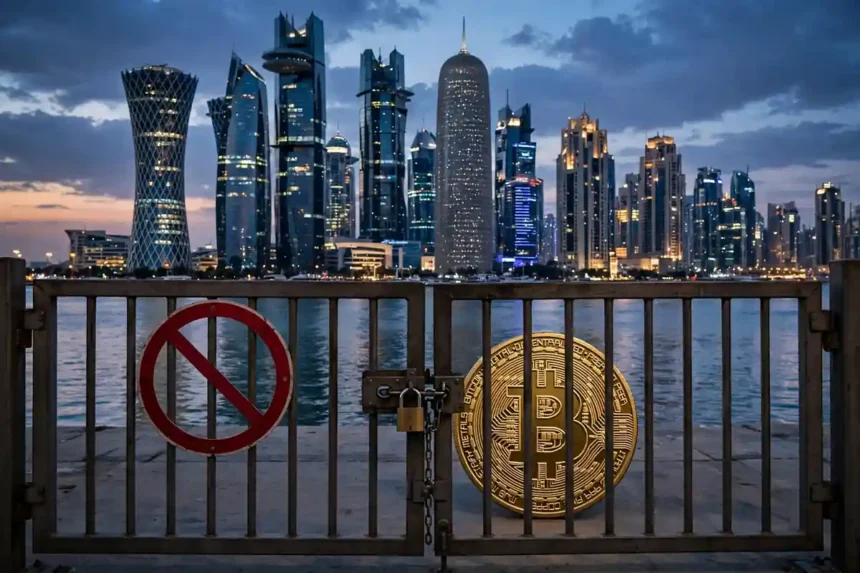
Here is the honest answer first. You cannot legally buy Bitcoin through any bank, exchange, or licensed company inside Qatar, because Qatar’s regulators banned crypto services years ago and never lifted the ban.
Many websites still tell you that buying Bitcoin in Qatar is easy. This guide checks the actual rules from the Qatar Central Bank and the Qatar Financial Centre, and it shows you what the law really says in 2026.

Key takeaways
- Qatar Central Bank Circular No. 6 of 2018 banned all banks in Qatar from dealing in Bitcoin.
- The QFC regulator banned virtual asset services in or from the Qatar Financial Centre in December 2019.
- No exchange holds a Qatari licence, and Qatari banks cannot process crypto purchases.
- The QFC Digital Assets Regulations 2024 allow tokenised real assets, but they class Bitcoin and stablecoins as Excluded Tokens.
- Any site promising an easy local buy in Qatar ignores these rules, so treat it as a warning sign.
The Short Answer: No Licensed Local Route Exists
Most country guides follow a simple pattern. They list local exchanges, local payment methods, and the steps to open an account.
- The Short Answer: No Licensed Local Route Exists
- The Three Rules That Ban Crypto in Qatar
- Rule one: the 2018 central bank circular
- Rule two: the 2019 widening
- Rule three: the 2022 public warning
- What Counts as a Banned Virtual Asset Service
- Why Other Websites Tell You Buying in Qatar Is Easy
- P2P and Offshore Offers: The Risks Nobody Warns You About
- Your bank account can freeze
- You hold no buyer protection
- Scammers target restricted countries hardest
- The Legal Door Qatar Did Open: Tokenised Real Assets
- How Qatar Compares With Nearby Countries
- What Would Have to Change Before You Can Buy Legally
- Frequently Asked Questions
- Is Bitcoin legal in Qatar?
- Can I buy Bitcoin with a Qatari bank account or card?
- Is there a licensed crypto exchange in Qatar?
- What is an Excluded Token in Qatar’s 2024 rules?
- Can I use a P2P platform or an offshore exchange from Qatar?
- What crypto related activity is legal in Qatar?
- Conclusion
Qatar breaks that pattern completely. No local exchange exists, no bank route exists, and no licence exists for any firm to sell you Bitcoin inside the country.
That makes this guide different from our other country guides. You can compare the normal route in our beginner’s guide to buying Bitcoin in Poland, where licensed exchanges accept local bank transfers and BLIK payments.
You can also browse every country in our hub of Bitcoin country guides around the world. Qatar sits in the small group of countries where the honest answer is no, not the group where the answer is a signup link.
The Three Rules That Ban Crypto in Qatar
Qatar did not ban crypto in one single law. Three separate regulators and circulars built the ban step by step between 2018 and 2019.

The table below sums up the timeline. Each row names the authority, the date, and the rule in plain words.
| Date | Authority | What the rule did |
|---|---|---|
| February 2018 | Qatar Central Bank, Circular No. 6 of 2018 | Banned banks from dealing in Bitcoin, opening accounts for it, or sending and receiving transfers to buy or sell it |
| December 2019 | Qatar Central Bank, Circular No. 46 of 2019 | Widened the central bank position from Bitcoin to all virtual assets |
| December 26, 2019 | QFC Regulatory Authority alert | Banned virtual asset services in or from the Qatar Financial Centre |
| May 2022 | Qatar Central Bank warning | Warned the public against unlicensed virtual asset platforms promoted on social media |
| September 1, 2024 | QFC Digital Assets Regulations 2024 | Opened a licensed route for tokenised real assets, while classing crypto and stablecoins as Excluded Tokens |
Rule one: the 2018 central bank circular
The Qatar Central Bank moved first. Its Supervision and Control of Financial Institutions Division sent Circular No. 6 of 2018 to every bank operating in Qatar in February 2018.
The circular called Bitcoin illegal and unsupported, and it warned about price swings and financial crime. Banks that broke the rule faced penalties under the central bank law.
Rule two: the 2019 widening
The central bank then widened the ban. Circular No. 46 of 2019 extended the position from Bitcoin alone to virtual assets in general.
Days later, on December 26, 2019, the Qatar Financial Centre Regulatory Authority issued its own alert. It stated that virtual asset services may not be conducted in or from the Qatar Financial Centre.
Rule three: the 2022 public warning
The regulators kept enforcing the position in public. In May 2022, the Qatar Central Bank warned residents against unlicensed providers after social media posts promoted a virtual asset trading platform in Qatar.
That warning matters for readers today. It shows the central bank still treats unlicensed crypto offers aimed at people in Qatar as a problem, not as a grey area.
What Counts as a Banned Virtual Asset Service
The QFC ban covers more than a simple buy button. The regulator defined virtual asset services broadly, and the definition still shapes what firms can do.
A virtual asset means anything of value that acts as a substitute for currency, that people can trade or transfer digitally, and that they can use for payment or investment. The ban then covers the services built around such assets.

Those services include exchanging virtual assets for money, exchanging one virtual asset for another, and transferring virtual assets for clients. They also include safekeeping and administration of virtual assets, which means custody wallets.
The ban also reaches firms that take part in or provide financial services for an issuer’s offer or sale of virtual assets. In plain words, an exchange, a broker, a custodian, and a token sale platform all fall inside the ban.
One honest detail deserves space here. No published Qatari rule makes simple personal ownership of Bitcoin a named criminal offence, and this guide will not pretend otherwise.
The bans bind banks, licensed firms, and service providers. Still, a resident who cannot use any bank or licensed service to buy has no practical legal route to purchase, whatever the ownership question says.
Why Other Websites Tell You Buying in Qatar Is Easy
Search results for this topic contradict each other. Aggregator pages claim that buying crypto in Qatar is generally legal and simple, and they rank offshore exchanges for Qatari users.
Those pages rarely cite the central bank circulars. They earn commissions when readers sign up, so the commercial incentive points one way and the legal sources point the other way.
None of the exchanges those pages promote holds a Qatari licence. Complaints about them go to their home regulators abroad, not to any Qatari authority, and no Qatari supervisor protects your account.
Read any such page with one test in mind. If it never mentions the 2018 circular, the 2019 QFC ban, or the Excluded Token rules, it sells you a signup instead of informing you.
P2P and Offshore Offers: The Risks Nobody Warns You About
Some readers still meet peer to peer offers or offshore platforms that accept them. This section does not recommend any such route, because no such route carries Qatari approval or protection.
It explains the risks instead, so you can judge any offer with open eyes. Risk knowledge protects people better than silence.
Your bank account can freeze
Qatari banks must not process transfers meant to buy or sell crypto. A transfer that a bank flags as crypto related can trigger questions, delays, or a frozen account while the bank checks it.
You would then argue your case with the bank, not with the platform. The platform sits abroad and owes you nothing under Qatari law.
You hold no buyer protection
A licensed market gives you a regulator, a complaints process, and rules on client money. The offshore and peer to peer route gives you none of those things.
If a seller vanishes with your riyals, or a platform blocks your withdrawal, no Qatari authority can order your money back. Your only options sit in a foreign court or a foreign regulator’s queue.
Scammers target restricted countries hardest
Restrictions create a perfect hunting ground for fraud. Scammers promise locals a special way around the ban, show fake QFC approval letters, and collect deposits through social media accounts.
The central bank’s May 2022 warning came after exactly this pattern. A platform promoted itself to people in Qatar on social media, and the regulator had to warn the public.
Learn the safety basics before you touch any wallet or offer. Our step by step walkthrough on how to get a Bitcoin wallet as a beginner explains wallet types and the mistakes that cost people money.
The Legal Door Qatar Did Open: Tokenised Real Assets
Qatar has not rejected blockchain technology itself. The country built a licensed framework for one narrow use of it, and that framework went live on September 1, 2024.
The QFC Digital Assets Regulations 2024 and the Investment Token Rules 2024 govern this framework. The Qatar Financial Centre Authority and its regulator run it, with the central bank aligned behind it.

Under Article 8 of the regulations, a token means a cryptographically secured digital unit that represents rights in real or personal property, including contract rights. The legal right behind the token matters, not the token itself.
Firms can tokenise shares, bonds, sukuk, commodities, and real estate rights as Permitted Tokens. Licensed providers can generate, custody, exchange, and transfer these tokens inside the QFC under supervision.
Bitcoin stays outside as an Excluded Token
The same regulations draw a hard line. A token counts as an Excluded Token if it represents no right in any property beyond itself, or if it substitutes for currency or works as a means of payment.
The official rulebook gives two plain examples. A cryptocurrency token that people use as an alternative to government money counts as an Excluded Token, and a stablecoin counts as one too.
Excluded Tokens cannot be generated by licensed token generators in the QFC, and no activity may take place in or from the QFC around them. The 2024 framework therefore confirms the crypto ban instead of ending it.
The digital riyal is a bank only pilot
The Qatar Central Bank also experiments with a central bank digital currency. Its digital riyal project tests settlement between banks, and the project limits the currency to that wholesale use.
Residents cannot hold or spend a digital riyal. The pilot changes nothing for a person who wants to buy Bitcoin.
How Qatar Compares With Nearby Countries
Qatar’s position looks strict even inside its own region. Some neighbours built licensing systems for exchanges, while Qatar kept a full ban on services.
Qatar is not alone in the ban group, though. Our guide on buying Bitcoin in Kuwait explains a similar warning based system next door, and our guide on buying Bitcoin in Morocco covers another long standing ban.
The pattern repeats further east too. Our guide on buying Bitcoin in Nepal walks through a ban that the central bank enforces with criminal penalties.
The lesson across all four countries stays the same. A famous ban headline never tells the whole story, so always read the regulator’s own text before you trust any exchange list.
Before you trust any Qatar crypto offer, check three things
- Ask the firm for its Qatari licence number, then verify it with the QFC or the central bank.
- Search the Qatar Central Bank site for warnings about the platform name.
- Walk away from any seller who asks for payment through social media or personal accounts.
What Would Have to Change Before You Can Buy Legally
A legal local market needs action from the regulators, not from readers. The central bank would have to withdraw or replace its circulars, or a new law would have to license crypto services onshore.
The QFC would also need to remove crypto from the Excluded Token class or build a separate licence for it. Neither step appears in any published plan as of October 2026.
Watch the official sources if you want the earliest real signal. The Qatar Central Bank publishes its circulars and warnings on its own site, and the QFC publishes its rulebook changes the same way.
Until one of those sources moves, treat every claim of a new legal route as unverified. A genuine change will appear in the circulars first and in marketing pages last.
Frequently Asked Questions
Readers ask the same core questions about Bitcoin in Qatar again and again. The answers below follow the regulator texts cited in this guide, not exchange marketing pages.
Is Bitcoin legal in Qatar?
Qatar bans crypto services rather than naming personal ownership as a crime. The Qatar Central Bank barred banks from dealing in Bitcoin in 2018, and the QFC regulator banned virtual asset services in 2019, so no legal local market exists.
Can I buy Bitcoin with a Qatari bank account or card?
No. Circular No. 6 of 2018 orders banks in Qatar not to deal in Bitcoin or move money for buying and selling it, and later circulars widened the rule to all virtual assets.
Is there a licensed crypto exchange in Qatar?
No. No exchange holds a licence from the Qatar Central Bank, the Qatar Financial Markets Authority, or the QFC regulator, and any platform serving you operates under a foreign licence only.
What is an Excluded Token in Qatar’s 2024 rules?
An Excluded Token is a token that represents no property right beyond itself or that works as a substitute for currency. The QFC rulebook names cryptocurrency tokens and stablecoins as examples, so Bitcoin sits outside the legal token framework.
Can I use a P2P platform or an offshore exchange from Qatar?
No Qatari authority approves or protects that route. You face bank account freezes, no complaints process, and high scam risk, so this guide does not recommend it.
What crypto related activity is legal in Qatar?
Licensed firms in the Qatar Financial Centre can tokenise real assets such as shares, bonds, sukuk, commodities, and real estate under the 2024 framework. The Qatar Central Bank also tests a digital riyal for settlement between banks only.
Conclusion
The question in the title has a short answer. You cannot buy Bitcoin through any legal local route in Qatar in 2026, because banks, exchanges, and QFC firms all sit under standing bans.
The 2024 digital assets framework opened one real door, and that door leads to tokenised real assets, not to Bitcoin. Anyone who tells you otherwise either missed the Excluded Token rules or wants your signup.
Keep this guide bookmarked and check the regulator sources once or twice a year. If Qatar ever licenses a local market, the circulars will say so first, and we will update this page to match them.