


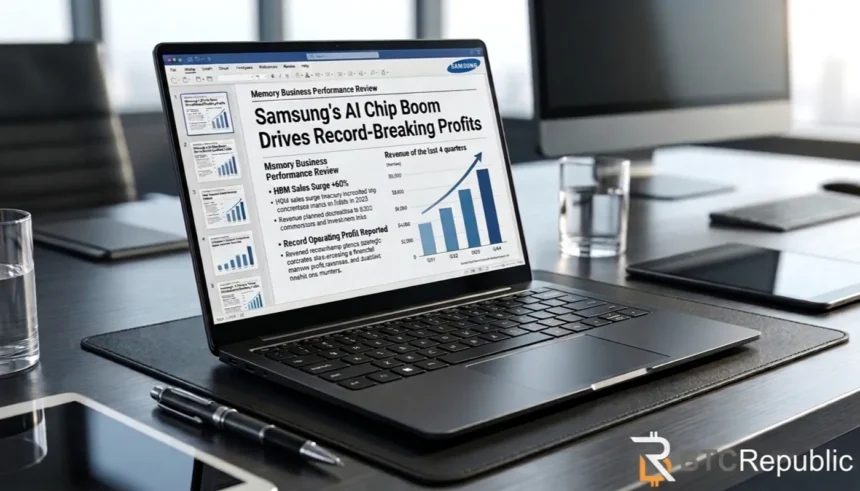
Tech giant Samsung Electronics has reported record quarterly revenue of 89.4 trillion won (around $58 billion), supported by strong demand for artificial intelligence (AI) chips.
Samsung said its operating profit for the April–June quarter exceeded analysts’ estimate of 87.3 trillion won. The figure marks a sharp increase from 4.7 trillion won reported in the same period last year.

The tech giant also expects quarterly revenue to jump 129% year over year to 171 trillion won.
However, despite the milestone, the company’s shares fell more than 10% as investors became cautious about whether the AI-driven growth can continue.
Samsung’s share price fell because investors had already expected strong earnings after the stock climbed ahead of the results.
They also pointed to growing concerns that spending on AI infrastructure, including data centres, could slow in the coming months.
Albert Yong, managing partner at Petra Capital Management, said much of Samsung’s strong performance had already been reflected in its share price.

He added that investors are becoming more cautious about whether the AI boom can continue, especially if major U.S. technology companies reduce their investments in AI infrastructure.
Samsung Earnings Get AI Memory Lift
Samsung’s earnings were supported by a strong rise in memory chip prices, even after the company booked provisions for semiconductor employee bonuses tied to a wage agreement reached in May.
BNK Investment & Securities analyst Lee Min-hee said the company outperformed expectations because of the sharp increase in memory prices.
Analysts added that operating profit could have exceeded 100 trillion won if the bonus-related expenses had been excluded.
The rally in memory prices was driven by expanding AI demand, which extended beyond high-bandwidth memory (HBM) to conventional DRAM and NAND chips.
The rapid expansion of HBM manufacturing has reduced the supply of traditional memory chips used in smartphones, PCs, and enterprise servers, helping keep prices elevated.
Despite the stronger pricing environment, Samsung’s revenue came in slightly below expectations.
Morningstar analyst Jing Jie Yu said the market had anticipated steeper DRAM price increases, and the smaller-than-expected gains weighed on investor sentiment.
Raisah Rasid, global market strategist at JPMorgan Asset Management in Singapore, believes the pace of returns for Samsung will ease, with the exceptional gains seen in the first half of the year unlikely to continue.