


Direct answer: The binance bitcoin security options expiry collision hit Bitcoin on October 30, 2026. Binance paused deposits and withdrawals during a security investigation on the same morning that about $11 billion in Bitcoin options expired on Deribit.
Bitcoin fell to a six-week low of $77,646 in the sell-off. Ether fell to a two-month low of $2,238.76 at the same time.

This was not one story. It was two market shocks landing in the same few hours, and traders read them together.
- Key takeaways
- What Binance confirmed so far
- Frozen is not the same as taken
- Why the options expiry made the fall sharper
- What price levels matter now
- The self-custody lesson competitors bury
- What to watch next
- Common mistakes to avoid today
- Frequently Asked Questions
- Is Binance still pausing withdrawals on October 30?
- How much did Binance freeze so far?
- How much was actually stolen from Binance?
- Are Binance user funds safe?
- Why did Bitcoin fall on options expiry day?
- Conclusion
Key takeaways
- Binance says about $3 billion in assets linked to the incident are now verified frozen.
- Binance puts the estimated total impact at about $6.3 billion, while outside outflow estimates differ.
- Deposits and withdrawals stayed paused on the morning of October 30 while security checks continued.
- About $11 billion in Bitcoin options expired on Deribit at 08:00 UTC on October 30.
- The expiry max pain level sat near $78,000, close to where Bitcoin traded after the fall.
- Stablecoins can be frozen by their issuers, but Bitcoin and Ether cannot, and that difference matters.
What Binance confirmed so far
Binance said its teams found a potential security issue and acted fast. The exchange paused all deposits and withdrawals as a precaution.
Binance also paused trading on Binance Alpha. It said it will cover all losses from its SAFU emergency fund and company funds.
The laptop clue in the first investigation
Binance said its initial investigation points to a compromised DevOps engineer laptop. That laptop may have let an attacker reach a service container and submit unauthorized withdrawal transactions.
Binance said it found no evidence that wallet private keys leaked. It promised a full post-mortem once investigators verify every fact.

Co-CEO Yi He repeated the core promise in plain terms. She said user funds are safe, and withdrawals will resume once systems are confirmed secure.
Frozen is not the same as taken
Many headlines blur three different numbers. Our table keeps them apart, because mixing them up misleads readers.
Read the table row by row before you repeat any single figure as the loss.
| Figure | Amount | What it means |
|---|---|---|
| Verified frozen | About $3 billion | Assets Binance and partners froze on chain so far, up from $2.54 billion |
| Binance estimated total impact | About $6.3 billion | Binance estimate of the incident size, not a confirmed final loss |
| Outside outflow estimates | About $5.7 to $5.8 billion | Tracker estimates of funds that left, which count different chains and tokens |
| Tether USDT frozen | Over $1.57 billion | USDT frozen by Tether at issuer level |
| Circle USDC frozen | Over $800 million | USDC frozen by Circle in coordination with law enforcement |
| Other issuer freezes | Over $200 million plus $27 million | Ripple froze about $200 million, and World Liberty confirmed about $27 million in USD1 frozen |
The frozen total can rise as partners trace more wallets. The final loss will only be clear after Binance publishes its post-mortem.
One detail shows why the freeze worked so fast for some coins. Arbitrum Security Council moved 74.56 million Arbitrum tokens from the hacker wallet into a frozen wallet.
Why the options expiry made the fall sharper
About 135,000 Bitcoin in options contracts settled on Deribit on October 30. That notional value sits near $11 billion, or about one third of Deribit open interest.
Calls outnumbered puts by a wide margin. Open interest showed about 89,540 calls against 47,120 puts, a put to call ratio near 0.53.
Gamma sat right where the price landed
About 70 percent of gamma in the expiring options sat between $75,000 and $82,000. Dealers hedge inside that band, so moves through it can feed on themselves.
The largest call strikes sat at $90,000, $95,000 and $100,000. Those calls looked set to expire worthless while Bitcoin traded near $78,000.
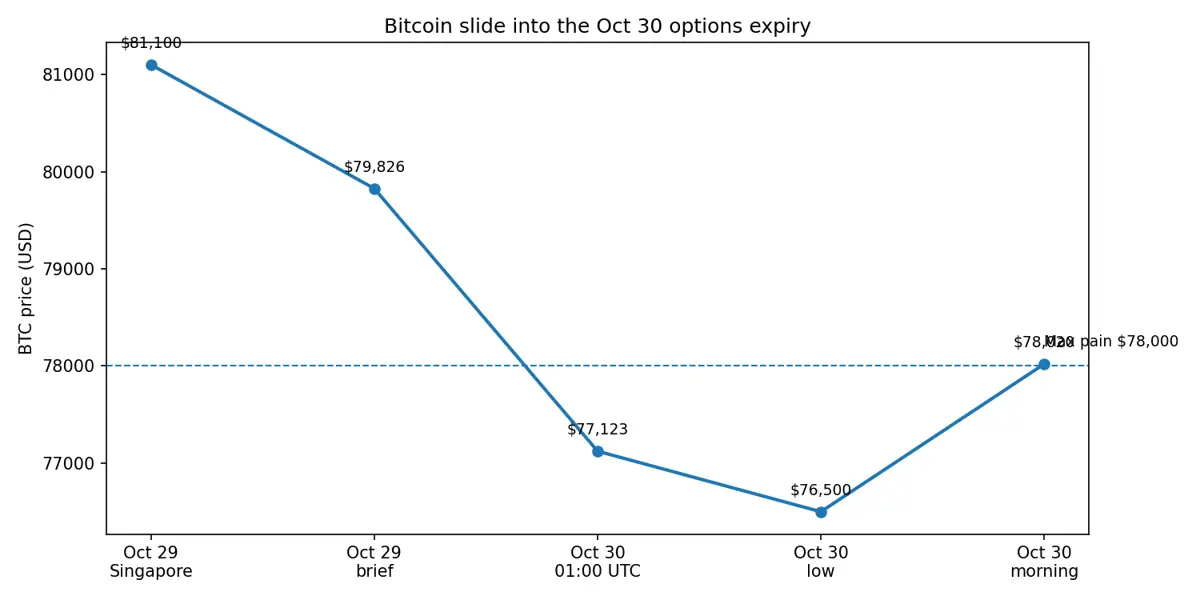
Max pain sat near $78,000, with analyst ranges from $76,000 to $79,000. Bitcoin trading back toward $78,000 after the low fits that picture, but it does not prove the expiry caused the whole fall.
What price levels matter now
Traders now watch a short list of levels, not a prediction. The short-term holder cost basis near $76,500 is the first line that must hold.
Below it sits the 200-day simple moving average near $73,059. A break of both levels would shift the market mood fast.
Above, $79,500 acted as support through several pullbacks this week. Santiment analysts flagged a move back toward $82,500 to $84,000 if Bitcoin holds above $80,000.
Bitcoin traded near $78,020 in morning data on October 30, after a session low near $76,500. That bounce says little on its own, because expiry hedging can distort one morning badly.
Our own chart below tracks the slide from the October 29 Singapore session into the expiry morning. It uses reported prices only, and it shows the $78,000 max pain line for context.
Readers who want the wider market picture can start with our Bitcoin Fed hold and exchange outflows analysis. It explains how supply moves shaped the bounce near $81,000 before this week turned.
The self-custody lesson competitors bury
Here is the lesson most fast news posts skip. Issuers can freeze USDT and USDC, because a company controls those tokens.
No issuer can freeze Bitcoin or Ether in the same way. That is why about 195,000 stolen Ether moved on while stablecoin freezes piled up.
Self-custody does not mean you must trade alone. It means you hold your own keys for coins you plan to keep long term.
Our guide to using Sparrow Wallet for free Bitcoin self-custody walks through the setup step by step. Our hot wallet versus cold wallet explainer helps you pick the right storage mix.
Peer to peer routes also cut exchange risk for some buyers. Our RoboSats beginner guide and our Bisq no-KYC steps guide cover two routes that work without a central exchange account.
None of this fixes Binance for its users today. It only changes where your next coins sit, and that choice is yours to make calmly.
What to watch next
Watch three signals in order. First, watch for Binance to confirm that withdrawals have resumed.
Second, watch the next proof of reserves snapshot, due November 1. It will show whether Binance filled any gap in its reserves.
Third, watch open interest after the expiry. Option sellers may wait until after the November 3 United States midterm elections to write fresh contracts.
That wait could keep volatility high even after the expiry passes. A Bloomberg survey put the median year-end Bitcoin forecast at $90,800 if Republicans hold both chambers, $76,450 if Democrats hold both, and $84,100 if control splits.
Those survey numbers are opinions, not targets. Treat them as a mood gauge for election week, not as a promise.
For context on long term targets, see our Bitcoin price prediction for 2026. It separates scenario bands from single-number hype.
Common mistakes to avoid today
Do not panic sell into a paused withdrawal window you cannot use anyway. Selling on another venue at a distressed price locks in a loss that a calmer market may reverse.
Do not trust screenshots that claim a new Binance refund link. Binance said it will share verified updates through its own channels, and fake links spread fast after hacks.
Do not quote the $3 billion frozen figure as the amount stolen. Frozen funds are recovered or blocked funds, and the stolen total is still under investigation.
Do not assume the options expiry alone explains the fall. The security scare, the expiry, and thin pre-election liquidity all pushed in the same direction.
Frequently Asked Questions
These answers use only the verified figures in this article. They will change as Binance publishes new updates.
Is Binance still pausing withdrawals on October 30?
Yes, based on the latest Binance updates on the morning of October 30. Deposits and withdrawals stayed paused while security checks continued.
How much did Binance freeze so far?
Binance says the verified frozen total is about $3 billion. That figure rose from $2.54 billion in an earlier update.
How much was actually stolen from Binance?
Binance has not confirmed a final stolen amount. It estimates total impact at about $6.3 billion, while outside trackers estimate outflows near $5.7 to $5.8 billion.
Are Binance user funds safe?
Binance says user funds are safe and it will cover all losses from SAFU and company funds. Users should still wait for the official post-mortem before they treat that promise as settled fact.
Why did Bitcoin fall on options expiry day?
Bitcoin fell because a security scare hit on the same day as an $11 billion options expiry. Dealer hedging between $75,000 and $82,000 likely added pressure, but no single factor explains the whole move.
Conclusion
October 30 gave traders a rare collision, not a simple hack story. A security scare froze billions, paused withdrawals, and landed hours before $11 billion in options expired.
The smart move now is boring and useful. Wait for verified Binance updates, watch the $76,500 and $78,000 levels, and move long term coins to keys you control.
Markets will argue about the final loss figure for days. Your job is simpler: protect your coins, ignore fake refund links, and let the verified facts catch up.