

Yes, you can buy Bitcoin in South Korea as a resident. You need a Korean ID or Alien Registration Card, a Korean phone number, and a real-name bank account at the exchange’s partner bank.
Bitcoin traded near $81,600 on October 23, 2026, and you buy a small fraction of a coin. A modest amount of won starts your first buy, but Korea’s rules differ sharply from most countries, so read the local detail before you send a single won.

- South Korea only lets you buy Bitcoin through 5 licensed exchanges, each tied to one partner bank for real-name deposits.
- Your name must match exactly on your ID, bank account, and exchange account, or the system rejects you automatically.
- Expect a 72-hour crypto withdrawal lock after your first won deposit, and watch the kimchi premium before you buy.
- The 22% crypto gains tax is still scheduled for January 1, 2027, after three delays, but a fresh push to delay it to 2029 is undecided.
Is Bitcoin Legal in South Korea?
Owning and trading Bitcoin is legal in South Korea. The country treats crypto as a regulated financial activity, not as money, and no shop has to accept it as payment.
- Is Bitcoin Legal in South Korea?
- The 5 Licensed Exchanges and Their Partner Banks
- How to Buy Bitcoin in South Korea, Step by Step
- Step 1: Open an account at the partner bank
- Step 2: Register on the exchange and verify
- Step 3: Link the bank account and finish security
- Step 4: Deposit won from your own account
- Step 5: Buy on the market screen with a limit order
- Step 6: Move larger amounts to your own wallet
- What Your First Buy Really Costs
- The 72-Hour Lock and the Kimchi Premium
- Tax: The October 2026 Reality Check
- Scams That Target Korean Buyers
- Mistakes First-Time Buyers Make
- Frequently Asked Questions
- Is Bitcoin legal in South Korea in 2026?
- Can foreigners buy Bitcoin in South Korea?
- Which exchange is best for beginners in South Korea?
- How much does it cost to buy Bitcoin in South Korea?
- Do I pay tax on Bitcoin in South Korea?
- Can I use Binance or Coinbase in South Korea?
- Conclusion: Verify One Account Today
The rules come from two bodies: the Financial Services Commission and the Financial Intelligence Unit. They supervise every licensed exchange, and their system creates a walled garden that works well for residents and keeps outsiders out.
The real-name bank rule
Korea’s core rule is simple and strict. You can only deposit Korean won into an exchange through a real-name account at that exchange’s partner bank.
The names on your ID, your bank account, and your exchange account must match exactly. Even a small mismatch, like a space or a different name order, gets your application rejected automatically.
This closed loop stops money laundering, but it also blocks arbitrage. Korean residents cannot freely move won abroad, so Korean Bitcoin prices often drift away from global prices.

The Virtual Asset User Protection Act
Korea’s user protection law is in full force in 2026. It forces exchanges to keep your assets separate from company funds and to carry insurance against hacks.
A broader law, the Digital Asset Basic Act, is in its final consultation stage as of October 2026. It would set licensing rules for exchanges and stablecoin issuers in one framework, but the basic protections already apply today.
The 5 Licensed Exchanges and Their Partner Banks
Only five exchanges hold verified bank partnerships that allow won deposits in 2026. Every other venue that claims to serve Korean residents is either offshore or operating without the required real-name agreement.
The table below lists all five with their partner banks and published KRW trading fees. We built it from the exchanges’ own fee pages and current reporting, and you won’t find this exact comparison in one place elsewhere.
| Exchange | Partner bank | KRW trading fee | KRW withdrawal fee |
|---|---|---|---|
| Upbit | K-Bank | 0.05% | ~1,000 won |
| Bithumb | KB Kookmin Bank | 0.04% | ~1,000 won |
| Coinone | KakaoBank | 0.02% | ~1,000 won |
| Korbit | Shinhan Bank | 0.04% | ~1,000 won |
| Gopax | Jeonbuk Bank | Varies | ~1,000 won |
Upbit dominates with roughly 70 to 80 percent of domestic volume. Upbit and Bithumb together capture about 96 percent of all Korean crypto trading.
Check the fee page before you trade, because exchanges run promos. Bithumb has run zero-fee promotions in 2026, and rates can change without the old guides updating.
How to Buy Bitcoin in South Korea, Step by Step
The order below protects beginners from the two most common Korean failures: a name mismatch and the first-deposit lock. Follow it exactly and your first buy stays boring, which is what you want.
These steps use Upbit and K-Bank as the example, because most readers will start there. The same workflow applies to Bithumb, Coinone, and Korbit with their own partner banks.
Step 1: Open an account at the partner bank
Open a real-name account at K-Bank first if you plan to use Upbit. The exchange rejects deposits from any other bank, so this step comes before the app.
You verify in the bank’s app with your Korean ID or Alien Registration Card and your Korean phone number. The bank checks your identity against the resident register.
Step 2: Register on the exchange and verify
Install the official Upbit app from the Google Play Store or Apple App Store. Never use a third-party APK, because fake exchange apps are a real theft vector in Korea.
Enter your name exactly as it appears on your ID, plus your date of birth and phone number. The system cross-checks the phone subscriber name, so the phone contract must be in your name too.
Step 3: Link the bank account and finish security
Select K-Bank inside the Upbit app and authorize the real-name linkage. Upload your ID if the app asks, then enable two-factor authentication before you deposit anything.
An authenticator app beats SMS codes for this step. Set a withdrawal password too, because Korean exchanges require one for every payout.
Step 4: Deposit won from your own account
Send won from your K-Bank account to your Upbit deposit account. The transfer is free and arrives in seconds, and it must come from your own account, never a friend’s or relative’s.
Your first deposit triggers the 72-hour crypto withdrawal lock described below. Plan for it, because it surprises almost every beginner.
Step 5: Buy on the market screen with a limit order
Open the BTC/KRW market screen and place a limit order at the highest price you will pay. The big simple-buy button hides its cost inside a worse price, so the market screen keeps your fee visible.
Compare the Korean quote with the global price before you confirm. The kimchi premium section below explains why the numbers often differ.
Step 6: Move larger amounts to your own wallet
Once the 72-hour lock expires, register a destination address that passes Upbit’s Travel Rule check. Send a small test amount first, then the rest.
For amounts that would hurt to lose, learn how to store coins yourself. Our beginner wallet guide compares the safest options before you withdraw.
What Your First Buy Really Costs
Korean trading fees look tiny, and they are, but beginners still lose money on three hidden costs: the spread, the withdrawal fee, and the kimchi premium. The table below shows a realistic first buy of 100,000 won on Upbit.
| Cost item | Amount on 100,000 won | Notes |
|---|---|---|
| KRW deposit | 0 won | Free from the partner bank |
| Trading fee (0.05%) | 50 won | Charged on the market screen |
| KRW withdrawal | ~1,000 won | Only when you cash out to the bank |
| Kimchi premium | Varies | Often 2 to 7% above the global price in 2026 |
The premium dwarfs the fee, which is why the quote check matters more than fee shopping. A 3% premium on 100,000 won costs you 3,000 won, sixty times the trading fee.
Buying through an offshore exchange to dodge the premium is not a loophole. Korean residents cannot deposit won into unlicensed venues, and moving funds out for arbitrage runs into capital controls.
The 72-Hour Lock and the Kimchi Premium
Two Korean quirks shape every first buy, and both catch beginners off guard. Understand them before you deposit and neither will cost you money.
The 72-hour withdrawal lock
Korean exchanges lock crypto withdrawals for 72 hours after your first won deposit. This is an anti-fraud rule, not a bug, and support will not lift it early.
Plan around it: deposit, buy, and wait. Don’t promise anyone a same-day transfer of your new coins, and don’t start a withdrawal and panic when it sits pending.
The kimchi premium
The kimchi premium is the percentage by which Korean Bitcoin prices exceed the global average. It exists because strong domestic demand meets capital controls that stop arbitrageurs from closing the gap.
The premium averaged 4 to 5 percent historically and spiked above 50 percent during the 2018 boom. In mid-2026 it typically ran between 2 and 7 percent, widening during rallies.
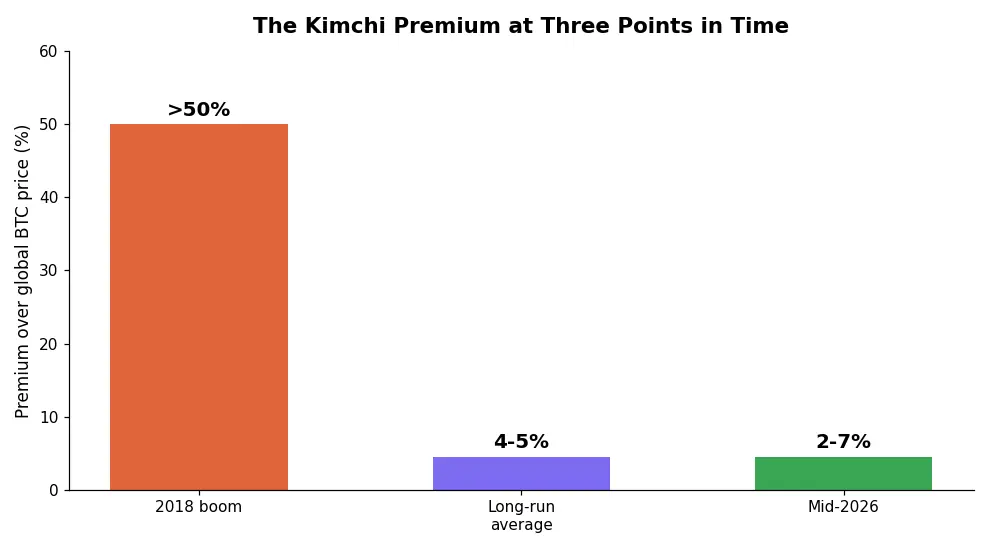
Practically, this means you usually pay more per Bitcoin in Korea than a buyer in the US does. Check a global price tracker before every buy so you know the premium you are paying.
Tax: The October 2026 Reality Check
Here is the part most guides get wrong, because the story changed this month. South Korea plans a 20% national tax plus a 2% local surtax on crypto gains, a combined 22%, on annual gains above 2.5 million won (about $1,700).
The tax has already been delayed three times, and it is currently scheduled to start on January 1, 2027. On October 20, 2026, finance officials met the major exchanges, and the industry argued its reporting systems are still not ready.
A lawmaker proposal would tie the start date to cross-border data sharing under the OECD framework and could push the tax to 2029. That proposal is not law, and no new delay has been enacted, so January 2027 remains the official date.
Our honest advice: keep full records from your first trade, no matter what happens. Log every deposit, trade, and transfer with dates and won amounts, because the 2027 return will need cost-basis math even if the start date slips again.
Scams That Target Korean Buyers
Korea’s closed system breeds its own scams. The most common is the fake exchange app, which copies Upbit or Bithumb’s logo and steals your login the moment you sign in.
Download apps only from the official app stores, and check the developer name. A second common scam is the “kimchi premium arbitrage” pitch, where a stranger promises risk-free profit moving coins across borders for you.
That pitch is either a lie or a request to break capital controls. Either way, your money is gone, because real arbitrage needs licensed accounts on both sides, which a stranger’s scheme never has.
Mistakes First-Time Buyers Make
Most first losses in Korea have nothing to do with the Bitcoin price. They come from rushing the verification, ignoring the lock, or trusting the wrong venue.
Opening the exchange account before the partner bank account wastes a week. Depositing from someone else’s account freezes the funds for review.
Skipping the small test buy turns a typo into a disaster. If your home country blocks bank transfers to crypto entirely, our Qatar guide walks through the honest workarounds.
And leaving everything on the exchange long term repeats the oldest crypto mistake. The platform holds your keys while your coins sit there, so move serious amounts to a wallet you control.
If you want to compare how other countries handle the same steps, our 2026 country-guides hub lines up 11 more guides. Readers moving between markets also like the Japan guide, since Japan runs a similarly strict licensed-exchange system.
Frequently Asked Questions
Quick answers to the questions Korean buyers ask us most. The full detail sits in the sections above.
Is Bitcoin legal in South Korea in 2026?
Yes. Owning and trading Bitcoin is legal, and five licensed exchanges operate under Financial Services Commission and Financial Intelligence Unit supervision.
Bitcoin is not legal tender, and shops don’t have to accept it.
Can foreigners buy Bitcoin in South Korea?
Yes, if you hold an Alien Registration Card and a Korean phone number in your own name. You must open a real-name account at the exchange’s partner bank, and your name must match exactly across your ID, bank, and exchange accounts.
Which exchange is best for beginners in South Korea?
Upbit suits most beginners because it holds the deepest liquidity and the widest selection of listed coins, with a 0.05% KRW trading fee. Bithumb is the main alternative, with a 0.04% fee and a beginner mode added in 2026.
How much does it cost to buy Bitcoin in South Korea?
KRW deposits are free, trading fees run 0.02% to 0.05%, and KRW withdrawals cost about 1,000 won. The bigger cost is usually the kimchi premium of 2 to 7% above the global price in 2026, so check the quote before you buy.
Do I pay tax on Bitcoin in South Korea?
A 22% combined tax on gains above 2.5 million won per year is scheduled to start on January 1, 2027, after three delays. A proposal to delay it to 2029 is undecided, so keep full records of every trade from day one.
Can I use Binance or Coinbase in South Korea?
Not for won deposits. Only the five licensed exchanges with real-name bank partnerships can legally accept KRW, and Korean residents cannot fund offshore platforms with won.
Using unlicensed venues breaks the rules and risks frozen funds.
Conclusion: Verify One Account Today
Buying Bitcoin in South Korea rewards patience and punishes shortcuts. The real-name system, the 72-hour lock, and the kimchi premium are the whole game, and now you know all three.
Your next step is simple: open the partner bank account today, verify the exchange tomorrow, and make one small test buy this week. If your plans span borders, the Romania guide shows how an EU MiCA-licensed route compares, and the Saudi Arabia guide covers another strict-regime market.