



Talk of a US government bitcoin sale spread fast on October 7, and the reason was simple. Wallets linked to US authorities moved 833.599 BTC, worth about $71.56 million, to Coinbase Prime deposit addresses. In the same nine-hour window, 40,285 BNB worth about $31.63 million moved through several other wallets.
Together, the moves added up to about $103.19 million. That is a big headline number. But a transfer is not a sale, and no US agency has confirmed that any of these coins were sold.

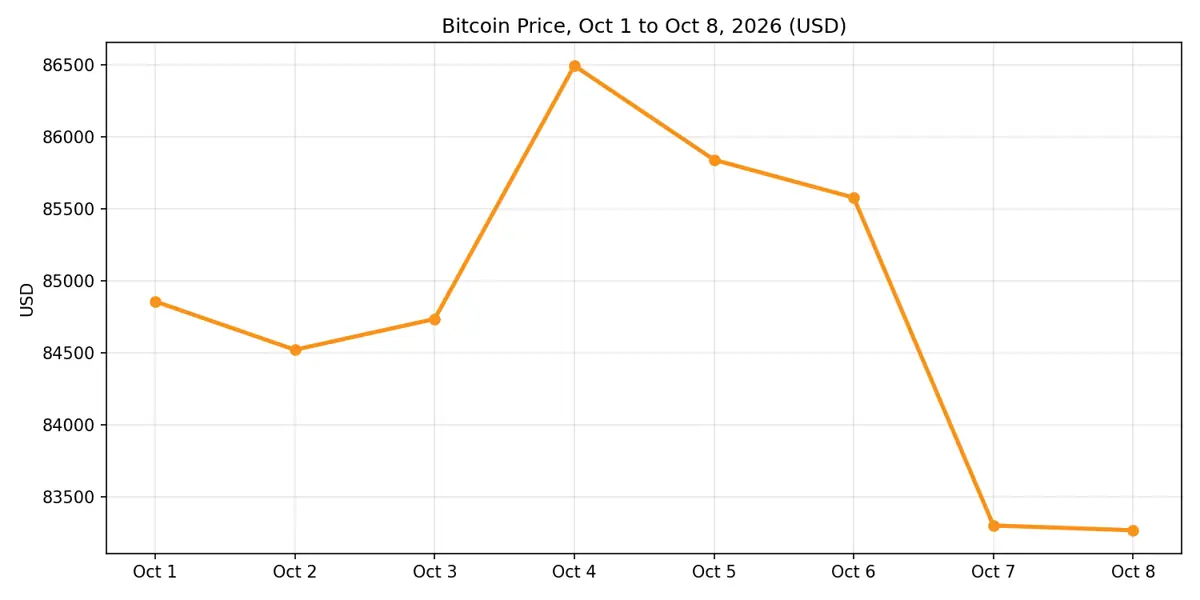
Bitcoin was trading near $83,300 when the news spread on October 8. It had slipped below $85,000, and traders were already nervous. So the timing made the wallet alert feel bigger than the transfer itself.
Key takeaways
- US government wallets moved about $103.19 million in seized crypto on October 7.
- The Bitcoin leg was 833.599 BTC, worth about $71.56 million, and it reached Coinbase Prime.
- The BNB leg was 40,285 BNB, worth about $31.63 million, and it ended at an unlabeled wallet ending in 81E.
- No sale has been confirmed, and Coinbase Prime is also a custody platform used by the US Marshals Service.
- Government wallets still held about $28 billion in crypto, including roughly 324,000 BTC, after the moves.
What exactly moved on October 7?
On-chain trackers including Lookonchain, EmberCN, Arkham, and Onchain Lens flagged the activity as it happened. The Bitcoin did not move in one clean step. It first passed through two unlabeled addresses, then landed at addresses that Arkham labels as Coinbase Prime deposits.
The BNB took a different path. It moved to an unlabeled wallet, moved again, and ended at a wallet ending in 81E. It did not go straight to a labeled Coinbase Prime deposit address.
Where the Bitcoin came from
Trackers linked the 833.599 BTC to two forfeiture cases. About 568.7 BTC came from the case involving Sergei Potapenko and Ivan Turogin. About 264.9 BTC was linked to the 2016 Bitfinex hack case.
Those details matter. This was not one random wallet waking up. It was seized and forfeited crypto, the kind of crypto the government has handled through official channels for years.

Where the BNB came from
The BNB was tied to funds seized from FTX and Alameda Research. That origin helps explain the separate route. Different cases and different assets do not always move through the same custody path.
It also means traders should not lump the two transfers together. The Bitcoin reached a known institutional platform. The BNB ended at an unlabeled address, which tells us much less.

Does a Coinbase Prime deposit mean a sale?
No, not by itself. Coinbase Prime is an institutional platform for custody and trading. The US Marshals Service uses it for digital assets, so a deposit there fits custody work just as well as it fits a possible trade.
That distinction gets lost on social media. A wallet alert is public and instant. The reason behind the move is not. Until an agency says a sale happened, or on-chain data shows a clear sale pattern, the honest answer is that nobody outside the government knows the purpose yet.
This is not the first time this pattern has caused a stir. Our earlier report on the US government transfer of $288M in Bitcoin to Coinbase Prime covered the same mix of real movement and unproven sale fears.
Why custody is a strong explanation here
Agencies move seized assets for boring reasons too. They consolidate wallets. They change custodians. They prepare assets for a court process or move them into safer storage.
None of that makes headlines. But boring explanations are common in custody work, and the size here was small next to the total stash. The 833.6 BTC moved was well under 1 percent of the roughly 324,000 BTC still held in government-linked wallets.
The Strategic Bitcoin Reserve changes the sale question
In March 2025, an executive order created the Strategic Bitcoin Reserve. The order says Bitcoin deposited into that reserve shall not be sold. It also directed forfeited Bitcoin toward the reserve instead of routine liquidation.
That policy is why a quick sale would be a surprise. It would go against the stated plan for reserve Bitcoin. The debate around that plan has been building for a while, including the push described in the proposal to treat Bitcoin as a strategic reserve asset.
Bitcoin and other coins sit in different buckets
The same March 2025 order created a separate Digital Asset Stockpile for other forfeited digital assets. The Treasury secretary decides how to handle that stockpile. So BNB and similar assets have more flexible handling than reserve Bitcoin.
In plain words, the rules treat Bitcoin as the asset to hold. Other seized coins get more case-by-case treatment. That split may explain why the BTC and BNB moved in different ways on the same day.
What would count as real proof of a sale?
Proof would be an official statement, a Marshals Service auction notice, or a clear on-chain pattern that matches past sales. A single deposit to Coinbase Prime is not enough.
Traders who acted on past wallet alerts learned this the hard way. Price often dips on the alert, then recovers when no sale follows. Anyone watching the Bitcoin price prediction for October 2026 knows the $82,000 to $83,000 support area matters far more right now than one custody move.
How the market reacted
The market mostly shrugged. Bitcoin held near $83,300 to $84,000 after the transfers, inside a weak week where price fell from above $86,000 on October 4. ETF flows were choppy too, with about $168.6 million of outflows on October 7 after inflows the day before.
That backdrop matters more than the wallet move. Selling pressure this week came from broader risk-off trading, a firm dollar, and shaky ETF demand. Our longer view in Bitcoin price predictions for 2026 shows how macro and ETF flows keep driving the bigger trend.
Sent to Coinbase Prime, worth about $71.56M
Moved multi-hop, worth about $31.63M
Still held in government-linked wallets
The chart below shows Bitcoin through this period. Price was already sliding before the transfer news peaked, which is a useful check against blaming the government wallets for the whole drop.
Common mistakes traders make with wallet alerts
The first mistake is treating every exchange deposit as a sale. Custody platforms take deposits for many reasons. The second mistake is ignoring size. A $71.56 million Bitcoin move sounds huge, but it is a small slice of a roughly $27.7 billion Bitcoin stash.
The third mistake is panic selling into thin, nervous markets. That is how small alerts turn into real losses for the people who react fastest. A calmer read of how low Bitcoin can go in a bear market helps put a one-day wallet alert in context.
A simple checklist before you react
Ask three questions. Has any agency confirmed a sale? Did the coins move on from the deposit address in a sale pattern? And is price actually breaking key support, or just wobbling near it?
If the answers are no, no, and wobbling, then the alert is information, not a signal. Coinbase itself is a regulated public company, and its institutional role keeps growing, as seen when Coinbase secured a UK license for derivatives and equities.
What to watch next
Watch the Coinbase Prime wallets for follow-up moves. A second transfer out, in a pattern tied to trading, would change the picture. Silence for days would support the custody explanation.
Also watch for any statement from the Treasury or the Department of Justice. Past government sales were usually documented. A quiet custody move, by contrast, rarely gets a press release.
Finally, watch price, not just wallets. If Bitcoin holds $82,000 to $83,000 and ETF outflows cool, this story fades fast. If support breaks on heavy volume, the cause will more likely be macro pressure than 833 BTC.
Frequently Asked Questions
Did the US government sell its Bitcoin on October 7?
No sale has been confirmed. On-chain trackers showed 833.599 BTC reaching Coinbase Prime deposit addresses, but Coinbase Prime also provides custody for the US Marshals Service, so a deposit alone does not prove a sale.
How much crypto did US government wallets move in total?
About $103.19 million in total. That was $71.56 million in Bitcoin and $31.63 million in BNB, according to on-chain trackers who flagged the moves on October 7.
Can the US government sell Bitcoin from the Strategic Bitcoin Reserve?
The March 2025 executive order says Bitcoin deposited into the Strategic Bitcoin Reserve shall not be sold. That rule covers reserve Bitcoin, while other forfeited digital assets sit in a separate stockpile with different handling.
Why did the BNB take a different route from the Bitcoin?
The BNB came from seized FTX and Alameda funds and moved through several unlabeled wallets to an address ending in 81E. It did not go directly to a labeled Coinbase Prime deposit address like the Bitcoin did.
What should Bitcoin traders watch next?
Watch for any official statement from the Treasury or the Department of Justice, any further moves from the Coinbase Prime wallets, and whether Bitcoin holds the $82,000 to $83,000 support area.
Conclusion
The October 7 transfers were real, and the numbers check out: about $103.19 million moved, with the Bitcoin leg landing at Coinbase Prime. What is not proven is a sale. The reserve policy against selling Bitcoin, the custody role of Coinbase Prime, and the small size next to the total government stash all point to caution.
Your next step is simple. Do not trade on the alert alone. Wait for confirmation, watch the $82,000 to $83,000 support zone, and treat any official statement as the real signal if one comes.