



Can Bitcoin really reach $200,000? The short answer is yes, it is possible, but analysts are deeply split on when, or whether it happens this cycle at all. Some of the biggest names in finance say $200K could arrive as early as 2026. Others push the milestone out to 2029. And a loud camp of bears warns that Bitcoin must first survive much lower prices before any new high is on the table.
Bitcoin trades near $86,000 on October 2, 2026. Reaching $200,000 would require a gain of roughly 132% from here. That sounds enormous, until you remember Bitcoin has posted rallies like that several times before. The real question is not whether the math is possible. It is whether the catalysts exist. Below is an honest, data-driven breakdown of who says what, the reasoning behind each view, and the bull, base, and bear cases for the biggest price target in crypto.

Key Takeaways
- The bulls: Bernstein, Bitwise, and Fundstrat’s Tom Lee all see $200,000 as a real target. Veteran trader Peter Brandt sees it in Q3 2029.
- The middle: Most big banks sit between $113,000 and $170,000, with $150,000 the most common call.
- The bears: On-chain analysts model bottoms near $38,000 to $45,000, and one advisor puts 60% odds on the bull cycle being over.
- The market’s own verdict: Prediction markets price only about a 5% chance of $200K by the end of 2026.
Where Bitcoin Stands Today
Bitcoin opened October 2026 trading near $85,000 and is holding above $86,000 as of October 2. The recovery is real: the coin bottomed near $60,000 in February 2026, bounced, and has been grinding higher for six months. But it remains well below its all-time high of $126,000 set in October 2025. In percentage terms, Bitcoin is still down about 32% from its peak.
- Where Bitcoin Stands Today
- The $200K Bulls: Who Is Calling for It
- The Middle Ground: $100K to $170K Comes First
- The Bear Case: Why $200K Might Not Happen Soon
- Bull vs. Base vs. Bear: The Three Scenarios
- Common Mistakes When Reading Price Predictions
- FAQs
- Will Bitcoin reach $200K in 2026?
- What is the highest Bitcoin price prediction right now?
- What do the bears say Bitcoin could fall to?
- Has Bitcoin ever gained 130% in a year before?
- Should I buy Bitcoin because analysts predict $200K?
- The Bottom Line
Flows are improving. U.S. spot Bitcoin ETFs posted $102.7 million in net inflows on October 1, led by BlackRock’s IBIT, and Bitcoin’s recent move back above $85,000 came alongside softer inflation data. Still, our October 2026 forecast flags $84,800 as the level that decides whether BTC pushes toward $90,000 or slips back toward $74,000. Against that backdrop, the $200K debate is really a debate about what comes after the recovery.
The $200K Bulls: Who Is Calling for It
A surprising number of serious firms have $200,000, or more, on their books. These are not anonymous social media accounts. They are research desks with real models.
Bernstein and Bitwise
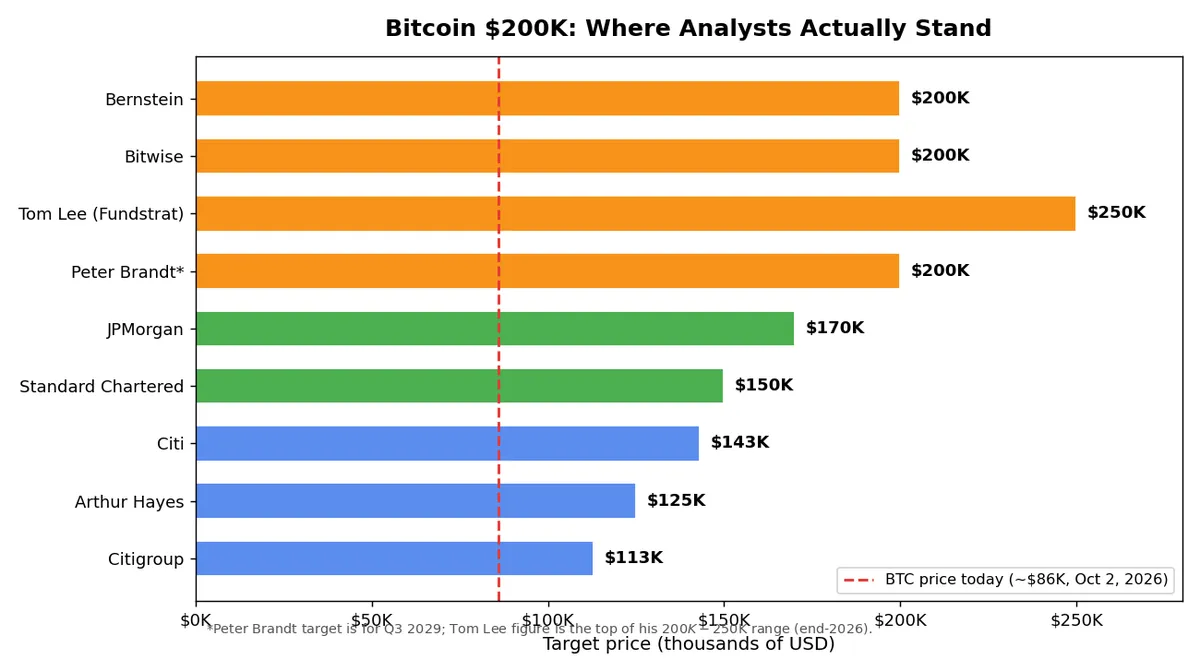
Bernstein holds a $200,000 target, built on what it calls a tokenization supercycle thesis. Bitwise has been equally firm. Its head of research has reiterated that Bitcoin will hit $200,000 in 2026, arguing that institutional inflows arrive “in waves” from wealth managers, endowments, pensions, corporations, and governments, creating a structural imbalance of demand versus supply. With post-halving annual mining output capped near 164,250 BTC, Bitwise’s logic is simple: steadily rising demand against fixed supply.
Tom Lee and Peter Brandt
Tom Lee of Fundstrat has repeatedly pointed to $200,000 to $250,000 by the end of 2026, arguing that expanding institutional allocation and easier access through ETFs can reshape how Bitcoin cycles behave. Peter Brandt, the veteran trader, takes the longer view: he sees $200,000 arriving in Q3 2029 as part of the next bull market, while warning that this cycle could still test much lower levels first.

Watch both arguments in their own words. Jason Yanowitz of Blockworks laid out a $200K case for the next 18 months, while Tom Lee detailed his $150K to $250K range for the end of 2026:
What the Prediction Markets Say
Here is where the story gets interesting. While banks publish six-figure targets, real money on prediction markets prices Bitcoin reaching $200,000 by December 31, 2026 at only about 4.9%, a figure that has barely moved despite the steady stream of bullish bank forecasts. The gap is the honest signal: Wall Street research desks are loud about $200K, but traders putting up their own capital are deeply skeptical it happens this year. Believing the target and believing the timeline are two very different things.
The Middle Ground: $100K to $170K Comes First
Most major banks sit below $200K, and their targets cluster in a clear band. Standard Chartered holds $150,000 for 2026. JPMorgan’s optimistic ceiling is $170,000 if capital allocation to Bitcoin starts resembling gold’s portfolio role. Citi sits near $143,000, contingent on about $15 billion in ETF inflows. Arthur Hayes expects $125,000 by December on improving global liquidity, and Citigroup recently raised its 12-month target to $113,000.
The pattern is hard to miss: almost every forecaster agrees Bitcoin must first reclaim $100,000 and hold it before $200K enters the conversation. A year-end roundup of bank and expert forecasts puts the center of gravity between $150,000 and $250,000. The chart below puts every major published target on one scale, against today’s price:
Compare this spread with our 2026 price prediction roundup, which maps five year-end scenarios from a $74,000 floor to a $150,000 dream case.
The Bear Case: Why $200K Might Not Happen Soon
The bears are not guessing. Their argument is built on volume, flows, and cycle history.
Glassnode lead analyst James Check has argued that $200,000 requires buying volume that simply has not shown up. In his framing, Bitcoin’s path to $200K has stages: first reclaim $120,000, then $130,000, then $140,000 and $150,000, and each level must hold. “Could it happen? Absolutely. Is it likely to happen? Very improbable,” he said, warning that a fast rise without strong support falls just as fast. He remains bullish over a five-year horizon, just not on a rushed timeline.
The deeper bear case comes from cycle analysts. Ali Martinez models a bear-market bottom near $37,500 to $38,000 around October 2026, based on Bitcoin’s historical rhythm of three-year upswings followed by one-year corrections. Willy Woo projects a possible bottom near $45,000. Investment advisor Andy Edstrom goes further, estimating a 60% chance the current bull cycle has already ended, even as whale accumulation complicates the picture. Their shared logic: June saw roughly $4 billion in ETF outflows, macro conditions tightened, and Bitcoin started 2026 above $93,000 before sliding to a 21-month low near $58,000. Our 2027 outlook explores how the pre-halving accumulation phase fits this debate.
Bull vs. Base vs. Bear: The Three Scenarios
From about $86,000, $200,000 is a 132% climb. Bitcoin has made moves like that before, so the disagreement is about catalysts, not arithmetic. Here is how the three cases stack up:
| Scenario | Target | Timeline | What has to happen |
|---|---|---|---|
| Bull | $200,000+ | 2026 to 2027 | ETF demand waves, Fed rate cuts, renewed retail volume, 2028 halving narrative building |
| Base | $120,000 to $170,000 | Late 2026 to 2027 | Steady institutional adoption, new all-time high first, macro stays neutral |
| Bear | $40,000 to $85,000 | 2026 | Macro tightening, renewed ETF outflows, cycle correction extends, volume never returns |
The Three Catalysts the Bulls Are Watching
First, ETF demand. The bull thesis lives or dies on flows. Weeks of record ETF inflows show what sustained institutional buying can do, and Bitwise’s “waves” argument says pensions and endowments are still early in their allocation process.
Second, macro policy. Bitcoin increasingly trades like a macro asset. Rate cuts and easier liquidity have historically lifted it, while today’s jobs report and the Fed’s next moves will shape risk appetite into year-end.
Third, supply math. Only about 164,250 new BTC are mined per year after the 2024 halving. Analysts note that corporations and institutions have at times bought several times more than miners produce. When demand persistently exceeds new supply, price is the release valve.

Common Mistakes When Reading Price Predictions
Most readers misuse forecasts in the same few ways. Treating all predictions as equal is the biggest one: a bank research note with a documented model is not the same as a social media chart with no disclosed method. Ignoring the timeline is next: “$200K” means something very different for December 2026 versus Q3 2029. Confusing possible with likely comes third: analysts themselves, like James Check, separate the two explicitly.
Finally, do not confuse published targets with market odds. Banks publish targets to frame scenarios; prediction markets price what traders will actually bet on. When those two disagree, as they do here, the disagreement itself is information.
FAQs
Quick answers to the most common questions readers ask about Bitcoin’s $200K target.
Will Bitcoin reach $200K in 2026?
Some analysts say yes: Bernstein, Bitwise, and Fundstrat’s Tom Lee all have $200,000 (or higher) as a 2026 target. But prediction markets give it only about a 5% chance by year-end 2026, so the consensus of real money is skeptical about the timeline.
What is the highest Bitcoin price prediction right now?
Among named analysts, Tom Lee’s $250,000 (the top of his $200K-$250K end-2026 range) is the highest near-term call. Standard Chartered has floated $400,000 for 2027, and Peter Brandt sees $200,000 in Q3 2029.
What do the bears say Bitcoin could fall to?
On-chain analyst Ali Martinez models a bottom near $37,500 to $38,000, Willy Woo sees a possible $45,000 bottom, and advisor Andy Edstrom estimates a 60% chance the bull cycle has already ended.
Has Bitcoin ever gained 130% in a year before?
Yes, several times. Bitcoin’s history includes multiple 100%-plus annual rallies. The question analysts debate is not whether the asset can move that fast, but whether current demand and macro conditions support it now.
Should I buy Bitcoin because analysts predict $200K?
No prediction, however credentialed, is financial advice. Forecasts are scenarios, not guarantees, and even bullish analysts stress staging, timelines, and risk management. Do your own research and never invest more than you can afford to lose.
The Bottom Line
$200,000 is not a fringe fantasy. It sits on the books at Bernstein, Bitwise, and Fundstrat, and veteran traders like Peter Brandt see it arriving by 2029. But the timeline spans years, the market prices 2026 odds near 5%, and the bear case, built on volume, flows, and cycle history, deserves equal weight.
Watch three things: whether ETF inflows keep arriving in waves, what the Fed does with rates into year-end, and whether Bitcoin can reclaim $100,000 and actually hold it. If all three break bullish, $200K moves from possible to plausible. Until then, treat every forecast as a scenario to test, not a destination to assume. For the nearer-term picture, start with our 2026 price prediction roundup and our 2027 outlook.
For Citi’s latest call, read Citigroup’s new $113,000 Bitcoin price target and what it means for Q4 2026.