

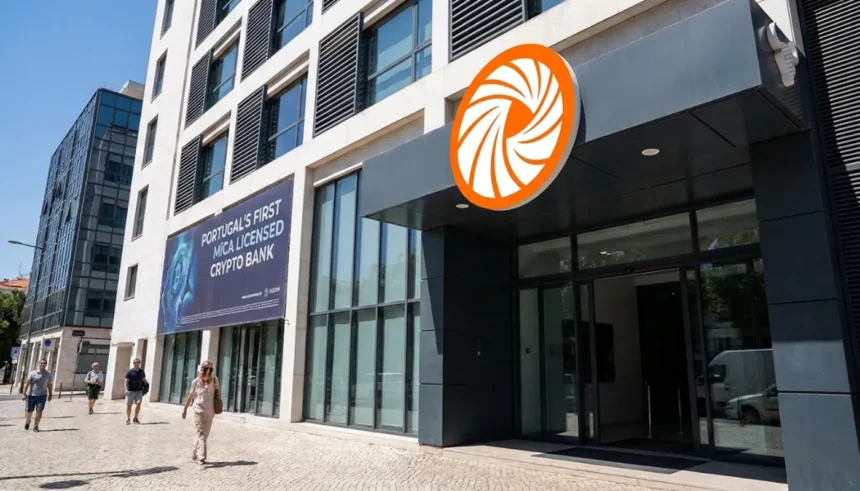
Bison Bank is now a direct Crypto-Asset Service Provider under MiCA in Europe. The bank, based in Lisbon, is the first in Portugal to obtain that license, the bank said in its official announcement.
Currently, only around 30 banks throughout the European Union have this authorization. Now Bison Bank is in that small group.

How Bison Bank Got Here
The bank acquired this license as a result of a merger. It merged its 100% owned subsidiary, Bison Digital Assets, into the parent company, following approval from the Bank of Portugal.
That was not the first crypto subsidiary. Bison Digital Assets was established in 2022, as Portugal’s first bank-owned Virtual Asset Service Provider, providing the bank with a three-year advantage over the MiCA rules.
By 2025, that subsidiary had become a real entity. It had approximately 275 clients and €165 million in trading volume, which provided Bison Bank with the operational foundation to support the integration of crypto into the core bank.
The move was described by CEO António Henriques as the logical next step. The bank had long known that the future of banking would be digital assets, and MiCA now provides a clear legal framework for that future to exist within, he said.
The new CASP license will enable institutional clients to have access to custody, exchange and advisory services for crypto-assets. It is all subject to the same compliance and risk management regulations as Bison Bank’s traditional banking activities.

Stablecoins and the Next Steps
The license also enables products already launched by Bison Bank. The bank launched EUB and USB, two euro and dollar-pegged e-money tokens, as part of a trend of bank-backed stablecoins, which includes the UAE Central Bank’s approval of a dirham-pegged stablecoin issuer.
Such a bank-issued stablecoin is following a trend that is emerging throughout the region. It reflects the same regulatory certainty that enabled Ripple to obtain a complete MiCA license to operate throughout the EU earlier this year.
Bison Bank has also identified real-world asset tokenization as a future trajectory. That places the bank in a small club of European lenders who see tokenized assets as a product line for the near future, not a far-off experiment.
The Money Behind The Wager
Bison Bank isn’t stretching to fund this expansion. The bank ended 2025 with a recurring net profit of €5m, which is double the previous year, and a CET1 capital ratio of 38.5%, one of the highest in European banking.
That capital strength provides Bison Bank with room that most smaller institutions don’t have. Its digital assets business was already recognised, too, winning the “Portugal’s Best for Digital Assets” award at the Euromoney Global Private Banking Awards 2026.
The transfer is also an indication of the direction of European banking regulation. As BTCRepublic has reported in some of the world’s most crypto-friendly countries, clear frameworks such as MiCA continue to attract institutional crypto activity.
With its license, Bison Bank is the first Portuguese bank to pass through that door. With so few EU banks having this status these days, it is unlikely to be the final one to follow suit.