



Kaspa price prediction 2026-2030 starts with a coin that does something no other major proof-of-work network does. KAS trades near $0.029 on November 12, 2026, and it produces ten blocks every second while Bitcoin produces one block every ten minutes.
Our short answer is this. Our base case puts KAS near $0.075 by 2030, with a bull case near $0.15 and a bear case near $0.025.

Nobody knows the real outcome. Published forecasts for 2030 run from about $0.035 to about $1.70, a gap of almost fifty times, and that spread tells you more about this coin than any single number does.
- Key Takeaways
- Kaspa Price Today: November 12, 2026
- What Is Kaspa, in Plain English
- Why KAS Has Fallen 86% From Its Peak
- What Could Move KAS Next
- Kaspa Price Prediction 2026-2030: Our Ranges
- What Other Forecasters Expect
- The Market Cap Test Nobody Runs
- Kaspa vs Bitcoin, Litecoin and Bitcoin Cash
- Risks That Could Break the Bull Case
- Common Mistakes Readers Make With KAS Predictions
- FAQs
- Our Verdict
KAS trades near $0.029 on November 12, 2026, based on live price pages that put it between about $0.0285 and about $0.0301 during the morning. Its market value sits near $807 million, with about 27.8 billion coins in circulation, and it ranks near 80 among all cryptocurrencies.
That puts Kaspa about 86 percent below its all-time high near $0.2074 from August 2024, and it is down about 25 percent in the last 30 days alone. The network just gained smart contracts and is heading for 100 blocks per second, but the price has not cared yet, and that gap is what this article is really about.
Key Takeaways
- KAS trades near $0.029 on November 12, 2026, with a market value near $807 million, rank 80, and about 27.8 billion coins in circulation.
- KAS is down about 86 percent from its August 2024 peak near $0.2074, and down about 25 percent in the last 30 days.
- Kaspa runs at 10 blocks per second since the Crescendo hard fork of May 2025, and the Toccata upgrade of June 2026 added covenants, zero-knowledge verification, and KRC-20 tokens.
- About 97 percent of all KAS is already mined, so new supply barely dilutes holders from here.
- Our base case puts KAS near $0.075 by 2030, with a bull case near $0.15 and a bear case near $0.025.
- A $1 KAS would need a market value near $28.7 billion, about 35 times what the network is worth today.
Kaspa Price Today: November 12, 2026
Here is the snapshot we verified this morning, before writing a single forecast. Prices move fast, so treat these as the starting point for the ranges below, not as a quote you can trade on.
| Metric | Value (Nov 12, 2026) |
|---|---|
| Price | About $0.029 |
| 24-hour range | $0.0285 to $0.0301 |
| 24-hour change | Down about 2.5% |
| 7-day change | Down about 9.8% |
| 30-day change | Down about 25% |
| Market value | About $807 million |
| Market rank | Near 80 |
| 24-hour trading volume | About $10 to $13 million |
| Circulating supply | About 27.8 billion KAS |
| Maximum supply | 28.7 billion KAS |
| All-time high | About $0.2074 (August 2024) |
| Distance from all-time high | Down about 86% |
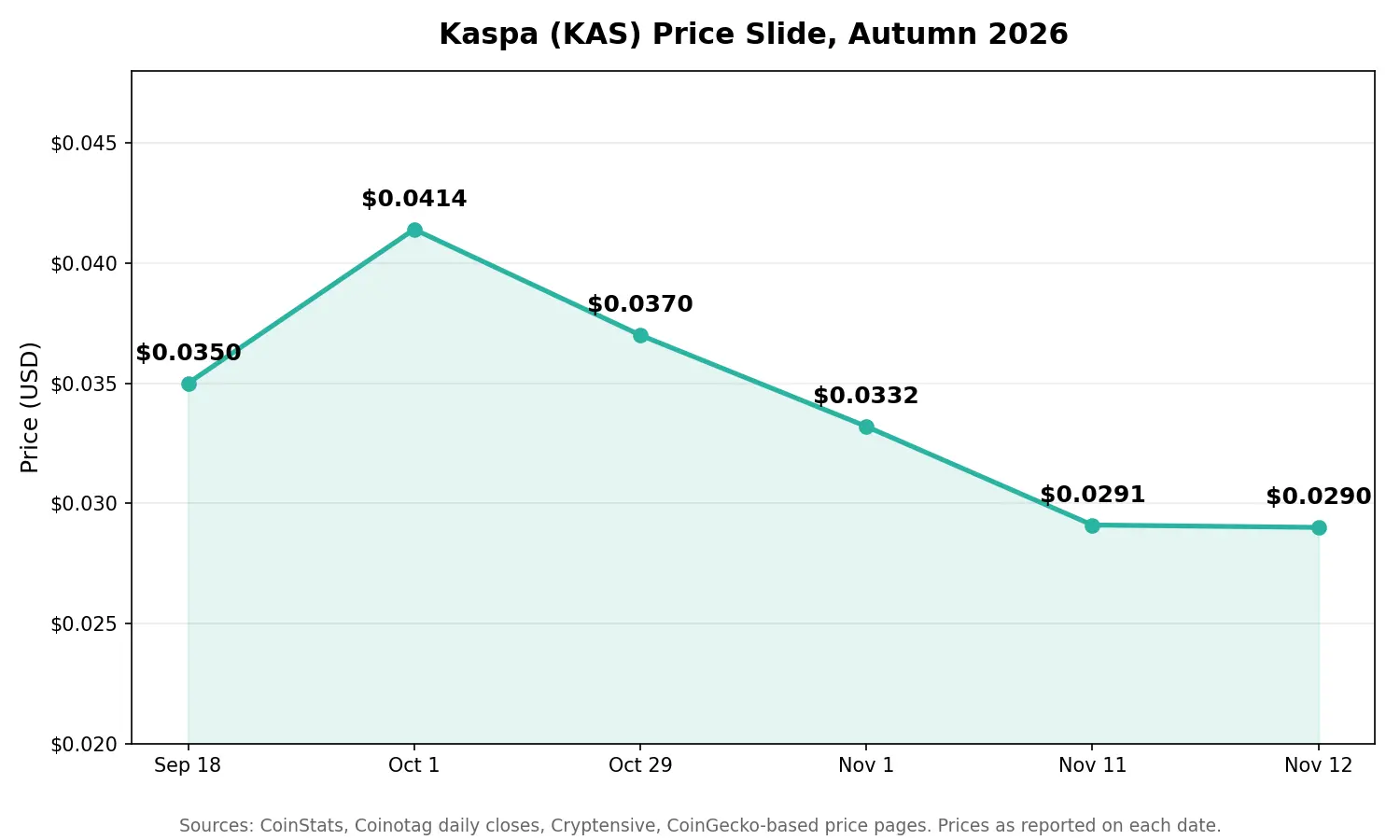
The short-term trend is weak. KAS closed at $0.0291 on November 11, at about $0.0297 on November 10, and it has spent the last month sliding from about $0.0414 at the start of October to about $0.0332 at the start of November.

October alone cost holders about 21 percent. The wider market is fearful too, with the Fear and Greed Index reading 30, which means fear, on November 11.
Trading volume tells the same quiet story. Roughly $10 to $13 million of KAS changed hands in the last 24 hours, which is small for a coin that once traded far more each day.
Low volume cuts both ways, since a little buying can move the price fast, but it also shows how few traders care about KAS right now.
What Is Kaspa, in Plain English
Kaspa is a proof-of-work cryptocurrency, like Bitcoin, but it uses a blockDAG instead of a single chain. Blocks mined at the same time are kept rather than thrown away, so the network can confirm transactions in seconds instead of minutes.
The network launched in November 2021 with no premine, no presale, and no coins set aside for the team. Its consensus protocol, GHOSTDAG, comes from research by computer scientist Yonatan Sompolinsky, and miners secure it with the kHeavyHash algorithm on specialised hardware.
KAS is the coin that pays for transactions on the network. Holders use it to send value, and miners earn it as a reward for securing the chain.
Why Kaspa is not just another Bitcoin copy
Bitcoin builds one block every ten minutes, and any block that loses the race is discarded. Kaspa builds about ten blocks every second, and the GHOSTDAG rules put all of them into a single agreed order.
That speed is the whole pitch. A payment on Kaspa confirms in seconds, while a Bitcoin payment can take an hour to feel final, and the network can handle far more transactions without a second layer.
The trade-off is complexity. Ordering thousands of parallel blocks is harder than ordering one chain, and Kaspa is still proving that its design holds up under heavy load.
The upgrades that changed Kaspa in 2025 and 2026
Crescendo was the first big change. The hard fork activated on May 5, 2025, raised the block rate from one block per second to ten, and shipped with Rusty Kaspa, a full rewrite of the node software in the Rust programming language.
The emission schedule did not change. Kaspa sets its monetary policy per second, not per block, so the reward per block fell tenfold when the block rate rose tenfold, and the number of new coins per second stayed the same.
Toccata was the second big change. The upgrade activated at the end of June 2026 and turned Kaspa from a fast payment chain into a programmable layer one, with covenants that limit how coins can be spent, native verification of zero-knowledge proofs, KRC-20 tokens, and the SilverScript compiler for developers.
The Igra network added another piece in March 2026. It is an EVM-compatible network built on top of Kaspa, so Solidity smart contracts can now settle on Kaspa, and the next milestones on the roadmap are DAGKnight, a successor to GHOSTDAG, and a gradual rise toward 100 blocks per second, targeted for 2027.
Why KAS Has Fallen 86% From Its Peak
KAS peaked near $0.2074 in August 2024, when the fast proof-of-work story was fresh and the Crescendo upgrade was still ahead of it. The price has fallen in steps ever since, and the autumn of 2026 has been the roughest stretch.
Our chart below uses verified prices reported on each date. It shows a coin that started October near $0.0414, bounced to about $0.037 at the end of the month, and then gave back almost everything in the first days of November.
The fall has three drivers. First, the whole market is weak, and small proof-of-work coins fall harder than Bitcoin when fear takes over.
Second, Kaspa had a bad headline in late September 2026. An exploit hit the Kasplex layer 2 network, and although the Kaspa layer 1 was unaffected, co-founder Shai Wyborski publicly criticised the security and governance of the ecosystem around it.
Third, the upgrades have not yet produced apps people use. Toccata shipped in June 2026, but the smart contract tools are young, the number of live applications is small, and traders price what exists today, not what the roadmap promises for 2027.
One number puts the slide in perspective. KAS entered November at about $0.0332, after an October that started at about $0.0414 and delivered a decline of about 21 percent, and it has now lost about a quarter of its value in 30 days.
What Could Move KAS Next
Four things could change the story, and each one is concrete enough to watch. None of them is priced in yet, because none of them has delivered users.
The first is DAGKnight and the road to 100 blocks per second. The roadmap targets a gradual rise in stages, around 25, then 40, and finally 100 blocks per second, expected in 2027, and DAGKnight is the consensus upgrade that makes it possible.
The second is real apps on Toccata. Covenants and zero-knowledge verification only matter if developers build with them, and the Igra EVM network gives Solidity developers a way in without learning a new language.
The third is the KSD stablecoin design. A proposed stablecoin for Kaspa drew debate in November 2026, and a working stablecoin would give the network something it has never had, a dollar-denominated asset that stays inside the ecosystem.
The fourth is the end of new supply. About 97 percent of all KAS is already mined, and the block reward fell again on November 4, 2026, from 2.060 to 1.945 KAS per block, so sellers have less and less fresh supply to dump.
The network itself keeps growing underneath the price. The Kaspa block explorer counted about 2.44 billion cumulative transactions and about 567,000 wallet addresses at the start of November 2026, and both measures rose sharply in the second half of the year.
That growth is a throughput signal, not proof of adoption. Transaction counts and wallet numbers do not tell you how many real people use the network, and readers should treat them as one input among many.
For a sense of how the wider market reads Kaspa, compare it with our Bitcoin price prediction for 2026, where the same fear reading and the same weak autumn show up in a much larger coin.
Kaspa Price Prediction 2026-2030: Our Ranges
Our ranges below are scenarios, not promises. They assume no new all-time high in 2026, a slow recovery tied to the roadmap, and a market that stays fearful for a while before it turns.
| Year | Bear case | Base case | Bull case | What the base case needs |
|---|---|---|---|---|
| End of 2026 | $0.025 | $0.032 | $0.045 | Fear fades, KAS holds $0.028 |
| 2027 | $0.028 | $0.042 | $0.065 | DAGKnight ships, apps appear |
| 2028 | $0.030 | $0.055 | $0.095 | One full cycle of recovery |
| 2029 | $0.035 | $0.065 | $0.12 | Smart contracts find users |
| 2030 | $0.025 | $0.075 | $0.15 | Roadmap delivered, adoption steady |
For the rest of 2026, we expect KAS to trade between $0.025 and $0.045. The base case near $0.032 means a small recovery from $0.029, and the bull case near $0.045 needs a reclaim of the $0.0418 level that capped the price in October.
For 2027, our base case is $0.042. That assumes DAGKnight arrives roughly on schedule and the first real apps launch on Toccata and Igra, while the bear case near $0.028 assumes the bearish channel holds and the price retests the late-2026 lows.
For 2028, our base case is $0.055. That assumes one full market cycle of recovery and renewed interest in proof-of-work networks, while the bull case near $0.095 needs KAS to reclaim old technical resistance in a strong market.
For 2029, our base case is $0.065. That assumes the smart contract layer finally has users and the network keeps its speed edge, while the bull case near $0.12 needs a genuine developer ecosystem, not just a roadmap.
For 2030, our base case is $0.075. That is about 2.6 times the current price, and it assumes steady adoption with no return to the old highs, while the bull case near $0.15 needs the full roadmap delivered and sustained demand.
Our bear case for 2030 is $0.025, below where KAS trades today. That is the outcome if Kaspa loses its speed story to faster chains, the smart contract layer stays empty, and the coin drifts for years, and it is the reason nobody should treat a prediction as a promise.
What Other Forecasters Expect
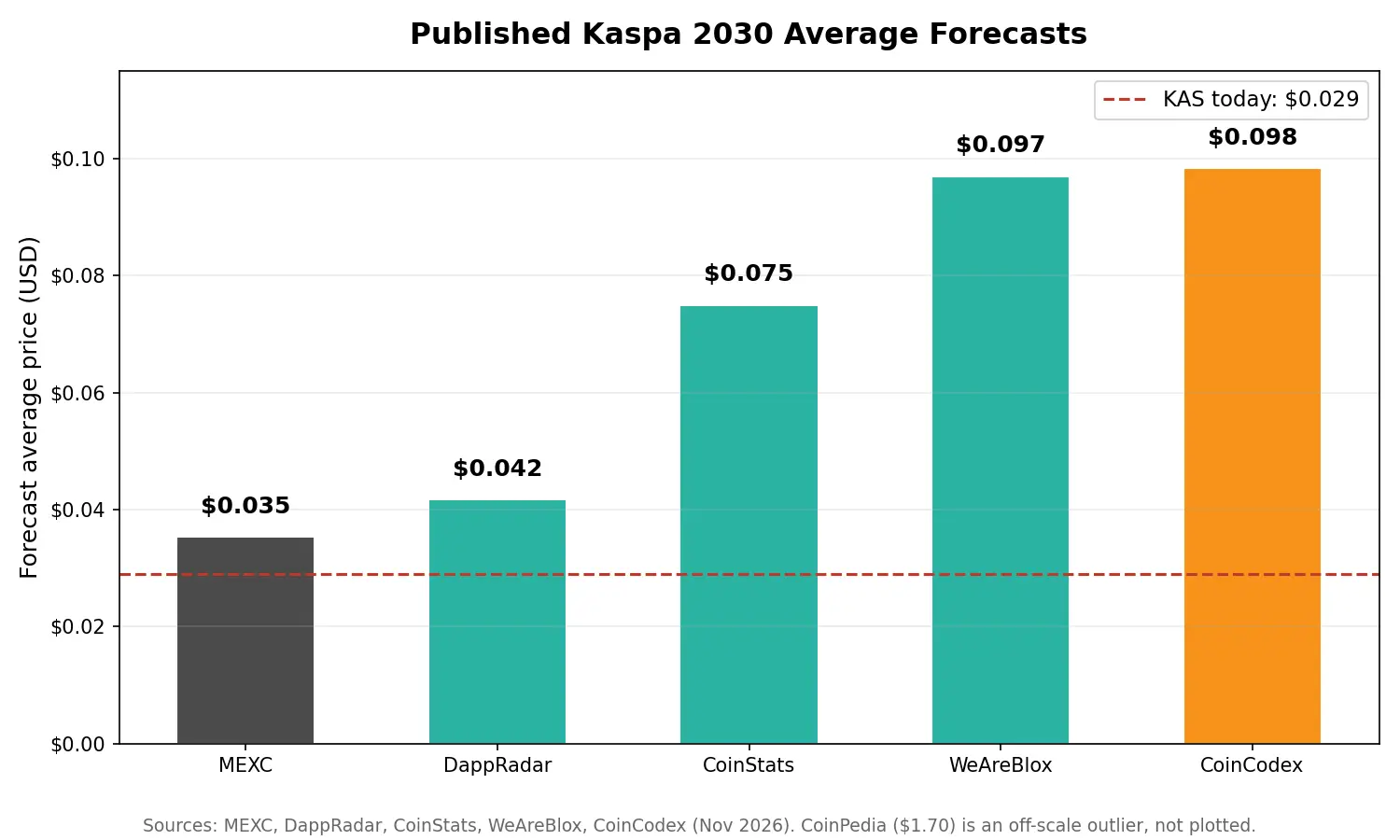
Published forecasts disagree by far more than ours do. We collected the latest numbers from the main forecasting sites, and the gap between the lowest and the highest 2030 average is almost fifty times.
| Source | 2026 average | 2027 average | 2030 average |
|---|---|---|---|
| CoinStats | $0.036 | $0.042 | $0.075 |
| DappRadar | $0.030 | $0.034 | $0.042 |
| CoinCodex | $0.037 | n/a | $0.098 |
| WeAreBlox | About $0.031 | About $0.028 | About $0.097 |
| MEXC | $0.029 | $0.031 | $0.035 |
| CoinPedia | $0.065 | $0.10 | $1.70 |
Most forecasters cluster between $0.035 and $0.10 for 2030. CoinStats, DappRadar, CoinCodex, WeAreBlox, and MEXC all sit in that band, and our base case of $0.075 sits in the middle of it.
CoinPedia is the outlier. It puts KAS at $1.70 on average by 2030, with a high of $3.10, and that number is about twenty times higher than the rest of the table, so treat it as a best-case fantasy rather than a forecast.
One forecaster has already been proven wrong. CoinCub expected KAS to set a new all-time high in 2026, possibly reaching $0.90 in the first half of the year, and the price never came close, which is a useful reminder that old forecasts go stale fast.
Another voice sits far above the rest. Analyst Jackmaster.kaspa outlined three paths through 2030, a conservative climb toward $1 to $1.20, a strong cycle toward $3 to $5, and a structural breakout between $8 and $15, and each one needs execution and adoption that Kaspa has not shown yet.
The honest read is that the middle of the table is the sensible place to stand. The $0.035 to $0.10 band is where five independent forecasters land, and our $0.075 base case sits inside it.
The Market Cap Test Nobody Runs
Price targets mean nothing without market value. A coin with 28.7 billion coins in circulation needs a huge amount of new money for every cent of price gain, and almost nobody who publishes a KAS forecast shows that maths.
We ran it ourselves, using about 28.7 billion circulating KAS for 2030, when the supply is essentially fully mined. Every target below is the market value KAS would need to reach that price.
| Price target | Implied market value | What it means |
|---|---|---|
| $0.029 (today) | About $0.81 billion | Where KAS stands now |
| $0.035 (MEXC 2030) | About $1.02 billion | About 1.3 times today |
| $0.042 (DappRadar 2030) | About $1.20 billion | About 1.5 times today |
| $0.075 (our base case) | About $2.15 billion | About 2.7 times today |
| $0.098 (CoinCodex 2030) | About $2.82 billion | About 3.5 times today |
| $0.15 (our bull case) | About $4.31 billion | About 5.3 times today |
| $0.2074 (old all-time high) | About $5.95 billion | About 7.3 times today |
| $1.00 | About $28.7 billion | About 35 times today |
| $1.70 (CoinPedia 2030) | About $48.8 billion | About 60 times today |
| $3.10 (CoinPedia high) | About $89.0 billion | About 110 times today |
The table kills the easy dream. A $1 KAS sounds close because the coin costs three cents, but it would need about $28.7 billion of market value, roughly 35 times what the network is worth today, and that would put Kaspa among the ten largest cryptocurrencies.
The same test makes our base case look modest. A $0.075 KAS needs about $2.15 billion, which is less than a threefold rise in market value over four years, and that is the kind of growth a working network can plausibly deliver.
It also exposes the wildest forecasts. CoinPedia at $1.70 needs about $48.8 billion, and its $3.10 high needs about $89 billion, which would make Kaspa bigger than most of the coins above it today, and that is why we call those numbers a fantasy.
Use this test on any forecast you read. If the forecaster never shows the market value their target implies, they have not done the maths, and you should not trust the number.
Kaspa vs Bitcoin, Litecoin and Bitcoin Cash
Kaspa competes with the old proof-of-work coins, so it helps to see them side by side. The table below compares the four networks on the facts that matter for a price forecast, not on hype.
| Feature | Kaspa (KAS) | Bitcoin (BTC) | Litecoin (LTC) | Bitcoin Cash (BCH) |
|---|---|---|---|---|
| Block time | 10 blocks per second | About 10 minutes | About 2.5 minutes | About 10 minutes |
| Consensus | Proof of work, GHOSTDAG | Proof of work, SHA-256 | Proof of work, Scrypt | Proof of work, SHA-256 |
| Maximum supply | 28.7 billion | 21 million | 84 million | 21 million |
| Supply already mined | About 97% | About 95% | About 91% | About 95% |
| Smart contracts | Covenants, ZK, Igra EVM | Limited script | Limited script | CashTokens |
| Launched | November 2021 | 2009 | 2011 | 2017 |
Kaspa wins on speed by a huge margin, and it is the only one of the four where new supply is nearly finished. Bitcoin wins on trust, liquidity, and adoption, and no speed advantage has ever closed that gap for a younger coin.
Litecoin is the closest warning for Kaspa holders. It is fast, cheap, and widely listed, yet it has spent years drifting while the market chased newer stories, and our Litecoin price prediction 2026-2030 shows the same slow grind in its own forecasts.
Bitcoin Cash is the other warning. It split from Bitcoin to be faster and cheaper, and it still trades far below its 2017 peak, which shows that a better payment coin does not automatically earn a better price, and our Bitcoin Cash price prediction 2026-2030 tells that story in numbers.
The lesson is simple. Speed is a feature, not a moat, and Kaspa needs users and apps, not just a faster block rate, to climb the table above.
Risks That Could Break the Bull Case
The biggest risk is that the smart contract layer stays empty. Toccata shipped in June 2026, but tools are young, apps are few, and a programmable chain with no programs is just a fast payment network with a small user base.
The second risk is the roadmap slipping. DAGKnight was once talked about for the third quarter of 2026, and it is now more often mentioned for 2026 to 2027, and a delay to 100 blocks per second would remove the next catalyst.
The third risk is security headlines. The Kasplex layer 2 exploit in September 2026 did not touch the layer 1, but it gave critics a reason to question the ecosystem, and another incident would hurt trust more than price.
The fourth risk is liquidity. About $10 to $13 million of daily volume means a single large seller can move the price, and thin markets fall fast when fear spreads.
The fifth risk is the simplest one. Bitcoin decides the market, and if Bitcoin falls, KAS falls further, so a Kaspa bull case is really a Bitcoin bull case with extra risk on top, and our Bitcoin price prediction for 2030 sets the ceiling for everything else.
Common Mistakes Readers Make With KAS Predictions
The first mistake is reading the price, not the market value. A three-cent coin feels cheap, but with 28.7 billion coins in circulation, KAS is already worth about $807 million, and $1 would need about $28.7 billion.
The second mistake is trusting a single forecaster. Published 2030 averages run from about $0.035 to about $1.70, so picking the highest number and calling it a prediction is just picking the answer you like.
The third mistake is treating old forecasts as live ones. CoinCub expected a new all-time high near $0.90 in 2026, and the price never came close, so always check the date on a forecast before you believe it.
The fourth mistake is confusing network growth with adoption. About 2.44 billion cumulative transactions and about 567,000 wallet addresses sound impressive, but they measure throughput, not real users, and they do not move the price by themselves.
The fifth mistake is forgetting the emission schedule. About 97 percent of KAS is already mined, which helps holders, but it also means miners earn less from new coins over time, and fees have to replace that income one day.
Our Polygon price prediction 2026-2030 ran the same market cap test on POL, and our Filecoin price prediction 2026-2030 shows what happens when a strong network story meets a weak token price, so the pattern is not unique to Kaspa.
FAQs
What is the Kaspa price prediction for 2030?
Our base case puts KAS near $0.075 by 2030, with a bear case near $0.025 and a bull case near $0.15. Published 2030 averages mostly fall between about $0.035 and about $0.10, with CoinPedia at $1.70 as the far outlier.
Can Kaspa reach $1?
Kaspa can reach $1, but it would need a market value near $28.7 billion, about 35 times what the network is worth today. That would put it among the ten largest cryptocurrencies, and it needs years of adoption, not just a good market.
Is Kaspa a good investment in 2026?
Nobody can answer that for you, because it depends on your risk tolerance and your time horizon. KAS is a fast, well-built network with a weak price, thin volume, and unproven apps, so it suits patient risk-takers, not anyone who needs the money soon.
Why is Kaspa down so much from its all-time high?
KAS peaked near $0.2074 in August 2024 and has fallen about 86 percent since, because the market turned fearful, the Kasplex layer 2 exploit hurt trust in September 2026, and the new smart contract features have not yet produced apps people use.
What is the highest Kaspa has ever traded at?
Kaspa reached an all-time high near $0.2074 in August 2024. It now trades about 86 percent below that peak, near $0.029.
Where can I buy Kaspa (KAS)?
KAS trades on major exchanges including Binance, Bybit, and Bitget, and you should compare fees and check availability in your country before you buy. Always move large holdings to a wallet you control, and never leave more on an exchange than you can afford to lose.
Our Verdict
Kaspa is the fastest proof-of-work coin that matters, and it is also one of the cheapest relative to its own history. Those two facts pull in opposite directions, and the price has followed the weaker one all year.
Our base case of $0.075 by 2030 is not exciting, and that is the point. It is the number you get when you run the market cap maths, respect the published forecasts, and refuse to believe a three-cent coin is one headline away from a dollar.
KAS suits patient buyers who believe in the blockDAG design and can wait three to four years, but it does not suit anyone looking for a quick gain. The coin is cheap and the network is genuinely fast, yet the price has fallen all year and the catalysts are all in the future, so this article is not financial advice and you should do your own research before buying.
This article is for education only and is not financial advice. Crypto prices are volatile, predictions are scenarios rather than promises, and you should do your own research or speak to a licensed adviser before making any investment decision.