



Bitcoin Cash trades around $283 on November 2, 2026, and that flat price tells the real story. Our base case puts BCH near $310 by the end of 2026, near $390 in 2027, and near $720 in 2030, but only if payment use and the wider crypto market cooperate.
Key takeaways
- BCH sits around $283, in the low 20s by market rank, with a market value near $5.6 billion.
- Published forecasts disagree wildly, from about $435 to about $875 for 2030, so treat every target as a scenario, not a promise.
- Our exclusive scenario bands run from $380 to $1,050 in 2030, with $720 as the base case.
- The next halving, expected around April 2028, cuts new supply to 1.5625 BCH per block.
- The biggest risk is simple: cheap payments alone do not guarantee that people will choose BCH.
What Bitcoin Cash is, in plain words
Bitcoin Cash is a peer to peer electronic cash network that split from Bitcoin on August 1, 2017. It aims to work for everyday payments, not just for holding value.

The split came from a disagreement about block size. Bitcoin kept small blocks, while Bitcoin Cash chose larger blocks so more payments could settle directly on the chain.
- Key takeaways
- What Bitcoin Cash is, in plain words
- Where BCH stands right now
- Bitcoin Cash price prediction 2026 to 2030: our scenario bands
- What other forecasters say, and why they disagree
- BCH versus BTC: payment coin or store of value
- Drivers that could lift BCH, and risks that could cap it
- Common mistakes when reading BCH predictions
- FAQs
- What is the Bitcoin Cash price prediction for 2026?
- What is the Bitcoin Cash price prediction for 2030?
- Can Bitcoin Cash reach $1,000?
- Is Bitcoin Cash a good investment?
- When is the next Bitcoin Cash halving?
- Bottom line
Why larger blocks matter for payments
Larger blocks give the network more room for transactions in each block. That extra room helps keep fees low even when many people transact at once.
Since May 15, 2024, an adaptive block size rule has set the limit, with a 32 MB floor. The network still targets a new block about every 10 minutes.
What it costs to use
Typical BCH fees sit under one cent, which is the whole point of the design. One data source reported a median fee of $0.0013 in the 24 hours to September 30, 2026.
That low fee suits small payments, tips, and remittances. It does not suit every use, and it does not by itself create demand.

Where BCH stands right now
Price sources on November 2, 2026 cluster close together, around $279 to $284 depending on the exchange and the hour. That tight range is normal for a large, liquid coin, and it means small differences between sources are not a signal.
CoinPaprika put BCH at $279.08 on November 2, with a $5.60 billion market value and rank 24. OKX showed $281.19 the same day, while CoinCodex showed $284.31 on November 1.
The compression signal nobody should ignore
A November 1 technical snapshot showed three moving averages squeezed into a $2.36 range. The 7 day average sat at $286.34, the 50 day average at $285.83, and the 200 day average at $283.98.
The 14 period RSI read 50.26, which is almost exactly neutral. The MACD histogram printed exactly zero, which means momentum had stalled rather than turned.
That snapshot put the pivot at $286.43, with resistance at $291.27 and $297.93. A break above $298 would change the short term picture, while a drop below $267 would reopen the lower band.
What the September CME news did, and did not, change
BCH jumped nearly 30 percent in a single day in late September 2026, from around $270 to above $345. The trigger was CME Group announcing plans to launch regulated BCH futures on October 19, pending approval.
That rally faded, and BCH now trades well below that spike. Regulated futures can bring new traders, but they do not force merchants or shoppers to use BCH.
Bitcoin Cash price prediction 2026 to 2030: our scenario bands
This is the exclusive element in this article: a single set of scenario bands built from the live November 2 price, the published forecasts below, and a halving calendar. Other sites publish one number, while this table shows what each outcome would need.
Read the bands as possibilities, not promises. Crypto prices can break any band in a week, in either direction.
| Year | Bear case | Base case | Bull case | What has to be true |
|---|---|---|---|---|
| End of 2026 | $240 | $310 | $400 | Market stabilises, no fresh breakdown below $267 |
| 2027 | $260 | $390 | $520 | Steady payment demand plus a normal crypto expansion |
| 2028 | $300 | $470 | $680 | Halving narrative holds and liquidity improves |
| 2029 | $340 | $580 | $850 | Merchant and remittance use keeps growing |
| 2030 | $380 | $720 | $1,050 | BCH keeps a real payments niche for four straight years |
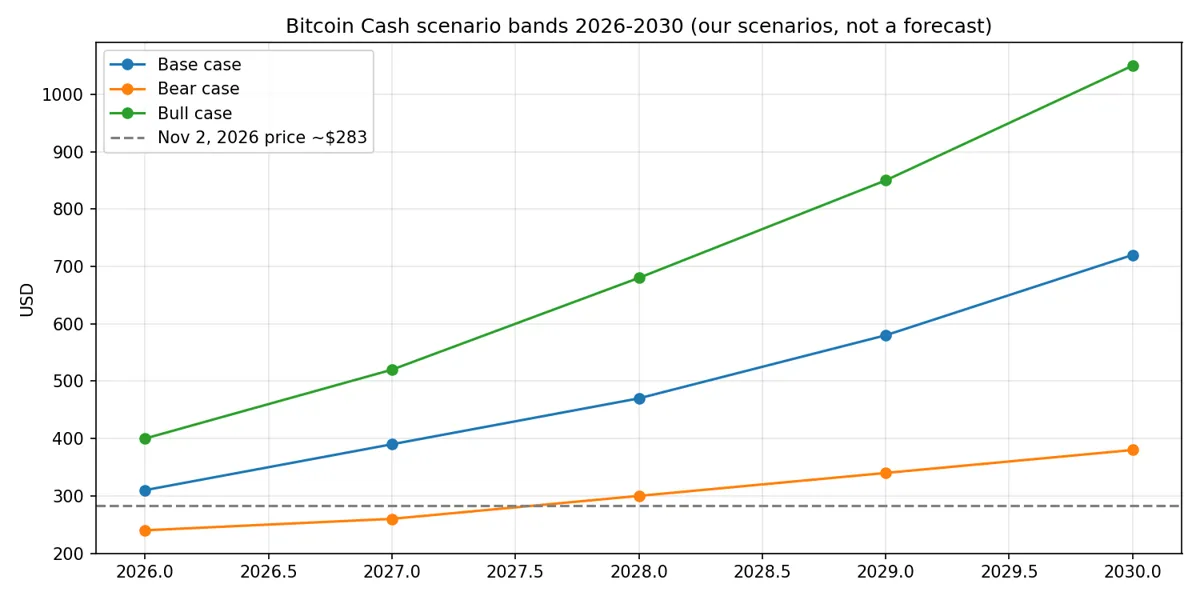
The chart above plots those same bands, with a dashed line near the November 2 price of $283. It is a scenario chart, not a forecast model, and it uses our bands only.
How to read the bear case
The bear case assumes BCH keeps its tech but loses the attention war. Traders rotate to newer coins, merchants stick with cards and stablecoins, and each rally fades.
In that world, $380 by 2030 still means growth from $283, just slow growth. That is the honest floor in this table, not a crash call.
How to read the bull case
The bull case assumes payment use compounds year after year. More wallets, more merchant checkouts, and steadier remittance flows would give BCH a reason to re-rate.
Even then, $1,050 in 2030 sits far below the old 2017 highs. That gap is a reminder that a good payments coin and a record price are different things.
What other forecasters say, and why they disagree
Published forecasts for BCH disagree more than usual, and that disagreement is useful information. It shows how little agreement exists about what BCH is worth as a payments network.
CoinCodex, updated November 1, 2026, forecast $402.65 by the end of 2026 and $875.26 by 2030. Gate forecast a 2030 average of $526.54, inside a $363.31 to $652.91 range, with a 2027 average of $337.41.
The conservative cluster
DappRadar, updated October 28, 2026, forecast $306.36 for 2026, $347.46 for 2027, and $434.57 for 2030. That slow climb fits a coin with steady use but no breakout story.
A 5 percent annual growth model cited by Kraken pointed even lower, near $283 by 2030. That model is simple maths, not a market prediction, so treat it as a floor exercise only.
The bullish cluster
CoinStats forecast $260 to $520 in 2027, averaging $390, and $420 to $1,050 in 2030, averaging $760. Bitrue published wider scenario bands, with a 2030 average of $850 and a high of $1,500.
Traders Union, using a trend continuation model, landed near $620.68 by the end of 2030. Our base case of $720 sits between that figure and the CoinCodex figure, which is a deliberate middle ground.
Why some old pages mislead readers
Some older forecast pages still show BCH near $426 and targets above $1,200 for 2026. Those pages predate the recent fall, so their starting price no longer matches reality.
Check the update date before you trust any target. A forecast built on a stale price is stale, even if the page still ranks well.
BCH versus BTC: payment coin or store of value
Bitcoin now sells itself mainly as a store of value, a digital asset people hold. Bitcoin Cash sells itself mainly as cash, a tool people spend.
That difference shapes the whole prediction. BTC can rise on scarcity and institutional demand alone, while BCH needs actual payment volume to justify a higher price.
For a fuller view of the Bitcoin side, see our Bitcoin price prediction for 2030. For the history behind the split, see our Bitcoin history from the 2009 genesis block.
Where BCH has a real edge
Fees under one cent beat Bitcoin base layer fees for small payments. Settlement on the chain itself, without a second layer, keeps the user experience simple.
CashTokens, added in 2023, brought tokens and simple smart contract style features to the chain. That gives builders more to work with than plain payments alone.
Where BCH still loses
Stablecoins now handle much of the cheap payment demand, especially for merchants who want price stability. Cards remain easier for most shoppers, and Bitcoin layers compete for the same users.
BCH also has far less hash rate and market value than Bitcoin. That smaller security and liquidity base makes large buyers more cautious, not less.
Drivers that could lift BCH, and risks that could cap it
Supply helps the bull case on paper. Only 21 million BCH will ever exist, about 19.96 million already circulate, and the April 2028 halving cuts the block reward to 1.5625 BCH.
Scarcity alone never lifts a price, though. New supply cuts matter only if demand holds up at the same time, and demand for BCH depends on use.
Merchant adoption, measured honestly
Directories list thousands of merchants that accept BCH, with one directory counting 2,645 and another counting more than 10,000. Those counts show listings, not verified daily checkout volume, so read them as reach, not revenue.
Real adoption looks like repeat checkouts, remittance corridors, and wallets people open weekly. Directory counts alone cannot prove any of that, and this article does not claim they do.
The competition problem
Payment coins compete with stablecoins, cards, bank transfers, and other chains at the same time. A merchant who already accepts stablecoins gains little by adding another volatile coin.
BCH must win on a specific job, such as low fee remittances or tipping, rather than on being generally cheap. General cheapness is now common, so it is no longer a unique selling point.
Common mistakes when reading BCH predictions
The first mistake is treating an average forecast as a promise. An average hides the full range, and the range for BCH in 2030 runs from about $380 to over $1,000 even in this article alone.
The second mistake is copying a target without checking its date. Prices, halving timing, and CME news all changed during 2026, so a target from early 2026 answers a different market.
The third mistake is confusing a payments use case with investment safety. BCH can work well for payments and still fall in price, because price follows buyers and sellers, not usefulness alone.
Readers who want payment focused alternatives should also check our best PayFi coins for 2026. For how privacy coins frame a different thesis, compare our Monero price prediction for 2026 to 2030, our Zcash price prediction for 2026 to 2030, and our Hyperliquid price prediction for 2026 to 2030.
FAQs
These are the questions readers ask most about BCH, answered with the same numbers used in the article above. If a target here differs from another site, check the date and the starting price first.
What is the Bitcoin Cash price prediction for 2026?
Our base case puts BCH near $310 by the end of 2026, inside a $240 to $400 scenario band. CoinCodex forecast $402.65 by the end of 2026, while DappRadar forecast $306.36 for 2026.
What is the Bitcoin Cash price prediction for 2030?
Our base case puts BCH near $720 in 2030, inside a $380 to $1,050 scenario band. Published forecasts range from about $435 to about $875, so our base case sits near the middle of that spread.
Can Bitcoin Cash reach $1,000?
Yes, $1,000 sits inside our bull case for 2030, at $1,050, but it needs four years of growing payment use and a strong crypto market. It is possible, not probable, on the evidence today.
Is Bitcoin Cash a good investment?
That depends on your risk tolerance and time horizon, and this article is not financial advice. BCH offers cheap payments and capped supply, but it also faces stablecoin competition and weak momentum.
When is the next Bitcoin Cash halving?
The next halving is expected around April 2028, when the block reward falls from 3.125 BCH to 1.5625 BCH. The exact date depends on block times, so treat April 2028 as an estimate, not a fixed date.
Bottom line
Bitcoin Cash at around $283 is a coin waiting for a reason to move, not a coin already moving. The compression in price, the neutral RSI, and the faded CME rally all point the same way.
Our base case leans mildly positive, to $720 by 2030, because capped supply and cheap payments give BCH a floor to build from. The bull case to $1,050 needs real payment growth, and the bear case to $380 is what happens if that growth never arrives.